






















































Safety & Emergency
Floods, DANA storms and weather warnings in Spain: how to prepare and stay safe
What a DANA is, lessons from the 2024 Valencia floods, how to prepare your home, what to do during a flood and how to claim through the Consorcio.


Updated: October 2026
Every autumn, parts of Spain face sudden torrential rain that can turn dry riverbeds into torrents within an hour. If you live on the Mediterranean coast, in the Balearics or near a river or ravine, it pays to understand the warnings and have a plan. This guide explains what a DANA is, what the Valencia floods of October 2024 taught everyone, how to prepare, what to do during a flood and how insurance works afterwards. For emergency numbers and the Es-Alert system, see our guide to safety and emergencies in Spain.
What is a DANA?
DANA stands for depresión aislada en niveles altos, an isolated low-pressure system high in the atmosphere. Older Spaniards often call it gota fría (“cold drop”). It forms when a pocket of cold air breaks away from the main jet stream and sits over an area, sometimes for days. The cold air aloft makes the atmosphere unstable: warm, moist air rises from below and builds tall storm clouds. A warm Mediterranean Sea at the end of summer adds extra moisture, which is why the most damaging episodes tend to hit the east coast in autumn.
Not every DANA is dangerous. Many bring only showers or cooler weather. Since October 2025, AEMET (Spain’s weather agency) gives a name to DANAs that are expected to cause high impact, using the same criteria as for named storms: orange or red warnings must be forecast. If you hear a DANA has a name, take it seriously.
Weather warnings and alerts
AEMET issues rain and storm warnings up to 72 hours ahead in three colours:
- Yellow: low danger, but exposed places and vulnerable people can be affected. Stay informed.
- Orange: significant danger. Take precautions, avoid unnecessary trips and keep away from riverbeds.
- Red: extraordinary danger with possibly catastrophic impacts. Act on the authorities’ instructions and avoid travel unless it is essential.
Your regional emergency service (for example 112 Comunitat Valenciana or 112 Andalucía) decides on civil protection measures such as school closures and sends Es-Alert messages to every phone in the area. Do not wait for an Es-Alert to act: a red AEMET warning on its own is reason enough to change your plans.
What Valencia’s October 2024 floods taught us
On 29 October 2024 a DANA dropped extreme rainfall on the province of Valencia. At Turís more than 700 litres per square metre fell in 24 hours, a Spanish record. Water from the inland hills poured down ravines such as the Rambla (barranco) del Poyo into the densely populated towns of L’Horta Sud, south of Valencia city, where in many places it had not rained much at all. The official death toll in the province is around 230 people, with further victims in Castilla-La Mancha and Andalusia.
The timeline matters. AEMET issued a red warning for parts of Valencia province early that morning and extended it to the whole province by mid-morning. The Es-Alert to phones was sent by the regional authorities only at 20:11 that evening, when water was already flooding many streets. The response is still being examined by the courts and a parliamentary inquiry, but the practical lessons for residents are clear:
- Danger can come from rain far away. A dry sky over your town does not mean you are safe if it is pouring upstream.
- Cars, garages and ground floors are traps. Many people died on roads, in underground car parks or on ground floors while trying to move their cars or belongings.
- Treat red warnings as a reason to act, even before an Es-Alert arrives.
How to prepare before the rainy season
- Check your flood risk. The national flood zone map (SNCZI) from the Ministry for the Ecological Transition shows mapped flood areas. Not every zone is mapped, so if you live near a river, ravine or rambla, assume some risk.
- Know your higher ground. Identify an upper floor, a neighbour on a higher storey or a nearby building you can reach on foot.
- Prepare a small emergency kit: torch, power bank, battery radio, drinking water, basic medicines, copies of your NIE/TIE, passport and insurance policy in a waterproof bag.
- Clear drains and gutters on roofs, terraces and patios, and keep rainwater channels free of rubbish.
- Do not store valuables or important papers in basements, storerooms or garages.
- Check your insurance covers your home, contents and car (see below).
- Install the AEMET app and follow your regional 112 service on social media.
What to do during a flood
- Do not drive unless you must. Never drive or walk through flooded roads, fords or underpasses. Just a few tens of centimetres of moving water can sweep a car away.
- Do not go down to garages or basements to save your car or belongings. Go up, not down.
- Move to a higher floor if water enters the building, and take your phone, charger and documents with you.
- Keep away from riverbeds, ravines and bridges, even to take photos.
- Switch off electricity and gas at the mains if water is coming in and you can do it safely.
- Call 112 only for real emergencies so lines stay free, and follow instructions on the radio and official channels.
After the water goes down
Stay away from fallen power lines, do not eat food that has been in contact with floodwater, and only drink tap water once the authorities say it is safe. Wear gloves and boots when cleaning, as floodwater often carries sewage and debris.
Insurance and the Consorcio de Compensación de Seguros
Ordinary insurers in Spain usually exclude so-called extraordinary risks such as floods, earthquakes and certain storms. Instead, these are covered by the Consorcio de Compensación de Seguros (CCS), a public body funded through a compulsory surcharge included in most home, business and car policies. You do not take out a separate policy, but you must have valid insurance on the damaged property when the event happens. Without a policy, the Consorcio will not pay.
How to claim:
- Take photos and videos of all damage before you clean up, and keep receipts for emergency repairs.
- File the claim on the Consorcio website, by phone (900 222 665), or through your insurer or broker.
- Have your policy details ready. An assessor (perito) will then inspect the damage.
- Payment follows the limits of your original policy, so check your sums insured are realistic.
For an overview of home, car and other policies, read our guide to insurance in Spain. If you rent, ask your landlord what the building policy covers and consider your own contents insurance; see our guide to renting in Spain.
Useful links
- AEMET: what the warning levels mean
- AEMET blog: what is a DANA and how does it form? (Spanish)
- AEMET: high-impact DANAs will be named (Spanish)
- MITECO: how to check if you live in a flood zone (Spanish)
- RACE: what the Consorcio de Compensación de Seguros covers (Spanish)
- Understanding insurance in Spain
- Safety and emergencies in Spain
FAQ: floods and DANAs in Spain
When is flood season in Spain?
The highest risk on the Mediterranean coast is usually from September to November, when the sea is still warm. Flash floods can, however, happen in other months and regions too.
Is a DANA the same as gota fría?
Broadly yes. Gota fría is the traditional name; meteorologists prefer DANA, the term for an isolated low-pressure system high in the atmosphere.
Does my insurance cover flood damage?
If you have a valid home, business or car policy, flood damage from an extraordinary event is normally paid by the Consorcio de Compensación de Seguros, up to the limits of your policy. Without insurance there is no Consorcio cover.
Should I move my car out of the garage when a flood warning is issued?
Only well before the rain arrives. Once water is rising, never go down to a garage or basement: it is one of the most dangerous places to be.
Disclaimer: This article is general information only and is not legal or insurance advice. Warnings, procedures and insurance conditions can change – always follow AEMET, your regional emergency service and your insurer.
Safety & Emergency
Safety and emergencies in Spain: numbers, alerts and scams
Emergency numbers, which police to call, the terrorism alert level, phone alerts, AlertCops, common scams and beach and heat safety in Spain.
Updated: October 2026
Spain is generally a safe country to live in, but knowing who to call and how the alert systems work makes a real difference when something goes wrong. This guide covers emergency numbers, the different police forces, the national terrorism alert level, emergency alerts on your phone, the AlertCops app, the most common scams, and how to stay safe on the beach and in the heat.
Emergency numbers to save today
The number to remember is 112. It is free, works from any mobile or landline (even without credit), covers police, ambulance and fire brigade, and operators in tourist areas can often help in English and other languages.
| Number | Service | When to use it |
|---|---|---|
| 112 | General emergencies | Any emergency: medical, fire, crime, accident |
| 091 | Policía Nacional | Crime in cities and larger towns, documents and foreigners’ matters |
| 062 | Guardia Civil | Rural areas, smaller towns, motorways and traffic |
| 092 | Policía Local | Local issues such as noise, parking, neighbour problems |
| 016 | Gender violence helpline | Advice and support; free and confidential |
| 900 202 202 | Salvamento Marítimo | Emergencies at sea |
In Catalonia the Mossos d’Esquadra and in the Basque Country the Ertzaintza take over many tasks of the national police. Medical emergency numbers such as 061 also exist in some regions, but 112 always works.
Terrorism alert level
Spain uses a five-level anti-terrorist alert scale under its national prevention plan. According to the Ministry of the Interior, the country is at level 4 out of 5 (high risk), where it has stayed for several years. The ministry regularly reinforces this level with extra police presence around Christmas, Easter (Semana Santa) and big events, focusing on transport hubs, shopping areas, religious celebrations and crowded public spaces.
Level 4 does not mean an attack is expected; it means security forces work with permanent extra measures. For residents it mostly shows up as more visible police at stations, airports and events. Spain has suffered serious attacks in the past, including in Madrid in 2004 and Barcelona in 2017, and its security services work closely with EU partners. Practical steps for you:
- Report anything suspicious to 112, 091 or 062, or discreetly through AlertCops.
- Follow official instructions at events and transport hubs, and carry ID.
- Check the current level on the Ministry of the Interior website, as it can change at short notice.
Emergency alerts on your phone and the AlertCops app
ES-Alert
Since February 2023 Spain has used ES-Alert, a public warning system that sends messages straight to all mobile phones in an affected area, for example during floods, wildfires, extreme weather or chemical accidents. You do not need to sign up. If you receive one, read it carefully and follow the instructions; it may tell you to stay indoors, avoid driving or move to higher ground.
AlertCops
AlertCops is the official app of the Ministry of the Interior for contacting the Policía Nacional and Guardia Civil. With it you can:
- Report a crime or danger and chat with the nearest police centre, with automatic translation, and send photos, video or audio.
- Set up an SOS button that alerts your chosen contacts and, if you choose, the police.
- Receive location-based safety warnings and, at some events, use the Guardián function, which shares your position during the event.
Common crimes and scams
Violent crime is relatively uncommon, but petty theft and scams target newcomers and visitors. Watch out for:
- Pickpockets and distraction thefts: on public transport, at markets, terraces and beaches. Someone pointing out a “stain” on your clothes or asking you to sign a petition may be working with a thief.
- Fake bank messages: SMS or calls claiming to be your bank and asking for codes. Banks never ask for your full PIN or one-time codes.
- Rental scams: attractive flats that require a deposit before a viewing. Never pay before seeing the property and checking the owner; see our guide to renting in Spain.
- Fake officials: people posing as plain-clothes police, gas inspectors or utility staff. Ask for ID and call the company or 091 to check.
- Car tricks: someone signalling a flat tyre on the motorway so you stop. Drive on to a busy service station before checking.
If you are a victim, report it (poner una denuncia) at a police station or, for some minor crimes, online. You need the report for insurance claims and to replace stolen documents.
Beach, sea and heat safety
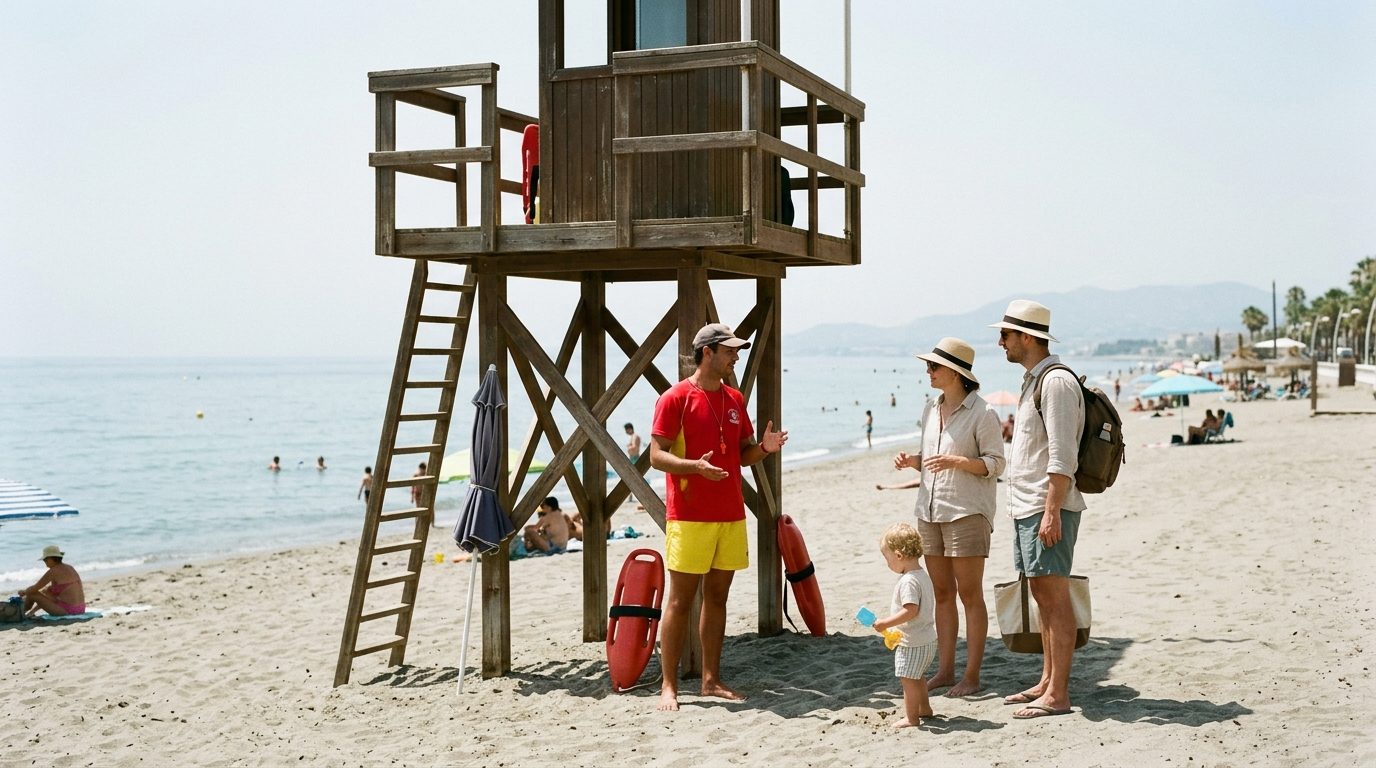
- Beach flags: green means bathing is allowed, yellow means take care, red means no swimming. Respect lifeguards’ instructions and swim at supervised beaches when possible.
- Currents and jellyfish: if caught in a current, swim parallel to the shore. For jellyfish stings, ask the lifeguard post for help.
- Heatwaves: summers are getting hotter. Avoid the sun in the middle of the day, drink water regularly, and check on older neighbours. Follow weather warnings from AEMET, Spain’s weather agency.
- Wildfires: never light fires or barbecues in the countryside in summer, and leave the area if authorities tell you to.
- Heavy rain (DANA): autumn storms can cause flash floods. Never drive through flooded roads or shelter in underground garages.
Make sure you also know how the health system works before you need it; see our guide to healthcare for foreign residents and our overview of hospitals in Spain.
Useful links
- Ministry of the Interior: level 4 of 5 anti-terrorist alert (Spanish)
- Ministry of the Interior: the ES-Alert warning system (Spanish)
- AlertCops official website
- Hospitals in Spain
- Renting in Spain as a foreigner
FAQ: safety in Spain
What is the emergency number in Spain?
Call 112 for any emergency. It is free, works from any phone and connects you to police, ambulance or fire services.
What is Spain’s current terrorism alert level?
The Ministry of the Interior has kept Spain at level 4 out of 5 for several years, with temporary reinforcements around holidays and major events. Check interior.gob.es for the latest decision.
Do I need to sign up for emergency alerts?
No. ES-Alert messages reach all mobile phones in the affected area automatically. AlertCops is a separate app you can download for police contact and SOS features.
Which police should I call?
In an emergency, just call 112. Otherwise use 091 (Policía Nacional) in cities, 062 (Guardia Civil) in rural areas and on main roads, and 092 for local matters.
Disclaimer: This article is general information only. Alert levels, numbers and procedures can change – always follow instructions from the emergency services and check official sources.
Safety & Emergency
The police in Spain: who does what and which number to call
Policía Nacional, Guardia Civil, Policía Local or regional police? Who does what in Spain, which number to call and how to report a crime.
Updated: October 2026
Spain has several police forces, and newcomers are often unsure whether to call the Policía Nacional, the Guardia Civil or the local police. This guide explains who does what, which number to ring in an emergency, how to report a crime as a foreigner and what to expect if you are stopped.
In an emergency: call 112
If someone is in danger or a crime is happening, call 112. It is the European emergency number and covers police, ambulance and fire. Calls are free from landlines and mobiles, and they work even from a phone with no SIM card or no coverage from your own network. The 112 centres send whichever force is responsible for the area, and many have operators who speak English.
| Number | Service | Use it for |
|---|---|---|
| 112 | All emergencies | Any urgent situation if you are unsure |
| 091 | Policía Nacional | Crimes in cities and provincial capitals |
| 062 | Guardia Civil | Crimes in rural areas and Guardia Civil towns, road incidents on interurban roads |
| 092 | Policía Local | Noise, parking, local disturbances, minor accidents in town |
In Catalonia and the Basque Country, the regional police (Mossos d’Esquadra and Ertzaintza) handle most calls instead. For more on staying safe, see our guide to safety and emergencies in Spain.
The national forces: Policía Nacional and Guardia Civil
The roles of the two national forces are set by the 1986 law on the security forces (Ley Orgánica 2/1986). They divide Spain mainly by territory:
Policía Nacional
The Policía Nacional (officially Cuerpo Nacional de Policía) covers provincial capitals and the larger towns designated by the government. Officers wear dark blue uniforms. Besides fighting crime, they have exclusive duties that matter to foreigners: they issue Spanish ID cards and passports, control border entry and exit, and handle immigration matters. That is why you go to a Policía Nacional office to have your fingerprints taken for the TIE residence card – see our guide to becoming resident in Spain.
Guardia Civil
The Guardia Civil is a police force with military status. It covers the rest of Spain – rural areas, many smaller towns and coastal municipalities, and territorial waters. Officers wear green uniforms, and you will find them at a local cuartel (station). Their exclusive duties include traffic on interurban roads and motorways, weapons and explosives control, customs and anti-smuggling work, and policing coasts, borders, ports and airports. If you are stopped on a motorway, it is almost always the Guardia Civil – read our driving licence guide to make sure your papers are in order.
Local and regional police
Policía Local
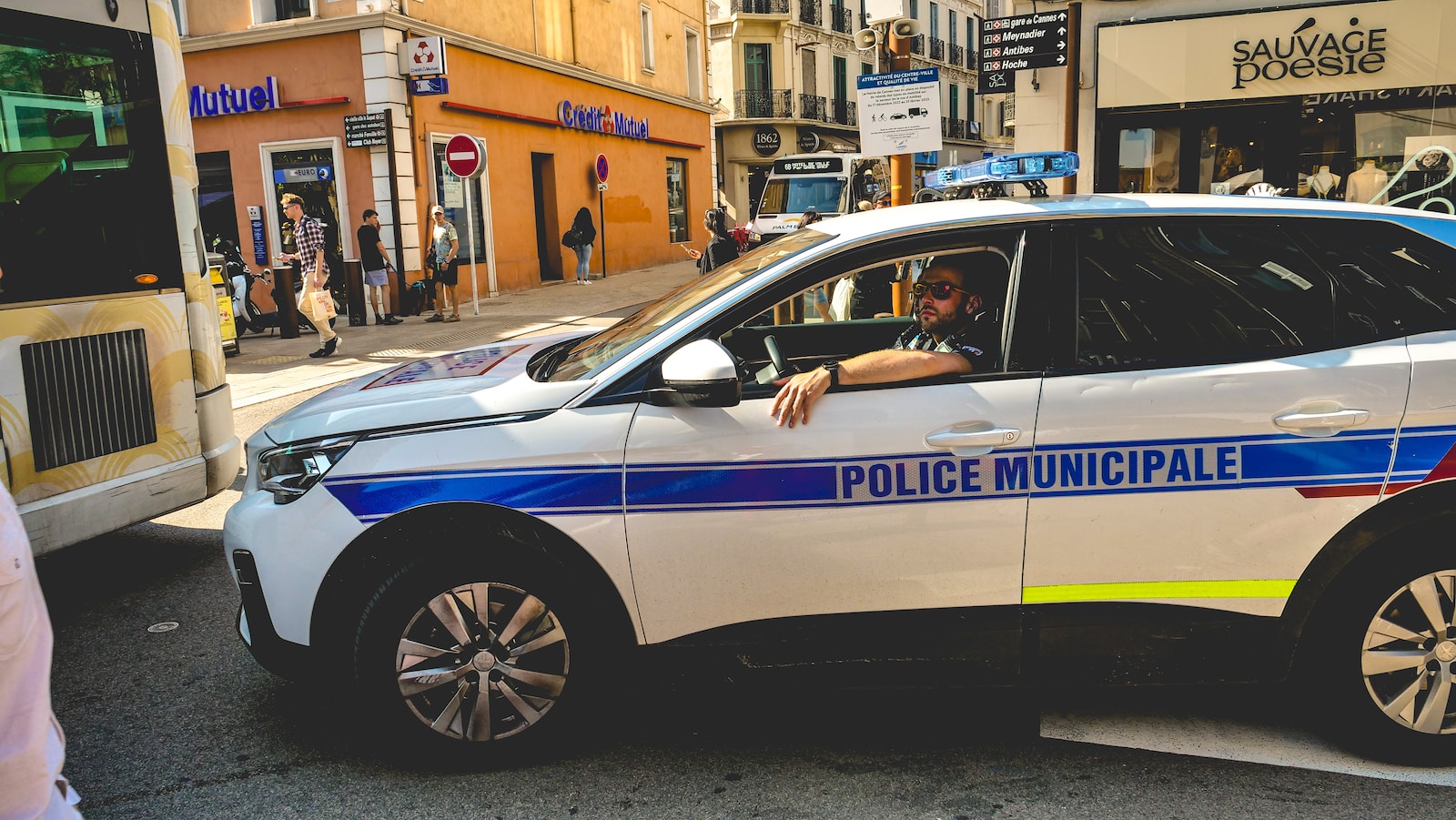
Most larger towns have their own Policía Local (called Policía Municipal in some cities, such as Madrid). They answer to the mayor and deal with town traffic and parking, local by-laws, noise complaints, markets and events. They also help the national forces with public safety. Uniforms vary from town to town.
Regional police
- Mossos d’Esquadra (Catalonia) and Ertzaintza (Basque Country): full regional forces that have taken over most duties of the national forces in their regions.
- Policía Foral (Navarre) and Policía Canaria (Canary Islands): regional forces that share duties with the national police.
- Andalucía, the Valencia region, Galicia and Aragón: have units of the Policía Nacional assigned to the regional government. They mainly protect regional buildings, enforce gambling rules and carry out similar tasks.
Why so many layers? It reflects the way Spain shares power between the state, the regions and the town halls – explained in our guide to how the Spanish government works.
How to report a crime (poner una denuncia)
To report a theft, burglary, scam or assault, you file a denuncia. You will need a copy for insurance claims and to replace stolen documents.
- Go to the right station: a Policía Nacional comisaría in cities, a Guardia Civil cuartel elsewhere, or the regional police in Catalonia and the Basque Country. You can report at any of them – they will pass it on if needed.
- Bring ID: your passport, TIE or NIE, plus any evidence such as receipts, screenshots or bank statements.
- Ask for an interpreter if you do not speak Spanish. In tourist areas, some stations have multilingual staff or forms.
- Keep your copy of the signed denuncia.
Some reports can be made online. Since July 2025 the Guardia Civil lets you file certain complaints fully online through its electronic office, using Cl@ve identification. These include minor theft, damage, vehicle theft and fraudulent card charges. The Policía Nacional also offers online reporting for some offences.
Practical tips for foreigners
- Carry ID: police can ask you to identify yourself. Carry your TIE, passport or national ID card, or at least a good copy.
- Traffic fines: you may be fined on the spot. You get a written notice, and you can pay by card or later. Paying within the deadline usually brings a discount.
- Download AlertCops: the Interior Ministry’s free app lets you send a geolocated alert to the Policía Nacional and Guardia Civil, chat with them and share your location with trusted contacts. It does not replace 112.
- Your rights: if you are arrested, you have the right to a lawyer, to an interpreter and to have your consulate informed.
Useful links
- Spanish government – the 112 emergency number
- Policía Nacional – find a police station or office
- Interior Ministry – Guardia Civil online complaints
- BOE – Organic Law 2/1986 on the security forces
- Safety and emergencies in Spain
FAQ: police in Spain
What is the difference between the Policía Nacional and the Guardia Civil?
Both are national forces. The Policía Nacional covers provincial capitals and big towns and handles ID, passports and immigration. The Guardia Civil covers rural areas, many smaller towns, interurban roads, coasts and borders.
Which number should I call in an emergency?
Call 112 for any emergency. It is free, works without a SIM card and connects you to police, ambulance or fire.
Can I report a crime in English?
You can ask for an interpreter when you make a denuncia. In tourist areas some stations have English-speaking staff or translated forms.
Who do I call about noisy neighbours?
The Policía Local, on 092 in most towns. They handle noise and other local by-law problems.
Disclaimer: This article is general information only and is not legal advice. Procedures and phone numbers can change – in an emergency always call 112, and check with the official source before you act.

Floods, DANA storms and weather warnings in Spain: how to prepare and stay safe

Car insurance in Spain for expats in 2026: what you need to know

How to register on the padrón in Spain in 2026 (empadronamiento)

Understanding the tax system in Spain

Andalucía guide: cities, culture and life in southern Spain

Marbella guide: areas, beaches and everyday life
-

 Banking & Finances2 years ago
Understanding the tax system in Spain
-
Tourist Info2 years ago
Andalucía guide: cities, culture and life in southern Spain
-
Tourist Info2 years ago
Marbella guide: areas, beaches and everyday life
-
Legal Requirements & Documentation2 years ago
How to get your Spanish NIE number in 2026 – step by step
-
Cost of Living2 years ago
Living on a small salary in Spain in 2026
-
Legal Requirements & Documentation2 years ago
Residency in Spain 2026: how to become a legal resident – step by step
-
Legal Requirements & Documentation2 years ago
Work visa and work permit in Spain 2026 – which one you need and how to apply
-
Housing & Utilities1 year ago
Tvmate Pro app & Streambox 4K media box for expats in Spain