





































































Employment
Working in a call centre in Málaga: multilingual customer service jobs
What multilingual call centre and customer service jobs in Málaga involve: languages in demand, pay and contracts, office vs remote work, and how to apply.









Updated: October 2026
Málaga has become one of Spain’s busiest hubs for multilingual customer service. International companies and outsourcing firms hire native speakers of many European languages to answer calls, chats and emails for customers across Europe. This guide is for newcomers thinking about a call centre or customer service job in Málaga. It explains the work, the pay, office versus remote set-ups and how to get hired.
What the jobs involve
“Telemarketing” in Spain today covers much more than cold calling. Most vacancies in Málaga fall into these groups:







 Online pharmacy & parapharmacySkincare, vitamins, baby care and more – delivered in SpainShop now
Vivid BusinessA business account for freelancers and companies in SpainOpen your account online, with sub-accounts and cards for your team.Learn more →(ad)
 Buying a home in Spain? Simulate your mortgageSee your monthly payment with Banco Sabadell’s mortgage simulator.Try the simulator →(ad)
 A bank account for autónomos in SpainCuenta Clara Autónomos: no commissions, free debit and credit cards, opened online.See the account →(ad)
 A European bank you open from your phonebunq: an EU-licensed bank with debit cards, managed fully in the app. Sign up in about five minutes.Get started →(ad)
 A mobile bank account with no commissionsB100, the mobile bank from Abanca: everyday account and free debit card, all in the app.Get the app →(ad)


- Customer support: helping customers of travel, tech, gaming, e-commerce or financial companies by phone, chat and email.
- Technical support: first-line help with software, devices or accounts, often with better pay.
- Sales and bookings: hotel reservations, travel packages or subscriptions, usually with a commission or bonus on top of base pay.
- Retention and back office: handling cancellations, complaints, payments and content moderation.
Employers include in-house service centres of international brands and large outsourcing companies such as Transcom, which regularly advertises roles in Málaga. Many offices are in the city centre or at the Málaga TechPark (PTA) on the western edge of the city.
Languages in demand
Your native language is your biggest asset. Recent Málaga job ads ask for native or advanced speakers of languages such as German, Dutch, French, Italian, Portuguese and the Nordic languages, usually plus a good level of English. Spanish is often not required for the job itself, although it helps a lot with daily life and promotion.
Rarer languages, such as Danish, Norwegian, Finnish or Dutch, tend to bring higher pay or a language bonus because fewer candidates are available.
Pay, contracts and the sector agreement
Most call centre jobs in Spain fall under the national collective agreement for the contact centre sector (III Convenio Colectivo de Contact Center). It runs until the end of 2026, and salary tables for 2026 were raised by 3.4%. The agreement sets minimum pay by job level, rules on shifts and breaks, and compensation for teleworking.







- Entry level: base pay for agents is close to the national minimum wage. In 2026 no full-time job can pay less than €17,094 gross a year (€1,221 in 14 payments).
- Multilingual roles: companies serving foreign markets often pay above the convenio minimum, with language allowances, performance bonuses or sales commission. Check the gross annual figure and what part is variable.
- Contracts: permanent contracts (indefinido) are now the norm in Spain, often with a trial period. Many roles are part-time or include weekend and evening shifts.
Because the current agreement expires at the end of 2026, check whether a new one has been signed when you compare offers. For a wider view of pay, see our overview of salaries in Spain.
Office, hybrid or remote
After the pandemic, many Málaga contact centres moved to hybrid or fully remote set-ups. Each option has trade-offs:
| Set-up | Advantages | Drawbacks |
|---|---|---|
| Office | Equipment provided, team support, easier training and promotion, social life with colleagues | Commute and parking costs, fixed shifts, noisy floors |
| Hybrid | Balance of flexibility and team contact | You still need to live within reach of the office |
| Remote from home | No commute, more freedom where to live | You need a quiet room and fast fibre, risk of isolation |
| Remote from a co-working space | Separation of home and work, networking | Monthly desk fee, the employer may not allow it for data-protection reasons |
If you work from home, ask how the telework compensation in the agreement is paid and what equipment the company provides. Remote roles almost always require you to live and be registered in Spain. If you are interested in co-working, our guide to Málaga for digital nomads covers the main spaces and neighbourhoods.
How to get hired
- Check your right to work. EU citizens can start straight away and register as residents. Non-EU citizens need a work permit, see our guide to visas and work permits.
- Search the right places. Company career pages, LinkedIn, Spanish job portals and the European job portal EURES. You can also register with the Andalusian employment service (SAE).
- Prepare for a language test. Most employers test your native language and English by phone or online.
- Expect paid or unpaid training. Ask before you start whether the initial training period is paid and whether it counts towards the trial period.
- Get your paperwork ready. You need an NIE, a Social Security number and a Spanish bank account for your salary.
Is it a good long-term career?
For many newcomers, a multilingual customer service job is a practical first step: it pays a regular salary, gives you a contract for your residence paperwork and lets you live by the sea while you learn Spanish. The work can be repetitive and target-driven, so plan your next move. Team leader, quality, training, workforce planning and account management roles pay more, and the experience is useful for jobs in tech and tourism. Read more in our guide to the Spanish job market.
Useful links
- Servicio Andaluz de Empleo (SAE): services
- European Commission: what is EURES
- BOE: 2026 minimum wage (Royal Decree 126/2026)
- Málaga for digital nomads
- Visas and work permits in Spain
FAQ: call centre jobs in Málaga
Do I need to speak Spanish to work in a Málaga call centre?
Often not. Many roles only require your native language and English, but Spanish makes daily life easier and helps with promotion.
How much do call centre agents earn in Málaga?
Entry-level pay is close to the 2026 minimum wage of €17,094 gross a year for full-time work. Multilingual roles, especially in rarer languages, often pay more plus bonuses.
Can I work remotely for a Málaga call centre from another country?
Usually not. Most employers require you to live in Spain and be registered with Spanish Social Security, even for fully remote roles.
Disclaimer: This article is general information only and is not legal advice. Pay, collective agreements and job offers change. Always check your contract and the official source before you act.


Co-working office
Why so many people work remotely from Spain
Climate, fibre, time zone, the digital nomad visa and the Beckham law – why Spain attracts remote workers, and the downsides to know before you move.


Updated: October 2026
Walk into a café in Málaga, Valencia or Las Palmas on a weekday morning and you will see laptops at half the tables. Spain has become one of Europe’s favourite bases for remote workers – employees of foreign companies, freelancers and founders who can do their job from anywhere and choose to do it here. This article looks at why, and at the less sunny side you should know about before you move.
1. Climate and quality of life
The obvious reason is still the main one. Long, light days and mild winters along the Mediterranean and in the Canary Islands make it easy to fit a walk, a swim or a padel game around the working day. Outdoor life, long lunches and a strong café culture make working alone feel less isolating than in a dark northern winter.
Online pharmacy & parapharmacySkincare, vitamins, baby care and more – delivered in SpainShop now
Vivid BusinessA business account for freelancers and companies in SpainOpen your account online, with sub-accounts and cards for your team.Learn more →(ad)
Buying a home in Spain? Simulate your mortgageSee your monthly payment with Banco Sabadell’s mortgage simulator.Try the simulator →(ad)
A bank account for autónomos in SpainCuenta Clara Autónomos: no commissions, free debit and credit cards, opened online.See the account →(ad)
A European bank you open from your phonebunq: an EU-licensed bank with debit cards, managed fully in the app. Sign up in about five minutes.Get started →(ad)
A mobile bank account with no commissionsB100, the mobile bank from Abanca: everyday account and free debit card, all in the app.Get the app →(ad)
2. Fast, widely available fibre
Spain has one of the most extensive fibre-to-the-home networks in Europe. In most towns and cities, symmetric fibre is standard and affordable, which is exactly what video calls and large uploads need. Check coverage at the exact address before signing a rental, especially for rural homes. See our guide to internet and mobile providers.
3. Cost of living compared with northern Europe
For someone paid a northern European, British or American salary, everyday costs – eating out, groceries, public transport, gyms – are often lower. Housing is the big exception: rents in Madrid, Barcelona, Málaga, the Balearics and popular coastal towns have risen sharply. Our cost of living guide breaks it down by region.
4. A time zone that works
Mainland Spain and the Balearics are on Central European Time, the same as Paris, Berlin and Stockholm, so working for a European employer needs no adjustment. The Canary Islands are one hour behind, on the same time as the UK and Portugal. For US companies, Spanish afternoons overlap with the East Coast morning.
5. A legal route for non-EU remote workers
EU, EEA and Swiss citizens can live and work in Spain freely, but must register if they stay more than three months. For everyone else, Spain created a specific permit for international teleworkers in 2023 – the digital nomad visa. Key points in 2026:
- You work remotely for companies outside Spain. If you are self-employed, up to 20% of your work may be for Spanish clients.
- The employer has been operating for at least one year, and you have worked with it for at least three months.
- You have a university degree or at least three years of relevant professional experience.
- Minimum income is 200% of the Spanish minimum wage. With the 2026 minimum wage (€1,221 a month in 14 payments), that is about €2,849 a month for the main applicant, plus about €1,068 for the first family member and €356 for each additional one.
- The residence permit can be granted for up to three years and renewed, and time in Spain counts towards long-term residence.
6. Tax: the Beckham law
Remote workers who move to Spain can often opt into the special tax regime for people relocated to Spain, known as the Beckham law. It taxes Spanish employment income at a flat 24% up to €600,000 for the year you arrive and the next five years, instead of the normal progressive rates. You must not have been tax resident in Spain in the previous five years, and you must apply within six months of registering with Social Security. Read more in our Beckham law guide.
7. Healthcare, safety and infrastructure
Spain combines a good public health system, affordable private health insurance, a large high-speed rail network and many international airports. That makes it easy to fly home for a meeting or have family visit. See healthcare for foreign residents.
8. Co-working spaces and communities
Every larger Spanish city – and many smaller coastal towns – now has co-working spaces, often with day passes and monthly memberships. They give you a desk, reliable internet and, just as important, colleagues to have lunch with. Meet-ups, sports clubs and language exchanges make it easier to build a social life. Málaga in particular has built a reputation as a tech hub; read why Málaga is a top destination for digital nomads.
The other side: what remote workers struggle with
- Bureaucracy. NIE, padrón, Social Security, bank account, tax returns – each step takes time and usually some Spanish. Start with how to get your NIE.
- Tax residence. Spend more than 183 days a year in Spain and you are normally tax resident here, taxed on your worldwide income. Many people find out too late.
- Social Security. Working from Spain usually means paying Spanish Social Security, either through your employer or as autónomo. See working remotely for a foreign company while living in Spain.
- Housing. Long-term rentals are scarce and expensive in the most popular areas, and landlords often ask for several months’ deposit.
- Summer heat. Without air conditioning, July and August can make concentration hard.
- Loneliness. Remote work plus a new country can be isolating. Co-working spaces and local clubs help.
Getting set up
- Sort out your legal status first: EU registration certificate or the digital nomad permit.
- Talk to your employer about Social Security and tax before you move.
- Decide on the Beckham law within the six-month window, if you qualify.
- Find a home with confirmed fibre coverage and a room you can work in.
- Set up your work equipment – see our guide to buying a laptop and home office equipment in Spain.
- If you freelance, give clients a professional address: providers such as Nominalia (ad) offer domains and business email with Spanish support.
Useful links
- Ministry of Inclusion: FAQ for international teleworkers (Spanish)
- Agencia Tributaria: special regime for workers relocated to Spain
- Spain’s digital nomad visa in 2026
- Residency in Spain: step by step
FAQ: working remotely from Spain
Can I work remotely from Spain on a tourist stay?
EU, EEA and Swiss citizens can. Non-EU citizens cannot legally work, even for a foreign employer, without a permit such as the digital nomad visa.
How much do I need to earn for the digital nomad visa in 2026?
About €2,849 a month for the main applicant, based on 200% of the 2026 Spanish minimum wage, plus extra for each family member. Check the current figure when you apply.
Do I pay tax in Spain if my salary is paid abroad?
If you are tax resident in Spain – usually after 183 days in a year – Spain taxes your worldwide income, wherever it is paid. Double tax treaties help avoid paying twice.
Which Spanish cities are most popular with remote workers?
Madrid, Barcelona, Valencia and Málaga are the big hubs, while the Canary Islands are popular for their year-round climate. Smaller towns offer lower rents if the internet connection is good.
Disclaimer: This article is general information only and is not legal or tax advice. Immigration and tax rules change and depend on your situation – speak to an immigration lawyer, gestor or tax adviser before you act. Links marked “(ad)” are affiliate links – NewInSpain may earn a commission at no extra cost to you.
Cost of Living
Buying a laptop and home office equipment in Spain
Spanish keyboards, plugs, the three-year warranty, summer heat and recycling: what to know before you buy a laptop or set up a home office in Spain.
Updated: October 2026
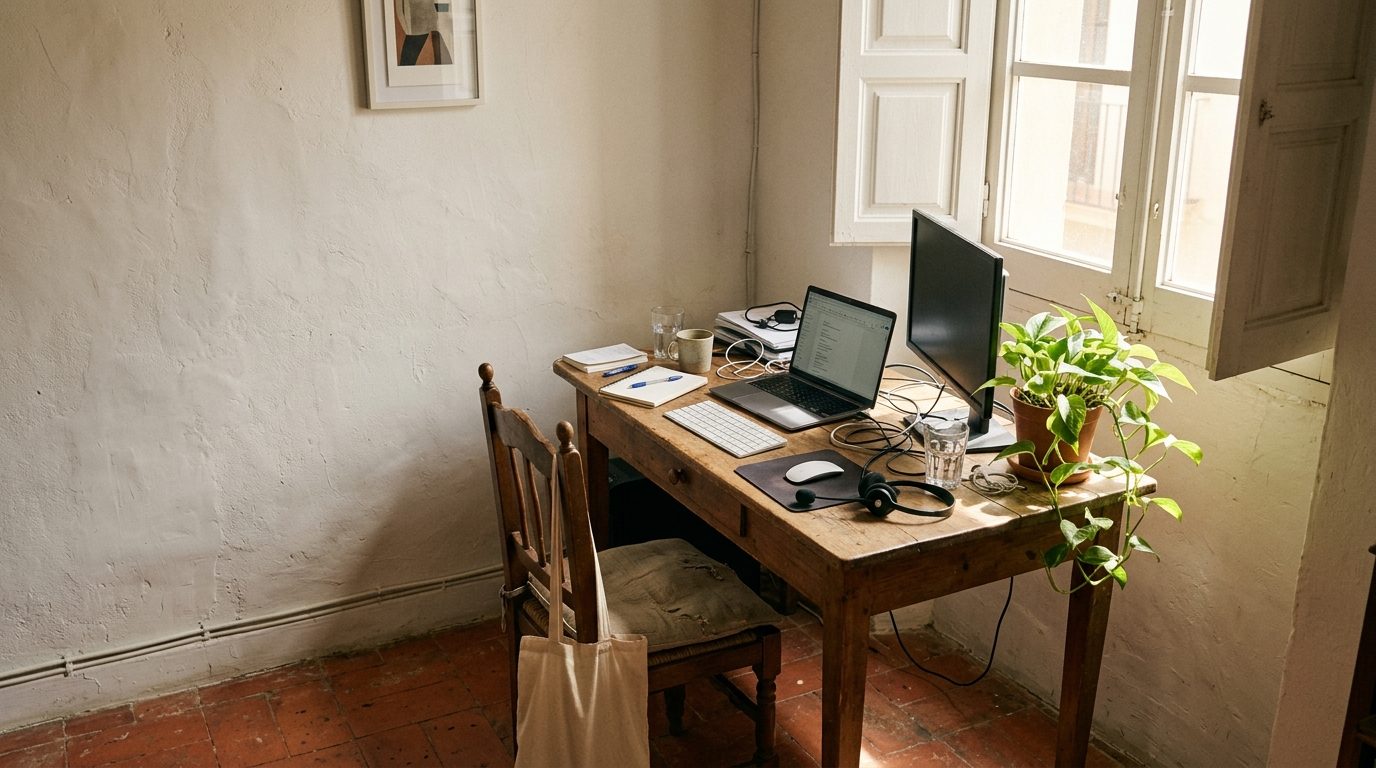
Whether you work remotely, study online or simply need a computer for banking and the endless online forms of Spanish bureaucracy, you will probably buy a laptop or set up a home office here sooner or later. Most of it works just like at home – but there are a few Spanish details worth knowing before you spend money: the keyboard, the plugs, the warranty, the heat and what to do with your old devices.
Bring your laptop or buy one in Spain?
If your current laptop works well, bring it. Laptop chargers are almost always rated for 100–240 V, so they work on the Spanish 230 V / 50 Hz grid – you only need a plug adapter or a new cable. Spain uses the European type C and type F sockets (two round pins), the same as most of mainland Europe. If you come from the UK, Ireland or the US, buy a proper adapter or a replacement power cable rather than relying on cheap travel adapters for a device that is plugged in all day.
Online pharmacy & parapharmacySkincare, vitamins, baby care and more – delivered in SpainShop now
Vivid BusinessA business account for freelancers and companies in SpainOpen your account online, with sub-accounts and cards for your team.Learn more →(ad)
Buying a home in Spain? Simulate your mortgageSee your monthly payment with Banco Sabadell’s mortgage simulator.Try the simulator →(ad)
A bank account for autónomos in SpainCuenta Clara Autónomos: no commissions, free debit and credit cards, opened online.See the account →(ad)
A European bank you open from your phonebunq: an EU-licensed bank with debit cards, managed fully in the app. Sign up in about five minutes.Get started →(ad)
A mobile bank account with no commissionsB100, the mobile bank from Abanca: everyday account and free debit card, all in the app.Get the app →(ad)
Buying in Spain makes sense when your laptop is old anyway, when you want a local warranty, or when you need to replace a desktop that is too heavy to move.
The Spanish keyboard: check before you pay
Laptops sold in Spain normally come with a Spanish keyboard layout. It has the letter ñ to the right of L, a different position for many symbols (@, #, quotation marks, brackets) and a key for accents. Touch typists used to a UK, US, German or Scandinavian layout often find it frustrating.
- Many shops only stock the Spanish layout. Some manufacturers let you configure a different layout when you order directly from their own online store – check before you pay.
- You can always switch the layout in Windows, macOS or Linux, but the printed keys will not match. Keyboard stickers are a cheap fix.
- For a home office, an external keyboard in your preferred layout solves the problem and is better for your posture anyway.
What to look for in a work laptop
- Memory: 16 GB RAM is a comfortable minimum for video calls, many browser tabs and office software. 8 GB quickly feels slow.
- Storage: an SSD of at least 512 GB, or 256 GB if you keep everything in the cloud.
- Battery and weight: matter if you plan to work from cafés, co-working spaces or on the train.
- Webcam and microphone: a 1080p webcam makes a real difference if you spend your day in meetings.
- Cooling: Spanish summers are hot. A laptop that throttles at 30 °C indoors is a daily annoyance – read reviews that mention heat and fan noise.
- Ports: at least one USB-C port with charging and display output makes it easy to connect a monitor with one cable.
Home office equipment worth buying
- External monitor: a 24–27 inch screen at eye level is the single biggest upgrade for long working days.
- Keyboard and mouse: in your own layout, if the laptop has a Spanish one.
- Headset: Spanish homes often have tiled floors and little soft furnishing, so rooms echo. A headset with a good microphone helps your colleagues more than a better webcam.
- Chair and desk: many furnished rentals come with a dining chair at best. An adjustable office chair is worth it if you work from home every day.
- Surge protector: storms and power cuts happen. A surge-protected power strip is cheap insurance for your equipment; a small UPS (uninterruptible power supply) keeps a router or desktop running through short outages.
- Fan or air conditioning: the room you work in will decide how productive you are in July and August.
Internet: the part that matters most
Spain has one of the most extensive fibre networks in Europe, and in most towns you can get symmetric fibre at a reasonable price. Check coverage at the exact address before you sign a rental contract – rural houses and some older buildings may only have 4G/5G home internet. Our guide to the best internet and mobile providers in Spain compares the main operators, and utility bills in Spain explains what you will pay each month.
Where to buy: shops, online and refurbished
- Electronics chains and department stores have laptops on display, so you can try the keyboard and screen before you buy.
- Online shops often have a wider range and better prices. Compare the final price including delivery.
- Manufacturers’ own stores are the best place to look for other keyboard layouts and custom configurations.
- Refurbished devices from professional sellers are a good way to save money; they still come with a legal warranty (see below).
- Second-hand from private sellers (Wallapop and similar) can be cheap but carries no legal warranty. Meet in person and test the device first.
Your rights as a buyer in Spain
- Three-year legal warranty: since 1 January 2022, new goods bought from a business in Spain have a minimum legal guarantee of three years from delivery. If a fault appears within the first two years, it is presumed to have existed when you bought it.
- Refurbished and second-hand from a business: the seller may shorten the guarantee, but not below one year.
- 14 days to change your mind online: for purchases made online or by phone you can withdraw within 14 days without giving a reason. This does not apply to purchases in a physical shop, where returns depend on the shop’s own policy.
- Keep the invoice (factura): you need it for warranty claims. If you are self-employed, ask for a full invoice with your NIF/NIE so you can deduct the purchase.
Prices in shops include VAT (IVA) at 21%. In the Canary Islands, IGIC applies instead at a lower rate.
Recycling your old devices
Electronic devices must not go in the normal rubbish. When you buy a new device, the shop is generally obliged to take back an equivalent old one free of charge, and large electronics shops must accept very small devices even without a purchase. You can also take old electronics to your town’s recycling point (punto limpio). Wipe your data first.
Working for yourself? Get a professional address
If you freelance or run a small business from your home office, a professional email address on your own domain looks better to clients than a free webmail address. Spanish providers such as Nominalia (ad) offer domains, email and hosting with Spanish-language support. For the paperwork side of freelancing, see our guide to becoming autónomo in Spain.
Useful links
- European Consumer Centre Spain: guarantees (Spanish)
- Working remotely for a foreign company while living in Spain
- Best internet and mobile providers in Spain
- Cost of living in Spain in 2026
FAQ: laptops and home office equipment in Spain
Can I buy a laptop with an English keyboard in Spain?
It is possible but not always easy. Most shops sell the Spanish layout. Look at manufacturers’ own online stores, which sometimes let you choose the layout, or use an external keyboard.
Will my UK or US laptop charger work in Spain?
Almost certainly – most laptop chargers accept 100–240 V. Check the label on the charger. You only need a type C/F plug adapter or a replacement cable.
How long is the warranty on electronics in Spain?
New products bought from a business have a three-year legal guarantee. For second-hand or refurbished goods from a business it can be shortened, but not below one year.
Can I return a laptop I bought online?
Yes, within 14 days of receiving it, without giving a reason, as long as the shop is a business selling at a distance. Check how the shop wants the product returned.
Disclaimer: This article is general information, not legal or financial advice. Links marked “(ad)” are affiliate links – NewInSpain may earn a commission at no extra cost to you. Prices, products and shop policies change; check before you buy.
Employment
Employment contracts in Spain in 2026: your rights as a worker
Contract types, trial periods, minimum wage, hours, holidays and dismissal pay in Spain in 2026 – what every new employee should know before signing.


Updated: October 2026
Starting a job in Spain means signing a Spanish employment contract, and the rules can be quite different from what you are used to at home. This guide is for foreign workers taking their first job here. It covers the types of contract, trial periods, the 2026 minimum wage, working hours, holidays and what happens if your job ends.
Where your rights come from
Three layers decide your working conditions:
Online pharmacy & parapharmacySkincare, vitamins, baby care and more – delivered in SpainShop now
Vivid BusinessA business account for freelancers and companies in SpainOpen your account online, with sub-accounts and cards for your team.Learn more →(ad)
Buying a home in Spain? Simulate your mortgageSee your monthly payment with Banco Sabadell’s mortgage simulator.Try the simulator →(ad)
A bank account for autónomos in SpainCuenta Clara Autónomos: no commissions, free debit and credit cards, opened online.See the account →(ad)
A European bank you open from your phonebunq: an EU-licensed bank with debit cards, managed fully in the app. Sign up in about five minutes.Get started →(ad)
A mobile bank account with no commissionsB100, the mobile bank from Abanca: everyday account and free debit card, all in the app.Get the app →(ad)
- The Workers’ Statute (Estatuto de los Trabajadores): the main labour law, which sets the minimum rights for almost every employee.
- The collective agreement (convenio colectivo): negotiated for your sector, province or company. It often sets salary tables, extra payments, hours and trial periods, and usually improves on the law. Ask your employer which convenio applies to you; it should be named in your contract and payslip.
- Your contract: it can give you more than the law and the convenio, but never less. A clause that waives your legal rights is not valid.
If you are not an EU citizen, you also need the right to work. See our guide to work visas and permits.
Types of employment contract after the labour reform
Since the 2021–2022 labour reform, the starting point is that employment contracts are permanent. Temporary contracts are only allowed for specific reasons. The official contract models from the public employment service (SEPE) now fall into a handful of types:
| Contract | When it is used |
|---|---|
| Indefinido (permanent) | The normal contract, full-time or part-time, with no end date |
| Fijo discontinuo | Permanent contract for seasonal or intermittent work, for example in tourism; you are called back each season |
| Temporal por circunstancias de la producción | Temporary peaks in work; as a rule up to six months, which a sector agreement can extend to a year |
| Temporal por sustitución | Covering a worker who is absent, such as on parental leave |
| Formativos | Training contracts combining work and study, or for gaining experience after a qualification |
If a temporary contract is used without a valid reason, or you are chained on temporary contracts for the same company for too long, you can become a permanent employee by law. A contract should be in writing, and for jobs lasting more than four weeks your employer must tell you the essential terms in writing.
Before and during your first weeks
Social Security registration
Your employer must register you with Social Security (alta) before you start work. You can check this, and your full work history, in your informe de vida laboral, which you can download free through the Social Security’s Import@ss portal or app. Working without being registered leaves you without healthcare, unemployment and pension rights, so check it in your first week.
Trial period (periodo de prueba)
Most contracts start with a trial period during which either side can end the job without notice or compensation. It must be agreed in writing. Unless your collective agreement says otherwise, it cannot exceed six months for qualified technicians (titulados) and two months for other workers, or three months in companies with fewer than 25 employees. Collective agreements often set shorter periods.
Pay, hours and holidays
Minimum wage 2026
The salario mínimo interprofesional (SMI) for 2026 is €1,221 a month in 14 payments, or €40.70 a day, applying from 1 January 2026 (Royal Decree 126/2026). On an annual basis that means at least €17,094 for a full-time job. Part-time workers receive it in proportion to their hours. Your convenio may set a higher minimum for your role. For typical pay levels, see our overview of salaries in Spain.
By law you are entitled to two extra payments a year (pagas extraordinarias), usually in summer and at Christmas. Many contracts spread (prorratear) them over twelve monthly payments instead. You must receive a payslip (nómina) every month showing gross pay, Social Security contributions and income tax withheld.
Working hours
- Maximum: 40 hours a week of actual work, calculated as an annual average. A proposal to cut this to 37.5 hours did not pass parliament in 2025 and, as of October 2026, the 40-hour limit still applies.
- Daily limit and rest: normally no more than nine ordinary hours a day unless your agreement distributes hours differently, at least 12 hours between the end of one working day and the start of the next, and a weekly rest of at least a day and a half.
- Time recording: employers have been required to record each worker’s daily start and finish times since 2019. Those records help you prove unpaid overtime. The government has been working on rules to make the record digital, so check the current requirements.
Holidays
You are entitled to at least 30 calendar days of paid holiday a year (often counted as 22 working days), plus the national, regional and local public holidays. Holidays cannot be swapped for money while you are still employed; unused days are only paid out when the contract ends.
When the job ends: notice and compensation
Compensation depends on how the contract ends. The legal minimums are:
| Situation | Statutory compensation |
|---|---|
| End of a temporary contract | 12 days’ salary per year worked |
| Objective dismissal (economic, technical, organisational reasons) | 20 days per year, up to 12 months’ pay, with 15 days’ written notice |
| Dismissal ruled unfair (improcedente) | 33 days per year, up to 24 months’ pay, or reinstatement at the employer’s choice |
| Disciplinary dismissal upheld | No compensation |
| Resignation | No compensation; give the notice set in your convenio (often 15 days) |
Older contracts can have different calculations for service before 2012. In every case you should receive a final settlement (finiquito) with outstanding pay, the proportional part of extra payments and unused holiday. You can sign it with “no conforme” if you disagree.
Deadlines are short. To challenge a dismissal you have 20 working days from the date it takes effect, and you must first request conciliation at your region’s labour mediation service before going to court. If you think you have been dismissed unfairly, see a labour lawyer (abogado laboralista) or a trade union straight away.
Where to get help
- Trade unions: the large unions run advice services, often free or cheap for members.
- Labour Inspectorate (ITSS): you can file a formal complaint about unpaid wages, missing registration or excessive hours, or report irregularities anonymously through its online mailbox.
- Labour lawyers and gestores: useful for checking a contract before you sign it or calculating a settlement.
If you are on a low salary, our guide to living on a small salary in Spain has practical tips, and the Spanish job market guide shows where the opportunities are.
Useful links
- BOE: Workers’ Statute (Estatuto de los Trabajadores, Spanish)
- SEPE: official employment contract models
- BOE: Royal Decree 126/2026 on the 2026 minimum wage (Spanish)
- Labour Inspectorate: how to file a complaint
- La Moncloa: how to get your vida laboral report (Spanish)
FAQ: employment contracts in Spain
Does my contract have to be in Spanish?
Contracts are normally in Spanish (or a co-official language). Ask for a translation if you need one, and do not sign anything you do not understand.
Can my employer pay me less than the minimum wage if I agree?
No. The SMI and your collective agreement’s salary tables are minimums that cannot be waived, even with your signature.
Am I entitled to unemployment benefit when my contract ends?
If you have contributed long enough and the job ended involuntarily, usually yes. Register as a jobseeker and apply to the SEPE promptly after the job ends.
How do I know which collective agreement applies to me?
It should be stated in your contract or payslip. If not, ask HR or a trade union; agreements are published in the BOE or your province’s official bulletin.
Disclaimer: This article is general information only and is not legal advice. Your collective agreement and personal situation can change the rules – always check the official source and ask a labour lawyer, gestor or trade union before you act.



 Ad
 A sea-view escape in MallorcaThe Donna Portals – stay by the sea with views over the Mediterranean.See prices →

 Vivid BusinessA business account for freelancers and companies in SpainOpen your account online, with sub-accounts and cards for your team.✓ For autónomos and companies
✓ Sub-accounts for budgets and taxes
✓ Cards for your teamLearn more →(ad)
 A European bank you open from your phoneSign up with bunq in about five minutes.Get started →(ad)


Renting a car in Spain: what to check before you sign

Rebajas: when the sales start in Spain and your rights

Processionary caterpillars in Spain: a danger to dogs

Andalucía guide: cities, culture and life in southern Spain

Understanding the tax system in Spain

Marbella guide: areas, beaches and everyday life








-

 Tourist Info2 years ago
Andalucía guide: cities, culture and life in southern Spain
-
Banking & Finances2 years ago
Understanding the tax system in Spain
-
Tourist Info2 years ago
Marbella guide: areas, beaches and everyday life
-
Cost of Living2 years ago
Living on a small salary in Spain in 2026
-
Spanish System2 years ago
How the Spanish government works: state, regions, provinces and town halls
-
Tourist Info2 years ago
Benalmádena explained: Pueblo, Arroyo de la Miel and the coast
-
Cost of Living2 years ago
Family living costs in Spain in 2026: monthly budget and moving-in money
-
Insurance2 years ago
Understanding insurance in Spain: a 2026 guide for expats