























































Insurance
Car insurance in Spain for expats in 2026: what you need to know
Compulsory cover, terceros vs todo riesgo, foreign licences and no-claims history, and what to do after an accident in Spain.


Updated: October 2026
If you drive in Spain, whether in a car you brought from home or one you bought here, you need valid motor insurance from the first day. This guide is for expats and new residents who want to understand what is compulsory, which type of cover makes sense, how to use your no-claims history from abroad and what to do if you have an accident.
For an overview of all the main policies in Spain, from health to home, see our guide to insurance in Spain.
What the law requires
Every motor vehicle that is normally kept in Spain must have compulsory third-party liability insurance (seguro obligatorio de responsabilidad civil). This applies even if the car is parked and not being driven. The rules are set out in the motor liability law (Real Decreto Legislativo 8/2004), which was updated by Law 5/2025 to transpose the latest EU motor insurance directive.
The legal minimum cover is 70 million euros per claim for personal injury, regardless of the number of victims, and 15 million euros per claim for damage to property. The compulsory part only pays for harm you cause to other people and their property. It does not repair your own car.
Driving or keeping a car on the public road without insurance is a very serious offence. Fines are high (often reported at around 1,500 euros for a car on the road), and the police can immobilise the vehicle on the spot. If you cause an accident without insurance, the Consorcio de Compensación de Seguros pays the victims and can then claim the full amount back from you.
Types of car insurance in Spain
Spanish insurers sell three broad levels of cover. Names differ slightly between companies, but the structure is almost always the same.
| Type | What it usually covers | Suits |
|---|---|---|
| Terceros (third party) | Compulsory liability, plus voluntary liability, legal defence and often roadside assistance | Older or low-value cars |
| Terceros ampliado (third party plus) | As above, plus extras such as glass, fire and theft | Mid-value cars that are a few years old |
| Todo riesgo (fully comprehensive) | Damage to your own car as well, even if the accident is your fault | New or financed cars |
Fully comprehensive policies are often sold con franquicia, meaning with an excess you pay yourself on each claim for your own damage. A higher excess lowers the premium. If you finance or lease a car, the lender usually requires comprehensive cover for the length of the contract.
What affects the price
- Driver profile: age, years holding a licence and claims history.
- The car: value, power and how attractive it is to thieves.
- Where you live and park: postcode and whether the car sleeps in a garage.
- Named drivers: adding young or occasional drivers usually raises the price.
Foreign licence, foreign plates and your history abroad
Driving on a foreign licence
Most Spanish insurers will cover a driver with an EU licence without problems. With a UK or other non-EU licence, check first whether you are still allowed to drive on it as a resident, because insurance does not make an invalid licence valid. Our driving licence guide explains the exchange rules for EU, UK and non-EU drivers.
Cars on foreign plates
Compulsory liability insurance from any EU country is valid across the EU, so a visitor driving a car insured at home is legally covered in Spain. Voluntary extras such as comprehensive cover may be limited to a certain number of days abroad, so read your policy. Since 2 August 2021, UK-insured cars no longer need a green card in the EU.
Once you live in Spain, the car is generally expected to be registered here, and you will then need a policy from an insurer authorised in Spain. Many Spanish insurers will not insure a foreign-plated car long term, so plan the switch together with the registration. See our guide to registering a foreign car in Spain.
Using your no-claims history from abroad
Spanish insurers check your Spanish history in a shared industry file called SINCO, which records at-fault claims for the last five years. As a newcomer you will not appear there, so you may be quoted as a new driver unless you prove your record.
- Ask your previous insurer for a claims history statement covering the last five years. Under EU rules it must be issued within 15 days of your request.
- Send it with your quote request. A sworn translation is not always required, but ask the insurer what they accept.
- Compare several offers. Insurers are not obliged to give you a discount, but Spanish law says that when they use these certificates they must not discriminate on the basis of nationality or of the country where the certificate was issued.
What to do after an accident
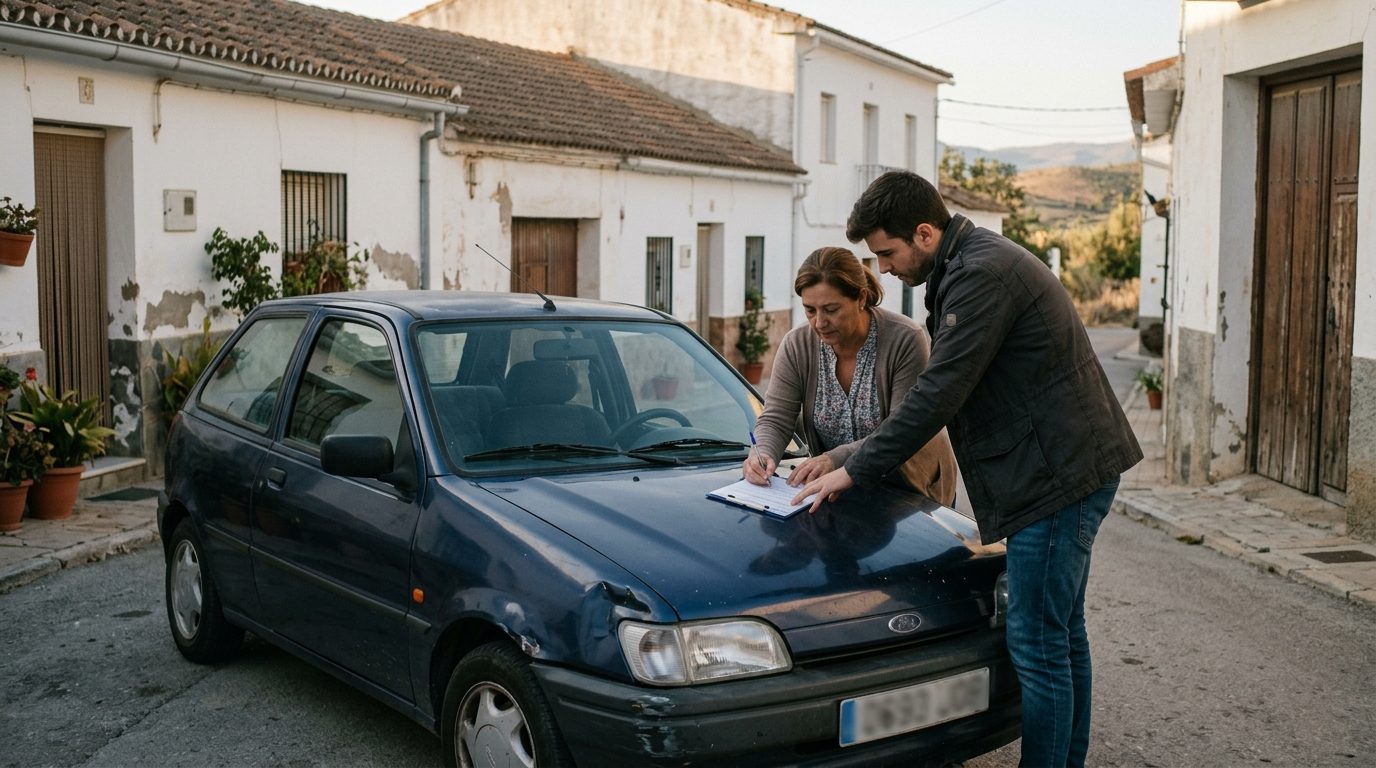
Minor collisions in Spain are normally settled with the parte amistoso, officially the declaración amistosa de accidente (DAA), a joint report both drivers fill in at the scene. Keep a blank copy in the glovebox; your insurer can give you one, and many insurers also offer a digital version in their app.
- Make the scene safe: hazard lights, high-visibility vest and the V-16 warning light, and move the cars if they block traffic and nobody is hurt.
- Call 112 if anyone is injured or if the other driver refuses to cooperate.
- Fill in one DAA together: both drivers’ details, insurers and policy numbers, a sketch and the boxes that describe what happened. Both sign, and each keeps a copy.
- Do not sign anything you do not understand. If your Spanish is limited, write your version in your own language in the observations box.
- Take photos of the cars, plates, the road and any witnesses’ details.
- Report the accident to your insurer within 7 days, the general deadline in the Spanish insurance contract law, unless your policy gives you longer.
When both drivers sign the same DAA, the insurers can usually settle the claim quickly between themselves. If the other party disagrees or drives away, call the police so they can write a report.
Checking whether a vehicle is insured (FIVA)
Spain keeps a central database of insured vehicles called FIVA (Fichero Informativo de Vehículos Asegurados), managed by the Consorcio de Compensación de Seguros. Police use it at roadside checks, and it is updated daily.
Private individuals cannot search it freely online. If you have been in an accident and need to know the other vehicle’s insurer, you can apply to the Consorcio with the request form and a copy of the accident report or DAA. RACE explains the procedure and other ways to check. If the vehicle turns out to be uninsured or unidentified, the Consorcio can compensate you directly.
Tips for buying a policy
- Read the exclusions: check driving abroad, named drivers and what happens if an undeclared driver has an accident.
- Watch the renewal: policies renew automatically each year. To cancel, notify the insurer in writing before the renewal date.
- Keep proof in the car: police check insurance through FIVA, but carrying the receipt or a digital copy avoids discussions.
- Use a broker if needed: an independent corredor can compare insurers that accept foreign licences and foreign no-claims statements.
Useful links
- BOE: Law 5/2025 on motor liability insurance (consolidated text, Spanish)
- Your Europe: car insurance validity in the EU and claims history
- RACE: how to check if a car is insured (Spanish)
- Understanding insurance in Spain
- Driving in Spain: licence rules for EU, UK and non-EU drivers
- Registering a foreign car in Spain
FAQ: car insurance in Spain
Do I need insurance if my car is parked and not used?
Yes. A vehicle registered in Spain must have compulsory liability insurance even when it is not driven, unless it has been formally deregistered with the DGT.
Will a Spanish insurer accept my no-claims bonus from home?
Many will take it into account if you provide a claims history statement from your previous insurer, but they are not obliged to give a discount. Ask before you buy and compare several offers.
Do UK drivers need a green card in Spain?
No. The green card requirement for UK-insured vehicles in the EU ended on 2 August 2021. You still need valid insurance and should carry proof of it.
How long do I have to report an accident?
The general legal deadline is 7 days from the accident, unless your policy allows longer. Report it as soon as possible, even if you missed the deadline.
Disclaimer: This article is general information only and is not legal or insurance advice. Rules, cover and prices can change – always read your policy conditions and check with the insurer, a registered broker or the official source before you act.
Updated: October 2026
Spain has one of the best public health systems in Europe – but as a foreign resident you only get access once you are registered in the right way. How you qualify depends on whether you work, receive a pension or live on your own income. Here is how it works in 2026, step by step.
Who can use the public health system?
- Employees and self-employed (autónomos): you are covered through your social security contributions, and so are your registered family members.
- EU pensioners: register your S1 form from your home country with the Spanish social security (INSS). Your home country then pays for your care in Spain.
- Residents without work or S1: you can join the public system by paying a monthly fee through the convenio especial – after at least one year of registration on the padrón. The national fee is around €60 per month under 65 and €157 from 65, and some regions run their own schemes.
- Visitors and new arrivals: EU citizens on a short stay can use their European Health Insurance Card (EHIC). Others need travel or private insurance.
How to register – step by step
- Get your NIE and padrón – you need both for almost everything. See how to get your NIE.
- Get your social security number – your employer usually arranges it, or you apply yourself at the social security office.
- Apply for recognition of your right to healthcare at the INSS (online or by appointment), with your S1 form if you are a pensioner.
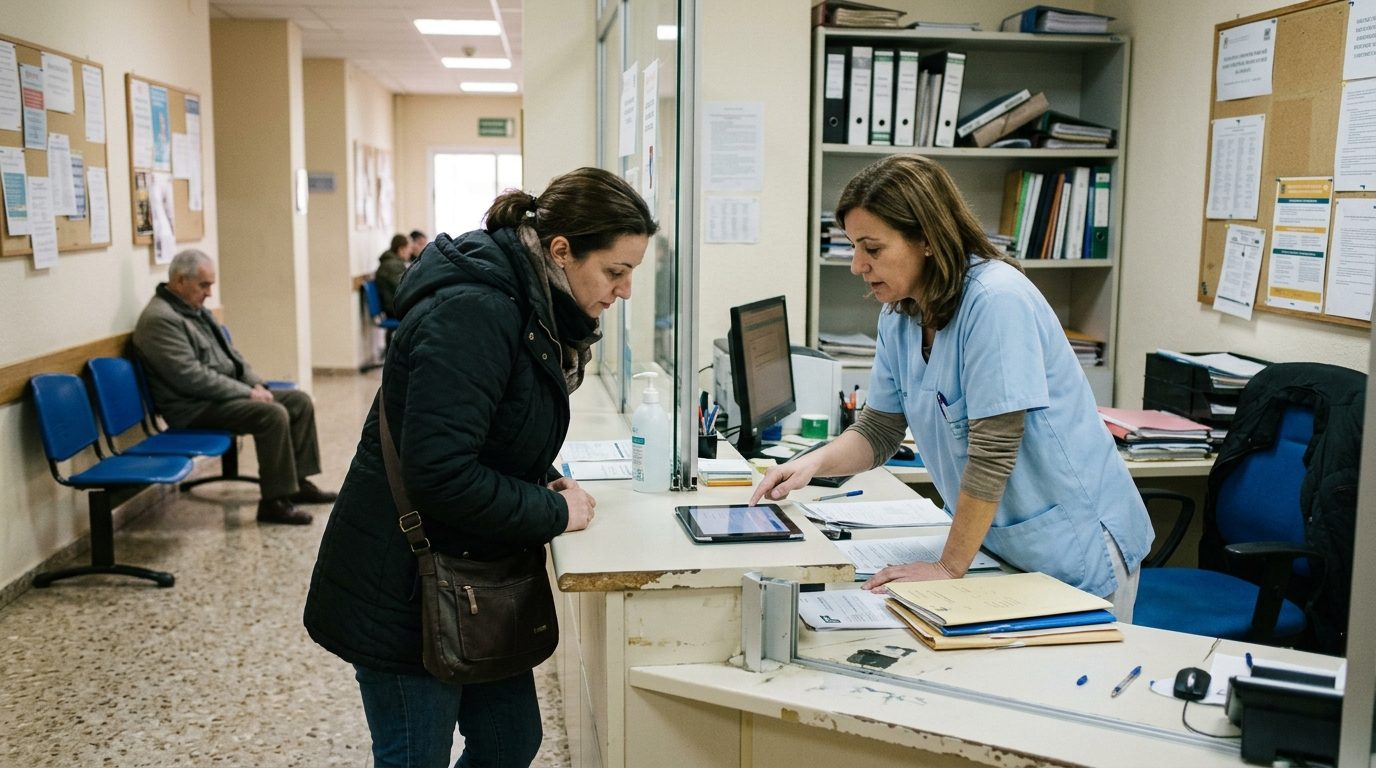
- Register at your local health centre (centro de salud) with your passport, NIE, padrón and INSS document. You will be given a family doctor.
- Receive your health card (tarjeta sanitaria individual) by post or at the health centre. Download your region’s health app to book appointments.
Public or private health insurance?
- Public: free at the point of use (prescriptions have a co-payment based on income). Waiting lists for specialists can be long.
- Private: faster access to specialists and English-speaking doctors. Many expats combine both. Policies typically cost €50–150 per month per adult, depending on age and cover.
- For visas: non-lucrative, digital nomad and student visas require private insurance with full cover and no co-payments (sin copagos) unless you are covered by social security.
Emergencies
Call 112 for any emergency – operators often speak English. Public hospital emergency departments (urgencias) treat everyone; if you are not covered, you may receive a bill afterwards.
FAQ: healthcare in Spain
Is healthcare free in Spain for foreigners?
It is free at the point of use if you are covered through work, an S1 form or the convenio especial. Otherwise you need private insurance.
Can I keep using my EHIC card when I live in Spain?
No. The EHIC is for temporary stays. Once you live in Spain you must register in the Spanish system or have private insurance.
How do I find an English-speaking doctor?
In tourist areas many public and private doctors speak English. Private insurers list English-speaking doctors in their apps.
Do I pay for medicines?
Yes, a share. Working-age patients pay 40–60% depending on income, and pensioners usually pay 10% with a monthly cap.
Useful links
- Spanish social security (INSS)
- Official directory of public health centres
- Mental health support for expats
Disclaimer: This article is general information only. Rules and fees differ between regions and can change – always check with the INSS or your regional health service.
Insurance
Understanding insurance in Spain: a 2026 guide for expats
Health, car, home, life, travel and pet insurance in Spain explained: what is compulsory in 2026, brokers vs agents and how to compare policies.

Updated: October 2026
Insurance in Spain works a little differently from what many newcomers are used to: some covers are compulsory, some are tied to a mortgage or a visa, and others are simply very popular locally. This guide explains the main types of insurance, what is required by law in 2026, the difference between a broker and an agent, and how to compare policies without paying for cover you do not need.
What is compulsory and what is optional
| Insurance | Required? | Notes |
|---|---|---|
| Car (third-party liability) | Yes, for every vehicle registered in Spain | Even if the car is parked and not used |
| E-scooters and personal mobility vehicles | Yes, liability cover since January 2026 | Linked to a new DGT registry for these vehicles |
| Health | Only in some cases | Needed for some visas and residence permits if you are not in the public system |
| Home | Not by law | Building damage cover is required by mortgage lenders |
| Dogs (liability) | Only for potentially dangerous breeds so far | General obligation for all dogs awaits implementing rules |
| Life, travel, funeral, accident | No | Optional, but often sold with mortgages and loans |
Health insurance
If you work in Spain, are self-employed or receive a pension that gives you rights here, you are covered by the public health system; see our guide to healthcare for foreign residents. Many expats still add private cover to get faster specialist appointments and English-speaking doctors. Public waiting lists are real: the Ministry of Health reported an average wait of around 121 days for planned surgery at the end of 2025, with large differences between regions.
If you apply for certain residence permits without access to the public system, such as non-lucrative residence, consulates and immigration offices usually require a private policy from an insurer authorised in Spain, with cover comparable to the public system and typically no co-payments and no waiting periods. Check the exact wording required before you buy; see our residency guide.
- Co-payment (copago): a small fee per visit; makes the premium cheaper.
- Waiting periods (carencias): time before some services are covered, often for maternity, surgery or hospital stays.
- Pre-existing conditions: often excluded; declare them honestly, or a claim can be refused.
- Age: premiums usually rise with age, and some insurers do not accept new customers above a certain age.
Car and e-scooter insurance
Every vehicle registered in Spain must have at least compulsory third-party liability insurance (seguro obligatorio), even if it is not driven. The common levels of cover are:
- Terceros: third-party liability only, the legal minimum plus usually legal defence.
- Terceros ampliado: adds items such as glass, theft and fire.
- Todo riesgo: fully comprehensive, also covering damage to your own car, often with an excess (franquicia) to lower the price.
Insurers price on your Spanish claims history, so ask your previous insurer abroad for a no-claims certificate, ideally translated. Since January 2026, owners of electric scooters and other personal mobility vehicles must also hold liability insurance under Law 5/2025, linked to a new DGT registry. For driving rules, see our driving licence guide.
Home, life and other common covers
Home insurance
Home insurance (seguro de hogar) is not compulsory by law, but if you have a mortgage the lender will require cover for damage to the building. You are not obliged to buy it from the bank; you can choose an equivalent policy elsewhere. In apartment blocks the community of owners normally insures the building, so owners often only need contents and liability cover. Tenants should consider contents and liability cover too; see our guide to renting in Spain.
Damage from floods, earthquakes and other extraordinary events is normally paid not by your insurer but by the Consorcio de Compensación de Seguros, a public body funded through a small surcharge included in most home and car policies. It also steps in for accidents caused by uninsured or unidentified vehicles. This is why having a valid policy matters even in a natural disaster.
Life, funeral and accident insurance
- Life insurance (seguro de vida): banks often push it with a mortgage. Compare it with independent offers, and check whether you can change policy later.
- Funeral insurance (seguro de decesos): very common in Spain, much more than in Northern Europe. It pays and organises the funeral, and some policies include repatriation of remains to your home country.
- Accident insurance: pays fixed amounts for injury or disability; popular with self-employed people and active retirees.
Travel and pet insurance
Annual multi-trip travel insurance suits residents who travel often. EU residents can use the European Health Insurance Card in other EU countries, but the European Commission stresses it is not a replacement for travel insurance. For dogs, the 2023 animal welfare law includes a liability insurance obligation, but it cannot be enforced until implementing regulations set the details; owners of potentially dangerous breeds already need liability cover, and some regions and towns set their own rules.
Broker, agent or bank?
You can buy insurance directly from an insurer, through an agent who represents one company (or a few), through a broker (corredor) who works independently with several insurers, or through your bank.
- Broker: can compare several insurers and move your policy if prices rise. Ask how they are paid, since commissions differ between companies.
- Agent: knows one insurer well and can be a direct contact when you claim, but offers less choice.
- Bank: convenient, but often more expensive and sometimes linked to better loan conditions. Do the maths before accepting.
Insurance distributors must be registered. In Andalusia the regional consumer service explains the register of agents and brokers, which is public and connected to the national register kept by the Dirección General de Seguros y Fondos de Pensiones (DGSFP).
How to compare policies
- Decide what you really need to cover, based on your residence status, home, car and family situation.
- Ask for the general and particular conditions (condiciones generales y particulares) and read the exclusions, not just the summary.
- Compare excesses, waiting periods, cover limits and whether you can choose your own doctor or repair shop.
- Check the renewal terms: most policies renew automatically each year, and you must give written notice before the renewal date if you want to cancel.
- Ask for documents in English if your Spanish is limited, but remember the Spanish version is usually the legally binding one.
The cheapest offer rarely gives the best protection. If a claim is refused, complain in writing to the insurer’s customer service department first; if that does not solve it, you can take the complaint to the DGSFP.
Useful links
- Consumo Responde (Junta de Andalucía): register of insurance agents and brokers
- RACE: what the Consorcio de Compensación de Seguros covers
- European Commission: what the EHIC covers
- Healthcare in Spain for foreign residents
- How to become a resident in Spain
FAQ: insurance in Spain
Which insurance is compulsory in Spain?
Third-party liability for cars and other motor vehicles, liability cover for e-scooters since January 2026, and liability for potentially dangerous dogs. Health insurance is required for some visas and permits.
Do I have to buy home and life insurance from my mortgage bank?
No. The lender can require building damage cover, but you can choose an equivalent policy from another insurer. Life insurance is optional, although banks may offer better loan terms if you take it.
Who pays for flood damage?
Damage from extraordinary events such as floods is usually paid by the Consorcio de Compensación de Seguros, but only if you have a valid home or car policy that includes its surcharge.
How do I cancel a policy in Spain?
Most policies renew automatically. Send written notice to the insurer before the renewal date, keep proof that it was received, and check the notice period in your conditions.
Disclaimer: This article is general information only and is not legal, financial or insurance advice. Rules, cover and prices can change – always read the policy conditions and check with the insurer or an authorised broker before you sign.

Floods, DANA storms and weather warnings in Spain: how to prepare and stay safe

Car insurance in Spain for expats in 2026: what you need to know

How to register on the padrón in Spain in 2026 (empadronamiento)

Understanding the tax system in Spain

Andalucía guide: cities, culture and life in southern Spain

Marbella guide: areas, beaches and everyday life
-

 Banking & Finances2 years ago
Understanding the tax system in Spain
-
Tourist Info2 years ago
Andalucía guide: cities, culture and life in southern Spain
-
Tourist Info2 years ago
Marbella guide: areas, beaches and everyday life
-
Legal Requirements & Documentation2 years ago
How to get your Spanish NIE number in 2026 – step by step
-
Cost of Living2 years ago
Living on a small salary in Spain in 2026
-
Legal Requirements & Documentation2 years ago
Residency in Spain 2026: how to become a legal resident – step by step
-
Legal Requirements & Documentation2 years ago
Work visa and work permit in Spain 2026 – which one you need and how to apply
-
Housing & Utilities1 year ago
Tvmate Pro app & Streambox 4K media box for expats in Spain