Embassies & Consulates
Lost or stolen passport in Spain: what to do next
Lost your passport in Spain? How to report it to the police, get an emergency travel document or new passport, and sort out your NIE and TIE.









Updated: October 2026
Losing your passport is stressful, whether you are on holiday or have lived in Spain for years. The good news is that the process is well established and, if you act in the right order, you can usually travel again within days. This guide covers the police report, the choice between an emergency travel document and a full replacement passport, consulate appointments and what it means for your NIE and TIE.
First steps in the first 24 hours
- Search properly: retrace your steps and ask your hotel, restaurant, taxi company or the local lost property office (oficina de objetos perdidos) at the town hall. Passports handed in are often passed on to the police or the consulate.
- Report it to the police: file a report (denuncia) at a Policía Nacional station (comisaría). In smaller towns the Guardia Civil may take the report instead.
- Report it to your own country: most countries require you to cancel a lost passport, often online. Once cancelled, the passport cannot be used again even if you find it.
- Contact your embassy or consulate: book an appointment or apply online for an emergency document or new passport.
- Protect yourself: if your wallet or phone went missing too, block cards and change passwords straight away.
The police report (denuncia)
A police report is the document that proves your passport was lost or stolen, and most consulates, airlines and Spanish offices will ask for it. Spanish police stations are open every day, around the clock, in the larger towns. Bring any ID you still have, such as a driving licence, residence card or a photocopy or photo of your passport.







If you do not speak Spanish, ask whether an interpreter or a multilingual form is available; popular tourist areas such as the Costa del Sol are used to handling reports in English and other languages. Read the report before you sign it and keep the copy you are given – it is the only official record you will have until your new document arrives.
The Spanish government’s guidance on lost passports also stresses that a declaration made at a consulate is not the same as a police report, so do both.
Emergency travel document or new passport?
Your choice depends on how soon you need to travel and whether you live in Spain or are just visiting.
| Option | Best for | Things to know |
|---|---|---|
| Emergency travel document | Visitors and residents who must travel within days | Usually valid for one specific journey only; check it is accepted in every country you will pass through |
| Emergency or provisional passport | Urgent cases where a travel document is not enough | Issued in exceptional cases by some countries; may not have a biometric chip |
| Full replacement passport | Residents in Spain with no urgent trip | Takes longer but is valid for normal travel and for Spanish paperwork |
Example: British citizens
British nationals outside the UK who need to travel within six weeks and cannot replace their passport in time can apply online for an emergency travel document. According to GOV.UK, the fee is £125, it is usually processed in around two working days, and the document normally covers a single or return journey through up to five countries. The application page lists what you need: a digital photo, a phone number, an email address and a card for the fee. British residents in Spain who are not in a hurry should instead apply for a full replacement passport online.







EU and other nationals
Most EU countries have an embassy in Madrid and consulates or honorary consuls in the main coastal areas, and they issue their own emergency passports or travel documents. Procedures, fees and processing times vary a lot, so check your country’s consular website or our guide to embassies and consulates in Spain to find the right office. EU citizens can often travel home within the Schengen area with a national ID card if they have one, but airlines decide what they accept at boarding, so check with them first.
Your consulate appointment
Many consulates now work by appointment only and some handle everything online. Before you go, prepare:
- the police report (original and copy)
- passport photos that meet your country’s rules
- any other ID: national ID card, driving licence, Spanish residence card, birth certificate
- proof of travel plans if you need an emergency document (ticket or booking)
- a payment card for the fee
For children, both parents may need to give consent, so ask the consulate in advance. If you are stuck without money or accommodation, consulates can usually advise on emergency options but will not pay your costs.
What it means for your NIE and TIE
Your NIE number stays the same for life, so a new passport does not change it. Read how the NIE works if you need a reminder. However, your new passport will have a new number, and that can cause small mismatches:
- Banks, notaries and employers: give them a copy of the new passport so your file is up to date.
- Residence documents: when you next renew or update your TIE or EU registration certificate, bring both the new passport and the police report for the old one. This avoids questions if the old number appears in your file.
- Lost TIE as well: if your residence card was stolen with your passport, you need a duplicate. This normally means a police report, the EX-17 form, the 790 code 012 fee, a photo and an appointment at the foreigners’ office (Oficina de Extranjería) or police.
- Travel while waiting: non-EU residents should not leave Spain without both a valid passport and a valid TIE or proof of residence, or they may have trouble re-entering.
For more on residence cards and status, see our guide to residency in Spain.
Travelling home
Before you book or rebook a flight, confirm with the airline that it accepts your emergency document. Check the rules for every country you will transit, not only your final destination. Keep the police report with you while travelling – border officers may ask for it. If your old passport turns up later, do not use it: once reported lost or stolen, it has been cancelled.
How to avoid it next time
- Keep a scan of your passport and residence card in a secure cloud folder.
- Carry your residence card or a copy for daily ID and leave the passport in a safe place at home.
- Be extra careful in busy tourist spots, stations and at the airport, where pickpockets operate.
- Note your consulate’s address and emergency details before you need them.
Useful links
- Spanish government – lost passports (Your Europe Spain)
- GOV.UK – emergency travel document
- GOV.UK – how to apply for an emergency travel document
- Embassies and consulates in Spain: how to find yours
- How to get your Spanish NIE number
- Residency in Spain: how to become a legal resident
FAQ: lost passport in Spain
Do I need a police report to get a new passport?
Most consulates ask for one, especially if the passport was stolen, and it is useful for Spanish offices and insurance claims. Get it as early as possible.
Will I get a new NIE with my new passport?
No. Your NIE stays the same. You only need to update your passport details with banks, employers and the immigration office when relevant.
Can I fly within Spain without a passport?
Airlines usually accept a valid Spanish residence card or EU national ID card on domestic flights, but rules vary by airline. Check before you go to the airport.
What if I find my old passport after reporting it?
Do not travel on it. A passport reported lost or stolen is cancelled and can cause problems at borders. Hand it to your consulate or follow your country’s instructions.
Disclaimer: This article is general information only and is not legal advice. Consular fees, rules and processing times change – always check with your own embassy or consulate and the official sources before you act.
Embassies & Consulates
Voting from Spain: home country elections and Spanish local elections for expats
How expats in Spain can vote in home elections by post, proxy or at the embassy – and register for the May 2027 Spanish local elections.

Updated: October 2026
Moving to Spain does not have to mean losing your voice in politics. Many expats can keep voting in their home country, and EU citizens – plus British nationals and some others – can also vote in Spanish local elections. This guide explains the main ways to vote from abroad, gives an overview of the rules for several common nationalities, and shows how to register for the Spanish municipal elections on 23 May 2027.
How voting from abroad usually works
Every country sets its own rules, but most use a combination of the same four methods:
- Overseas registration: you register as a voter living abroad, usually against your last home address or with a central office.
- Postal vote: ballot papers are posted to your address in Spain and you send them back. Post between Spain and your home country can be slow, so return them as soon as they arrive.
- Proxy vote: someone you trust votes on your behalf at home. This is often the safest option when the time between ballots being sent and election day is short.
- Embassy or consulate voting: some countries let you vote in person – often early – at their embassy or consulate in Spain.
It also helps to register with your consulate where that is possible. It does not always count as voter registration, but it means you receive notices about elections and other important changes. Use our guide to embassies and consulates in Spain to find yours.
Rules for some common nationalities
The summaries below are a starting point only. Always check your own government’s election website before each election, as deadlines and procedures change.
United Kingdom
Since 16 January 2024, the old rule that British citizens lost their vote after 15 years abroad has been abolished. You can register as an overseas elector however long you have lived in Spain, as long as you were previously registered or lived in the UK. You register online through the GOV.UK “Register to vote” service, using the address where you were last registered or last lived.
- Overseas electors can vote in UK Parliamentary general elections, not in local elections.
- Your registration lasts up to three years, after which you must renew it. Postal and proxy arrangements must be renewed at the same time.
- Many councils recommend a proxy vote rather than a postal vote, because ballots are sent only around two weeks before polling day.
Germany
Germans abroad who are not registered at a German address must apply to be added to the voter register for each Bundestag election, using an official form sent to their last municipality in Germany. In general you qualify if you lived in Germany for at least three uninterrupted months after your 14th birthday and within the last 25 years, or if you can show personal familiarity with German politics. The application must arrive no later than 21 days before the election, and voting is by post.
Netherlands
Dutch citizens abroad register once as a voter with the municipality of The Hague. After that, the voting documents for each election are sent to you. You can vote by post in elections for the House of Representatives (Tweede Kamer), the European Parliament and the electoral college for non-residents for the Senate.
Denmark and Sweden
Danish rules are stricter. In general, Danes who move abroad keep the right to vote in Folketing elections only in specific situations, for example if they intend to return within two years, are posted abroad by a Danish employer or public body, or are abroad for study or health reasons. Swedes abroad can generally vote in Riksdag elections by post or in person at a Swedish embassy or consulate before election day, but not on election day itself. Both countries have their own registration rules, so check the official Danish and Swedish election websites well before each election.
Voting in Spanish elections as a foreign resident
Foreign residents cannot vote in Spanish general or regional elections. However, many can vote in municipal (local) elections and, for EU citizens, in European Parliament elections. The next municipal elections are on 23 May 2027.
EU citizens: register by 30 December 2026
To vote in the 2027 local elections, EU citizens must be on the padrón and must have formally declared that they want to vote in Spain. According to the INE electoral census office, the deadline is 30 December 2026. You can declare your wish to vote:
- online at the INE electronic office with Cl@ve
- online with the access code (CTT) in the letter the census office sent in late September 2026, available until 30 December 2026
- by posting back the signed letter, with no stamp needed
- in person at your town hall, using form DFA
If you have declared your wish to vote for an earlier municipal election and still live in Spain, you are normally already on the roll. The INE press release of 30 September 2026 says more than 345,000 EU citizens were already registered, and over 515,000 letters were sent to those who were not – around 38,000 of them in Málaga province. Not on the padrón yet? Read our guide to registering on the padrón first.
British and other non-EU nationals with agreements
Spain has reciprocal agreements with a small group of countries, including the United Kingdom, Norway, Iceland, New Zealand and several Latin American countries. Nationals of these countries can vote in municipal elections if they hold a Spanish residence permit, are on the padrón and have lived in Spain legally for a minimum period – three years for British and Norwegian citizens and five years for most others. They must apply to be included on the electoral roll, usually at the town hall. For the 2023 elections the deadline was 15 January; for 2027, reports point to a window from 1 December 2026 to 15 January 2027. Confirm the exact dates with your town hall.
CERA, CERE and European elections
You may see two acronyms. CERA is the roll of Spanish citizens living abroad – it is not for foreign residents. The roll for foreigners living in Spain is often called CERE. For European Parliament elections, EU citizens in Spain choose whether to vote for Spanish MEPs here or for their home country’s MEPs, but you may only vote once. The next European elections are expected in 2029.
Practical tips
- Put renewal dates for your overseas registration in your calendar – missing one usually means starting again.
- Keep your address up to date with both your home election office and your Spanish town hall.
- Choose a proxy or embassy voting if your country’s postal ballots often arrive late in Spain.
- Join local expat or community groups – they often share reminders before elections. See our guide to building a social life in Spain.
Useful links
- INE – electoral roll of foreign residents for the 2027 municipal elections
- INE – press release on EU citizens and the 2027 municipal elections
- Government of the Netherlands – voting from outside the Netherlands
- Embassies and consulates in Spain: how to find yours
- Residency in Spain: how to become a legal resident
FAQ: voting from Spain
Can I vote in Spanish general elections as a foreign resident?
No. Only Spanish citizens can vote in general and regional elections. Foreign residents can vote in municipal elections if they meet the conditions, and EU citizens also in European elections.
Do I need to register again for every Spanish local election?
EU citizens who have already declared their wish to vote stay on the roll as long as they remain on the padrón. If you move town, make sure your padrón registration moves with you.
Can I vote in both Spain and my home country?
Yes, for different elections – for example Spanish local elections and your home country’s national elections. For European Parliament elections, you can only vote in one country.
I have lived in Spain for over 15 years. Can I still vote in UK elections?
Yes. The 15-year limit was removed in January 2024, so you can register as an overseas elector for UK Parliamentary elections.
Disclaimer: This article is general information only and is not legal advice. Election rules and deadlines change – always check with your home country’s election authority, your consulate or your Spanish town hall before you act.
Embassies & Consulates
Foreigners in Spanish prisons: what families need to know
A guide for families of a foreigner arrested or jailed in Spain: key figures, arrest rights, lawyers, transfer home, visits, money and the consulate.
Updated: October 2026
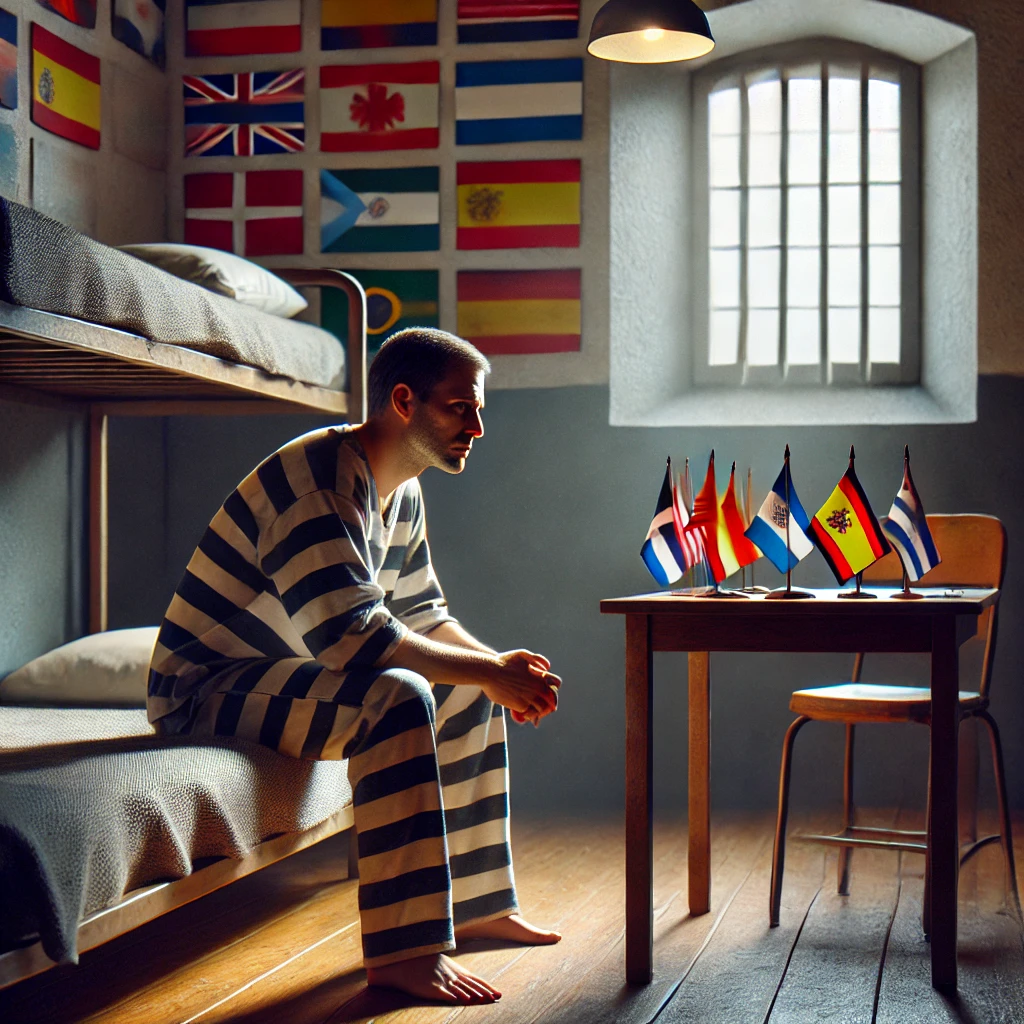
When a foreign national is arrested in Spain, the family often finds out late, from far away and in a language they do not understand. This guide is for parents, partners and friends of a foreigner who has been arrested or imprisoned in Spain. It explains how common this situation is, what happens in the first days, why the choice of lawyer matters so much for foreigners, and how to stay in contact with someone inside a Spanish prison.
Foreign prisoners in Spain: the numbers
You are not alone. Spain’s prison population reached 62,522 people at the end of 2025, according to year-end figures from the prison administrations reported in January 2026. Spain has two main prison systems: the state system run by the Ministry of the Interior’s Secretaría General de Instituciones Penitenciarias (SGIP), and Catalonia, which runs its own prisons. The Basque Country has also managed its own three prisons since 2021.
Foreigners make up around one in three prisoners. Instituciones Penitenciarias data for 2025 counted 20,524 foreign inmates, or 33.2% of the prison population, while foreigners are about 14.5% of the general population. Moroccan nationals are by far the largest group (6,188 in August 2025, about 10% of all prisoners), followed by Colombians and Algerians. Romania, the Dominican Republic, Ecuador, Peru, Senegal, Brazil and Albania are also among the most common nationalities. In Catalonia the share is even higher: the Council of Europe’s SPACE I report found that 52% of prisoners in Catalan prisons were foreign nationals in early 2025, against 29% in the state system.
| Indicator | Figure | Source and date |
|---|---|---|
| Total prison population | 62,522 | Prison administrations, end of 2025 |
| State system (SGIP, 80 centres) | 51,559 | End of 2025 |
| Catalonia (13 centres) | 9,186 | End of 2025 |
| Basque Country (3 centres) | 1,777 | End of 2025 |
| Foreign inmates | 20,524 (33.2%) | Instituciones Penitenciarias, 2025 |
| Moroccan inmates | 6,188 (about 10%) | Instituciones Penitenciarias, August 2025 |
| Foreign share in Catalan prisons | 52% | Council of Europe SPACE I, January 2025 |
| Foreign share in state prisons | 29% | Council of Europe SPACE I, January 2025 |
| Pre-trial detainees (all prisoners) | 17.6% | World Prison Brief / Council of Europe, 31 January 2025 |
| Imprisonment rate | 121 per 100,000 inhabitants | World Prison Brief, January 2025 |
Statistics count nationality, not country of birth, so people who have become Spanish citizens are counted as Spanish. Foreigners are also more likely to be held in pre-trial detention, because judges often see a higher risk that a person without strong ties to Spain will leave the country.
What happens after an arrest
After an arrest, the police (Policía Nacional, Guardia Civil, Mossos d’Esquadra in Catalonia or Ertzaintza in the Basque Country) may hold a person only for the time strictly needed to investigate, and never more than 72 hours. Within that time the person must be released or brought before a judge. In practice most people see the duty judge within one or two days.
During police custody a foreign detainee has the right to:
- A lawyer: a private lawyer of their choice or a free duty lawyer (abogado de oficio) appointed by the bar association.
- A free interpreter: for interviews, the court hearing and key documents, if they do not understand Spanish.
- Information: to be told the reason for the arrest and their rights in a language they understand.
- Contact: to have a relative or another person told about the arrest and where they are held, and to have their consulate informed.
- Silence: to stay silent, not to make a statement and not to sign anything they do not understand.
At the court hearing the judge decides between release, release with conditions (for example handing in the passport and reporting to court regularly), release on bail (fianza), or prisión provisional (pre-trial detention). Pre-trial detention is meant to be the exception, but for a foreigner with no address, job or family in Spain the risk of flight weighs heavily. This is the first moment where a well-prepared lawyer can make a real difference, for example by showing an address, a job offer or family ties in Spain.
Why a specialised lawyer matters for foreigners
A free duty lawyer is always available, and people with limited income can apply for justicia gratuita (free legal aid) for the whole case. Many duty lawyers do good work, but they are assigned by rota, handle many cases and may not speak your language. For foreigners the case is rarely only about the criminal charge. A lawyer who knows both criminal and penitentiary law, and the immigration side, can protect options that are easily lost.
What a specialised lawyer can do:
- Challenge detention: appeal pre-trial detention and ask for release with conditions or bail.
- Defend the case: review the evidence, the interpretation and the legality of searches, and negotiate where this is in the client’s interest.
- Prison life: request leave (permisos de salida), progression to open regime (tercer grado) and conditional release (libertad condicional), and appeal refusals before the prison supervisory judge (juez de vigilancia penitenciaria).
- Transfer home: prepare a request to serve the sentence in the home country. Within the EU this works under Framework Decision 2008/909/JHA. For many other countries it works under the Council of Europe Convention on the Transfer of Sentenced Persons or bilateral treaties.
- Expulsion instead of prison: under Article 89 of the Spanish Criminal Code, prison sentences of more than one year imposed on a foreign national can be replaced, fully or partly, by expulsion from Spain with a ban on returning. Whether this is good or bad depends entirely on the person’s life and family in Spain, so it needs careful advice. EU citizens can only be expelled on stricter public security grounds.
- Immigration consequences: a conviction and criminal record can affect residence permits, renewals, long-term residence and citizenship applications. A good lawyer looks at these from day one.
For families abroad, GC Libertad specialises in legal help for foreigners in Spanish prisons and their families. The team works with experienced criminal and penitentiary lawyers on the Costa del Sol, in Madrid and in Seville, speaks your language, and helps with the practical side too: finding out where your loved one is held, getting money and documents to the prison, arranging bail payments and keeping you informed. It is a good first call if you want to understand your options before you commit to a lawyer.
Whoever you choose, check that the lawyer is registered with a Spanish bar association (Colegio de Abogados), ask for a written fee agreement (hoja de encargo) and be careful with large payments in advance. Our guide to lawyers in Spain explains how to check credentials.
Finding the prisoner and staying in contact
Families are often not told directly where someone has been taken. Collect the full name, date of birth, nationality, passport or NIE number, and if possible the court and case number (número de diligencias or procedimiento). Then try:
- The lawyer who attended the court hearing: they know the decision and usually the prison.
- Your consulate: if the detainee agreed, the consulate is informed and can confirm the detention to family.
- The duty court (juzgado de guardia) where the arrest took place.
- The prisons themselves: state prisons, Catalan prisons and Basque prisons are run separately, so contact the administration for the region where the arrest happened.
Once you know the prison, contact works in much the same way across Spain, although timetables and booking systems differ:
- Authorised list: the prisoner must put you on their list of visitors and phone numbers. Relatives may need to prove the relationship, and foreign certificates may need translation.
- Comunicaciones orales: short visits through glass (locutorio), normally every week, booked in advance. Bring a valid passport or ID card.
- Vis a vis: longer visits in a private room, either family visits, intimate visits with a partner, or longer “convivencia” visits with a partner and young children. These are usually monthly and must be requested.
- Phone calls: prisoners cannot receive calls. They call authorised numbers a limited number of times per week, so give a number you will always answer, including an international one.
- Letters: you can write freely. Add the full name and, if known, the module.
- Money (peculio): prisoners use an internal account for phone calls, shop items and hygiene products. Families can usually pay in by bank transfer or at the prison. Ask the prison for the current method and limits.
- Parcels and clothes: rules are strict and vary by prison, so check before you send anything.
Every prison also has a social worker (trabajador social) who can help with family contact, documents and preparing for release. Ask the prisoner to request an appointment.
What the consulate can and cannot do
A consulate can visit or contact the prisoner, check on their health and treatment, pass on messages with their consent, give a list of local lawyers and interpreters, and explain how a transfer home works. It cannot get anyone released, interfere in the court case, give legal advice, or pay for lawyers, bail or fines. Services differ a lot between countries, so check your foreign ministry’s pages on prisoners abroad. Our guide to embassies and consulates in Spain helps you find yours.
| Who | What they do | What they do not do |
|---|---|---|
| Lawyer | Defends the case, appeals detention, requests bail, leave, tercer grado, conditional release and transfer, advises on expulsion and immigration | Cannot guarantee an outcome |
| Consulate | Welfare visits, contact with family, lists of lawyers, information on transfer | No legal advice, no payment of fees, bail or fines |
| Prison social worker | Family contact, documents, social reports, release planning | Does not handle the criminal case |
| Family | Finds a lawyer, sends money, visits, writes, gathers documents showing ties to Spain or home | Should not discuss case details on prison phone lines |
Practical tips for families abroad
- Keep one file: case number, court, prison, lawyer, consulate contact and a log of every call and payment.
- Get documents ready: proof of address, work, family and income can help with bail, legal aid, leave and transfer. Official documents from abroad may need an apostille and a sworn translation.
- Language: ask for a lawyer or helper who speaks your language, and do not sign fee agreements you do not understand.
- Plan visits: book before you travel and confirm that you are on the authorised list.
- Look after yourself: cases can take months or years. Our guide to mental health support for expats in Spain lists where to find help.
If your relative lived in Spain, a sentence can also affect their right to stay. Read our overview of immigration rules in Spain and residency in Spain for background.
Get help
If someone close to you has been arrested or is in prison in Spain, contact GC Libertad for specialised legal and practical help for foreign prisoners and their families.
Useful links
- Lawyers in Spain: how to find the right one
- Embassies and consulates in Spain
- Immigration rules in Spain 2026
- Mental health support for expats in Spain
FAQ: foreigners in Spanish prisons
How long can the police hold a foreigner before they see a judge?
No longer than strictly necessary and never more than 72 hours. The person must then be released or brought before a judge.
Does a foreigner get a free lawyer and interpreter in Spain?
Yes. A duty lawyer is appointed if the person does not choose their own, and an interpreter is free. Legal aid for the whole case depends on income.
Can a foreign prisoner serve the sentence in their home country?
Often yes, once the sentence is final. EU transfers follow Framework Decision 2008/909/JHA, others follow the Council of Europe convention or bilateral treaties. Both countries must agree and it takes time.
Can a prison sentence be replaced by expulsion from Spain?
Under Article 89 of the Criminal Code, sentences over one year for foreign nationals can be replaced fully or partly by expulsion and a re-entry ban. A lawyer should assess whether this is in the person’s interest.
Will the consulate pay for a lawyer or bail?
No. Consulates can provide lists of lawyers and check on welfare, but they do not pay legal fees, bail or fines.
Disclaimer: This article is general information only and is not legal advice. Laws, prison rules and procedures can change and vary by prison – always get advice from a qualified criminal lawyer about a specific case.
Embassies & Consulates
Embassies and consulates in Spain: how to find yours
What embassies and consulates in Spain do, how to find yours, and which expat nationalities have a consulate in Málaga.

Updated: October 2026
Sooner or later most foreigners in Spain need their own country’s embassy or consulate – to renew a passport, register a birth or get help after an accident or arrest. This guide explains what embassies and consulates actually do, how to find the right office, and which major expat nationalities have a consulate in Málaga or on the Costa del Sol.
Embassy, consulate or honorary consul – what is the difference?
Spain hosts well over a hundred foreign embassies, and almost all of them are in Madrid. On top of that, many countries run consulates in other cities, and a large network of honorary consuls covers the coasts and islands.
- Embassy: the main diplomatic mission, led by the ambassador. It handles relations with the Spanish government and usually has a consular section for citizens.
- Consulate or consulate general: a career office staffed by diplomats or civil servants from your country. It deals with citizens’ affairs: passports, civil registry, notarial services and help in emergencies.
- Honorary consulate: run by a local representative, often part-time. Services are limited and vary by country – typically advice, help in emergencies, contact with local authorities and sometimes collecting documents or issuing emergency travel documents.
- Consular agency: a small outpost (the USA uses this model) with a narrow list of services, usually by appointment.
Most offices now work by appointment only, and many services (passport renewals in particular) are handled online or centrally, even if you live next door to a consulate.
What your consulate can and cannot do
Typical services
- New or replacement passports and emergency travel documents
- Registering births, marriages and deaths with your home country
- Notarial services, such as certifying documents or signatures
- Help if you are seriously ill, injured, the victim of a crime or arrested – including contact with family and lists of local lawyers and doctors
- Voting from abroad and registration as a resident overseas, depending on the country
What they will not do
A consulate cannot get you out of prison, pay your bills, give legal advice, interfere in Spanish court cases or sort out Spanish paperwork such as your NIE, TIE or residence card. Those go through Spanish offices – see our guide to becoming a resident in Spain. Visa questions for foreigners wanting to visit your home country also usually go to a separate visa service, not the consulate.
How to find your embassy or consulate
- Start with your own foreign ministry’s website. It lists the embassy in Madrid, every consulate and honorary consulate in Spain, opening hours and how to book.
- Check the official Spanish list. Spain’s Ministry of Foreign Affairs publishes the Lista Consular (PDF), a full list of foreign consular offices in Spain by country and city, updated several times a year.
- Save the emergency number. Most embassies run a 24-hour line for genuine emergencies. In any immediate danger in Spain, call 112 first.
- Book before you travel. Turning up without an appointment rarely works, and offices close on both Spanish local holidays and your home country’s holidays.
Major expat nationalities: embassy and Costa del Sol consulate
The table covers the nationalities we hear from most. All embassies are in Madrid. The right-hand column shows whether there is an office in Málaga province, based on official sources checked in October 2026.
| Country | Embassy | Consulate in Málaga / Costa del Sol |
|---|---|---|
| United Kingdom | Madrid | Yes – British Consulate Málaga (career consulate, covers Andalucía, Ceuta and Melilla; by appointment) |
| Ireland | Madrid | Yes – new Consulate General in Málaga announced in May 2026; check which services are running before you go |
| Germany | Madrid | Yes – Consulate in Málaga |
| Netherlands | Madrid | Not confirmed – check the Dutch embassy’s website for the nearest honorary consul |
| Denmark | Madrid | Yes – honorary consulate in Málaga city |
| Sweden | Madrid | Yes – honorary consulate in Málaga city |
| Norway | Madrid | Yes – honorary consulate in Málaga city (moved from Fuengirola in December 2025) |
| Finland | Madrid | Yes – honorary consulate in Málaga city |
| USA | Madrid (plus Consulate General in Barcelona) | Yes – consular agency in Fuengirola |
For British citizens, passport renewals are done online through HM Passport Office rather than at the consulate – the British Consulate Málaga page explains what the office handles. Ireland’s new Málaga post was announced by the Department of Foreign Affairs, with consular services due to start during 2026.
Scandinavian and Nordic consulates
Denmark, Sweden, Norway and Finland each have an embassy in Madrid and a wide network of honorary consulates, reflecting the large Nordic communities on the coasts and islands. Denmark alone lists honorary offices in cities such as Alicante, Almería, Barcelona, Bilbao, Málaga, Palma, Santa Cruz de Tenerife and Valencia, while Finland has honorary consuls in places including Barcelona, Las Palmas, Málaga and Torrevieja.
On the Costa del Sol, the Nordic honorary consulates are now gathered in the same office building on Calle Córdoba in central Málaga. Norway’s office moved there from Fuengirola and reopened on 22 December 2025, according to the Norwegian embassy. Honorary consuls have limited powers, so passport applications are usually handled by the embassy in Madrid or online – always ask before you travel.
Tips for dealing with consulates in Spain
- Register with your country: many countries let residents abroad register online so they can be contacted in a crisis.
- Keep copies: store a scan of your passport, TIE and driving licence – it speeds things up if documents are lost or stolen. Report a theft to the Policía Nacional or Guardia Civil first and keep the report.
- Allow time: passport renewals can take weeks in busy periods, which matters if your TIE renewal or a trip depends on it.
- Know which office covers you: consular districts follow provinces, so a consulate in Seville or Alicante may cover you even if Málaga is closer.
Useful links
- Lista Consular – foreign consulates in Spain (Ministry of Foreign Affairs, PDF)
- British Consulate Málaga (GOV.UK)
- Norwegian honorary consulate in Málaga (norway.no)
- How to become a resident in Spain
- Immigration rules in Spain 2026
- Exchanging your driving licence in Spain
FAQ: embassies and consulates
Are all embassies in Spain located in Madrid?
Yes, practically all foreign embassies are in Madrid, the capital. Consulates and honorary consulates are spread across cities such as Barcelona, Málaga, Alicante, Valencia, Seville and the Balearic and Canary Islands.
Can an honorary consul issue a new passport?
Usually not. Honorary consuls can advise, help in emergencies and sometimes issue emergency travel documents, but regular passports are normally handled by the embassy or online. Check your country’s rules.
What should I do if I lose my passport in Spain?
Report the loss or theft to the Policía Nacional or Guardia Civil and get a copy of the report. Then contact your embassy or consulate for a replacement or an emergency travel document.
Can my consulate help with my Spanish residence card?
No. NIE, TIE and residence applications are handled by Spanish immigration offices and the police. Your consulate can only supply documents from your home country, such as a passport or certificates.
Disclaimer: This article is general information only. Consular offices open, close and move, and services and opening hours change – always check your own country’s official website before you travel.









Lost or stolen passport in Spain: what to do next

Granada guide: the Alhambra and life in the city

Unemployment benefit (paro) in Spain: who can get it and how to apply

Understanding the tax system in Spain

Andalucía guide: cities, culture and life in southern Spain

Marbella guide: areas, beaches and everyday life








-

 Banking & Finances2 years ago
Understanding the tax system in Spain
-
Tourist Info2 years ago
Andalucía guide: cities, culture and life in southern Spain
-
Tourist Info2 years ago
Marbella guide: areas, beaches and everyday life
-
Cost of Living2 years ago
Living on a small salary in Spain in 2026
-
Legal Requirements & Documentation2 years ago
How to get your Spanish NIE number in 2026 – step by step
-
Legal Requirements & Documentation2 years ago
Work visa and work permit in Spain 2026 – which one you need and how to apply
-
Legal Requirements & Documentation2 years ago
Residency in Spain 2026: how to become a legal resident – step by step
-
Tourist Info2 years ago
Benalmádena explained: Pueblo, Arroyo de la Miel and the coast