Housing & Utilities
Recycling in Spain: which bin is for what
Yellow, blue, green, brown or grey? How Spain’s street containers work, common mistakes, the punto limpio, medicines and bulky items.








Updated: October 2026
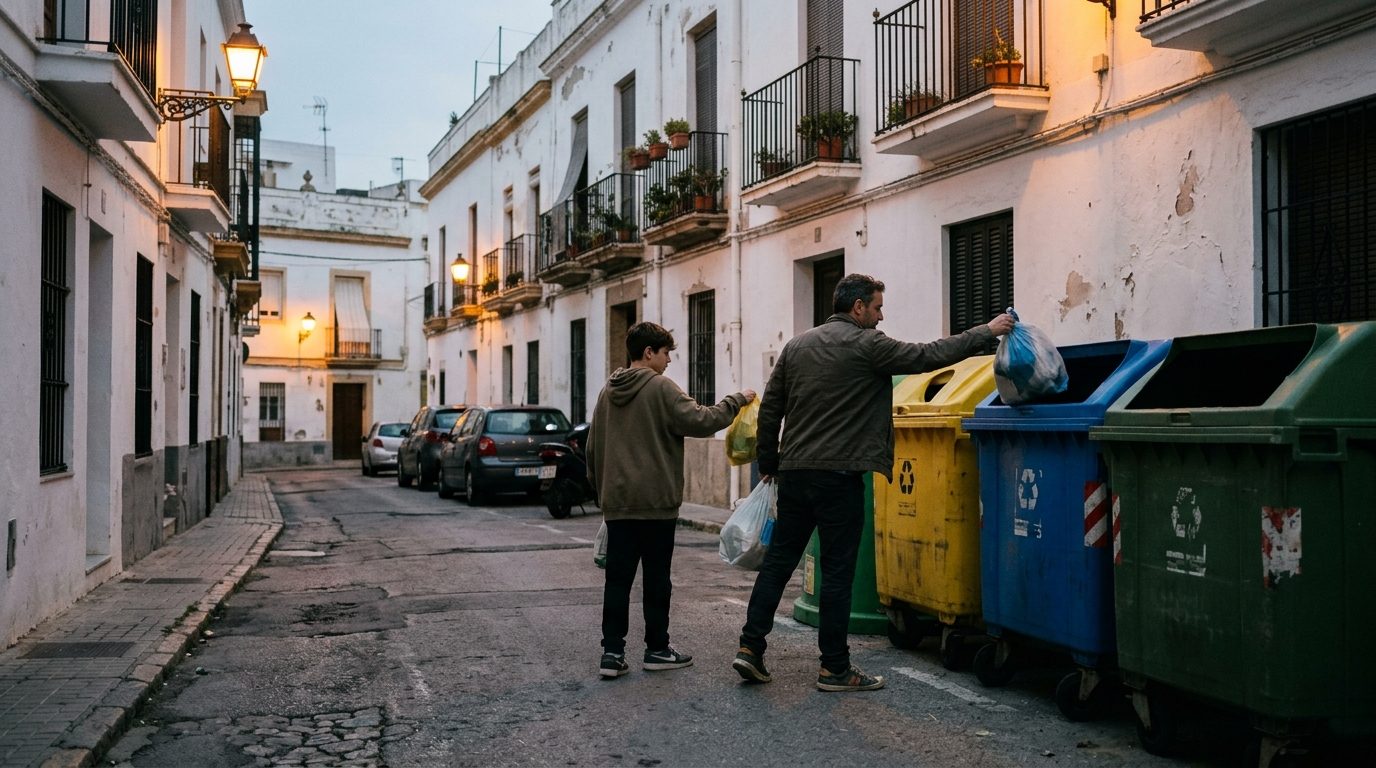
One of the first things newcomers notice in Spain is the row of large, colourful containers on every street corner. Most homes have no bin collected from the door, so you carry your sorted waste to these containers yourself. This guide explains which container is for what, the items people most often get wrong, where to take everything that does not fit in a street bin, and the local rules worth knowing.
The street containers at a glance
The colour system is broadly the same across Spain, although each town hall decides the details and some containers have coloured lids rather than coloured bodies.







| Container | Yes | No |
|---|---|---|
| Yellow (envases) | Plastic bottles and packaging, cans, drink cartons (bricks), foil trays, aerosol cans, plastic bags, yoghurt pots | Plastic toys, kitchen utensils, CDs, pens |
| Blue (papel y cartón) | Clean paper and cardboard, newspapers, cereal and shoe boxes | Used kitchen paper, napkins, greasy paper, envelopes with plastic windows left in |
| Green igloo (vidrio) | Glass bottles and jars, without lids or corks | Drinking glasses, window glass, mirrors, light bulbs, ceramics |
| Brown (orgánico) | Food scraps, coffee grounds, tea bags, natural cork, small amounts of garden waste | Nappies, cat litter, cigarette ends, dust from the vacuum |
| Grey or dark green (resto) | Everything that does not fit in the others | Anything recyclable or hazardous |
A simple rule for the yellow container: it is for packaging, not for “plastic” in general. A plastic bottle goes in yellow; a broken plastic chair does not. The Comunidad de Madrid publishes a handy A–Z list of where to throw each product (in Spanish) that applies well beyond Madrid.
The brown bin and what changed with the waste law
Spain’s waste law, Ley 7/2022, requires town halls to collect organic waste separately, and since 2025 they must also offer separate collection of textiles, used cooking oil and household hazardous waste. In practice, roll-out has been uneven: some towns have brown containers on every street, others only in certain neighbourhoods, and some still lack them. If there is no brown container near you, food waste goes in the resto container. The government’s waste services page explains what councils must provide and links to each region’s information.
Some brown containers are locked and open only with a card or app issued by the town hall. If you see one, ask at your ayuntamiento or its environmental services office how to get access.
Items people often get wrong
- Pizza boxes: clean parts go in blue; parts soaked in grease go in resto (or brown, if your town accepts it).
- Coffee capsules: plastic and aluminium capsules can go in yellow only when empty. With coffee still inside, they go in resto unless the brand runs its own collection.
- Corks: natural cork goes in brown; silicone or plastic stoppers go in yellow.
- Broken glasses and window glass: they melt at a different temperature from bottle glass and spoil the batch. Small amounts go in resto; larger pieces to the punto limpio.
- Light bulbs and batteries: never in the glass or yellow container. Many supermarkets and shopping centres have small collection boxes for both.
- Face masks, nappies and wet wipes: always resto, and never down the toilet.
- Cardboard boxes: fold them flat so they do not block the blue container’s opening, and never leave them on the ground beside it.
Where everything else goes
Punto limpio
Every area has a punto limpio (also called ecoparque or deixalleria in Catalonia), a municipal recycling centre for waste that does not belong in street containers: electrical items, paint, solvents, cooking oil, batteries, light bulbs, X-rays, thermometers, small amounts of building rubble, furniture and garden waste. Some towns also run a mobile punto limpio that visits different neighbourhoods on fixed days. Check opening hours and accepted materials on your town hall’s website first, as rules and limits differ.







Medicines: the SIGRE point
Pharmacies have a white SIGRE collection point for out-of-date or unwanted medicines, including pet medicines. Bring them in their box with the leaflet; there is no need to empty them. Needles, thermometers and X-rays are not accepted there.
Bulky items and old appliances
Mattresses, sofas and large furniture must not be left on the street at random. Most town halls run a free or low-cost recogida de enseres service: you book a collection by phone, app or online form, and leave the items outside your door on the agreed evening. When you buy a new appliance, the shop must take back the old one, so ask at the time of purchase.
Clothes and cooking oil
Textile containers, often run by charities, are common on streets and in supermarket car parks. For cooking oil, let it cool, pour it into a closed bottle and take it to an oil container or the punto limpio. Pouring oil down the sink causes blockages and is banned by some municipal by-laws.
Local rules, timing and costs
- When to take out rubbish: many town halls only allow general and organic waste to be deposited in the evening, before night-time collection. Recycling can usually be dropped off at any time. Look for a sticker on the container or check the municipal by-law (ordenanza de limpieza).
- Bags beside full containers: leaving bags or boxes on the ground is a common reason for fines. If a container is full, use the next one or report it to the town hall.
- Urbanisations and rural homes: containers may be grouped at the entrance of the urbanisation or on the main road rather than near your house. Ask your community administrator or neighbours.
- Rubbish tax: municipalities can charge a tasa de basuras, billed by the town hall or included with your water or property tax bill. The amount and method vary by town. Our guide to property taxes for foreign owners explains the local taxes that come with owning a home, and utility bills in Spain covers the rest of your household bills.
Tips for setting up at home
- Use a multi-compartment kitchen bin or separate bags for yellow, blue, glass and organic waste. Spanish kitchens are small, so stackable bins help.
- Rinse packaging only lightly; it does not have to be spotless, just empty.
- Keep a box for batteries, bulbs and small electronics and empty it on your next supermarket trip or visit to the punto limpio.
- Download your town hall’s app if it has one. Many show the nearest containers, punto limpio hours and how to book a bulky collection.
For wider tips on greener living, from saving energy to shopping locally, see our guide to sustainable living in Spain.
Useful links
- Comunidad de Madrid: where to throw each product (Spanish)
- administracion.gob.es: household waste services (Spanish)
- SIGRE: recycling medicines at pharmacies (Spanish)
- Sustainable living in Spain
- Electricity, water, gas and internet bills in Spain
FAQ: recycling in Spain
Which bin does a drinks carton go in?
The yellow container. Milk and juice cartons (bricks) count as packaging, even though they contain cardboard.
Should I remove the lids from glass jars?
Yes. Put the glass jar in the green igloo and the metal or plastic lid in the yellow container.
What if my street has no brown container?
Put food waste in the general (resto) container and check with your town hall whether brown containers are planned for your area.
How do I get rid of an old mattress?
Book your town hall’s bulky waste collection (recogida de enseres) or take it to the punto limpio. Leaving it next to the containers without booking can lead to a fine.
Disclaimer: This article is general information only. Container colours, collection times and fines are set by each town hall and can change – always check your local ayuntamiento’s rules.
Housing & Utilities
Moving to Spain with a dog or cat: paperwork, travel and settling in
How to move to Spain with a dog or cat: microchip and rabies timeline, travel options, pet-friendly rentals, registering and local health risks.

Updated: October 2026
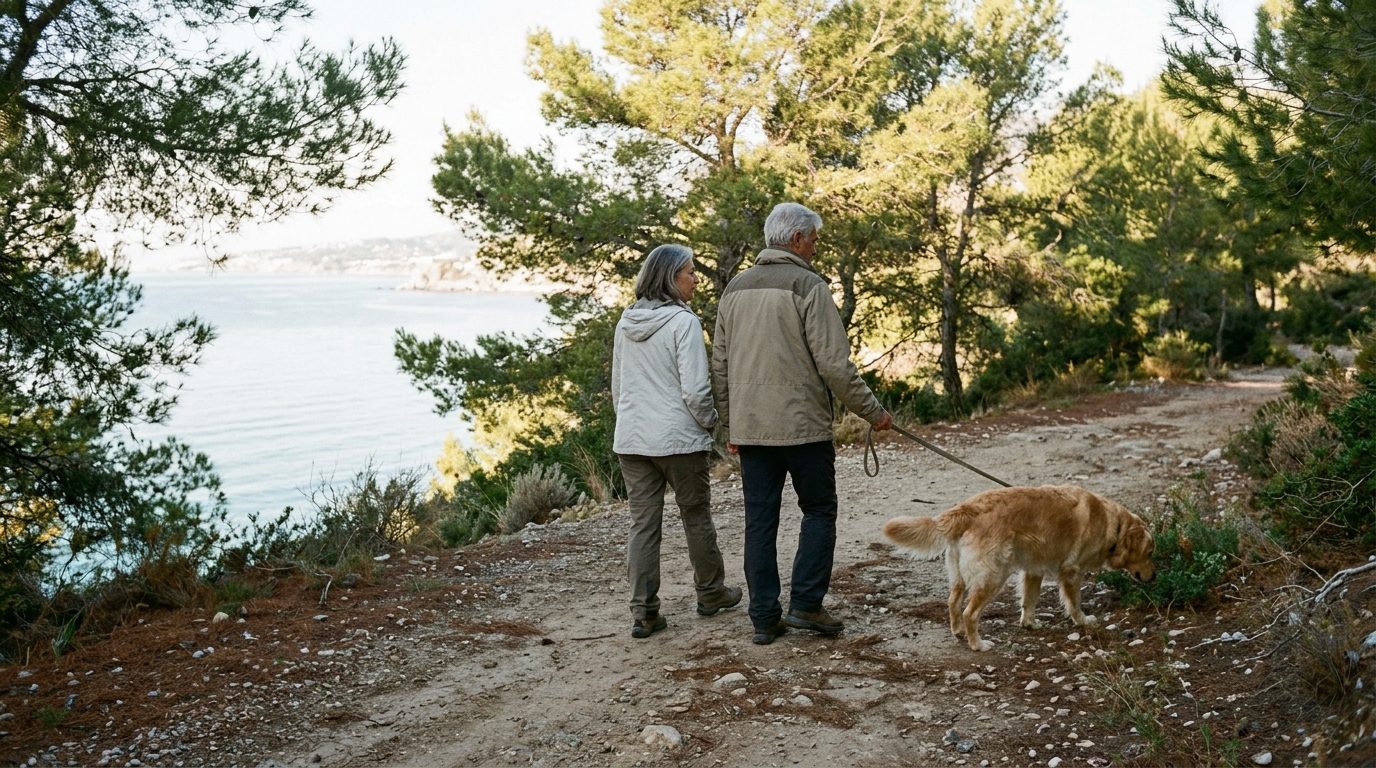
Bringing a dog or cat to Spain takes more planning than booking your own flight. This guide is for anyone moving with a pet, whether from another EU country, the UK or further afield. It walks you through the timeline, the travel options, your first weeks after arrival and the health risks that are specific to the Spanish climate. For the legal side of owning a pet here, see our separate guide to Spain’s animal welfare law.
Start with the paperwork timeline
The entry rules for dogs, cats and ferrets are set at EU level, so they are the same whether you land in Málaga, Madrid or Barcelona. What changes is how long the preparation takes, and that depends on where you are coming from.
| Coming from | Document | Plan ahead |
|---|---|---|
| Another EU country | EU pet passport | At least 3–4 weeks if the rabies vaccine is new |
| UK and other “listed” countries | Animal health certificate | At least 3–4 weeks, certificate issued within 10 days of arrival |
| Countries that need a rabies blood test | Animal health certificate plus lab report | 4 months or more |
The basic sequence is the same for everyone:
- Microchip: an ISO-standard microchip must be implanted before, or on the same day as, the rabies vaccination. A vaccine given before the chip does not count.
- Rabies vaccine: the animal must be at least 12 weeks old. After the first vaccination you wait at least 21 days before travelling. Spain does not accept unvaccinated puppies or kittens.
- Blood test (some countries only): if you come from a country with a higher rabies risk, a blood sample is taken at least 30 days after vaccination, tested in an EU-approved laboratory, and you then wait three months before entry.
- Travel document: an EU pet passport for EU residents, or an animal health certificate from an official vet for everyone else, together with a signed declaration that the move is not commercial.
You can bring up to five dogs, cats or ferrets per person on a non-commercial move. Spain does not require tapeworm treatment for dogs on arrival, but other countries on your route might. The Spanish agriculture ministry answers common questions in its pet travel FAQ (in Spanish), and the European Commission explains the rules for bringing a pet into the EU from a non-EU country.
Moving from the UK
Pet passports issued in Great Britain are no longer valid for travel to the EU. Each trip needs an animal health certificate, which your vet in the UK issues and which must be used within 10 days. Check the latest details on GOV.UK’s pet travel page before you book, as the rules have changed several times since Brexit. Once you live in Spain, a Spanish vet can issue an EU pet passport, which makes future trips much easier.
Choosing how to travel
- By car: often the least stressful option for larger dogs and multi-pet households. Plan breaks every few hours, never leave the animal in a parked car in warm weather and book pet-friendly hotels along the route in advance.
- By ferry: routes from the UK and Italy to Spain usually offer kennels or pet-friendly cabins, but these sell out early in summer. Ask exactly where the animal stays during the crossing.
- By plane in the cabin: many airlines allow a small dog or cat in an approved soft carrier under the seat. Each airline sets its own weight limit and number of pets per flight, so reserve the pet place when you book.
- By plane in the hold: larger animals travel as checked baggage or cargo in an IATA-approved crate. Some airlines restrict snub-nosed breeds such as pugs, bulldogs and Persian cats, and some limit hold transport in hot months.
- Pet relocation companies: useful for long-haul moves. Get a written quote that lists what is included.
Pets arriving from outside the EU must come through a designated travellers’ point of entry, where documents and the microchip can be checked. Not every Spanish airport or port is one, so confirm your arrival point with your airline or ferry company. Keep the original documents in your hand luggage, not in a suitcase.
Finding a home that accepts pets
The rental market is the biggest practical hurdle for many pet owners. Many landlords exclude animals in the contract, and the rules of a building’s community of owners can limit pets in shared areas such as gardens and pools. Mention your pet from the first contact, offer references from a previous landlord and expect that some landlords will ask for a higher deposit or additional guarantee. Read the pet clause carefully before signing. Our guide to renting in Spain as a foreigner covers contracts and deposits in more detail.
For dogs, a ground-floor flat with a terrace or a house with a fenced garden makes daily life easier. Check where the nearest green space is: many town centres have few parks, and dogs are generally banned from beaches outside designated dog beaches.
Your first weeks in Spain
- Register with a local vet. Bring all vaccination records. The vet can enter your pet’s microchip in the regional animal registry, which every autonomous community runs (in Andalucía it is the RAIA).
- Check your town hall. Many ayuntamientos keep a municipal pet census and have by-laws on leads, dog mess and beaches. Ask about it when you sign up for the padrón, since you will be at the town hall anyway.
- Get liability cover. Third-party insurance for dogs is written into national law but still awaits its implementing regulation. Owners of potentially dangerous breeds already need a licence and insurance. Even if it is not compulsory for your dog yet, cover is sensible and often cheap to add to home insurance. Vet bills are a separate matter: pet health insurance is worth comparing, and Petplan (ad) offers policies for dogs in Spain.
- Ask about an EU pet passport. If you arrived with a non-EU certificate, your new vet can issue one once your pet’s details are registered.
Health risks to know about
Spain’s warm climate brings parasites and hazards that pets from northern Europe may never have met. Talk to your new vet about a prevention plan in the first weeks.
- Leishmaniasis: a serious disease spread to dogs by sandflies, common in much of Spain. Vets usually recommend repellent collars or spot-ons during the warm months, and there are vaccines. Ask whether an annual blood test makes sense.
- Pine processionary caterpillars: in late winter and spring, these caterpillars walk in lines near pine trees. Their hairs can cause severe reactions in a dog’s mouth and tongue. Keep dogs away and see a vet immediately if your dog touches one.
- Ticks, fleas and heartworm: year-round protection is common in southern Spain, where winters are mild.
- Heat: walk dogs early in the morning and late in the evening in summer, test pavement temperature with your hand and always carry water. Our heatwave safety guide explains Spain’s heat warnings.
- Foxtails: dry grass seeds (espigas) can work their way into ears, paws and noses in late spring and summer. Check your dog after walks in the countryside.
Everyday life with a pet in Spain
Spain is increasingly pet-friendly. Many terraces welcome dogs, some shopping centres and shops allow them inside, and dog beaches are spreading along the coast. Public transport rules vary: small pets in carriers are usually allowed on buses and trains, while larger dogs face more restrictions depending on the operator and city. Dogs must be on a lead in most urban areas, and owners are expected to pick up after their dog and, in many towns, rinse urine with water. Fines for ignoring local rules can be significant.
Useful links
- Your Europe: travelling with pets – EU pet passport and the five-pet limit
- European Commission: bringing a pet from a non-EU country
- Spanish agriculture ministry: pet travel FAQ (Spanish)
- GOV.UK: taking your pet abroad
- Spain’s animal welfare law: what pet owners must know
- Renting in Spain as a foreigner
- Home insurance in Spain
FAQ: moving to Spain with a pet
Can I bring a puppy or kitten under 12 weeks to Spain?
No. Spain does not allow unvaccinated dogs, cats or ferrets to enter. The animal must be at least 12 weeks old when vaccinated against rabies and then wait 21 days, so the minimum age on arrival is about 15 weeks.
Is my UK pet passport still valid?
Not for entering the EU. Pets from Great Britain need an animal health certificate for each trip. After you move, a Spanish vet can issue an EU pet passport.
How many pets can I bring?
Up to five dogs, cats or ferrets per person on a non-commercial move. More than five is only allowed for registered competitions, shows or sporting events.
Do I need to register my pet after moving?
Yes. Ask a local vet to record the microchip in your region’s animal registry, and check whether your town hall also runs a pet census.
Disclaimer: This article is general information only and is not veterinary or legal advice. Pet travel rules, airline policies and local by-laws can change – always check with your vet, carrier and the official sources before you travel.
Housing & Utilities
Home insurance in Spain explained for owners, tenants and holiday-home owners
How seguro de hogar works in Spain: building vs contents, community and mortgage rules, flood cover via the Consorcio and how to claim.

Updated: October 2026
Home insurance in Spain, called seguro de hogar, is not compulsory for most private households, yet nearly every homeowner and many tenants have it. This guide is for expats who own, rent or keep a holiday home in Spain. It explains what a policy covers, how it fits with your community’s building insurance and your mortgage, who pays after floods and storms, and how to make a claim.
If you are new to Spanish insurance in general, start with our overview of insurance in Spain.
Continente and contenido: the two halves of a policy
Every Spanish home policy is built around two insured values. Getting them right is the most important part of buying cover.
- Continente (building): walls, floors, roof, fixed installations such as plumbing and wiring, fitted kitchens and bathrooms. The value should be the cost of rebuilding, not the market price of the property.
- Contenido (contents): furniture, appliances, clothes, electronics and personal belongings. Jewellery and valuables are usually limited unless you declare them.
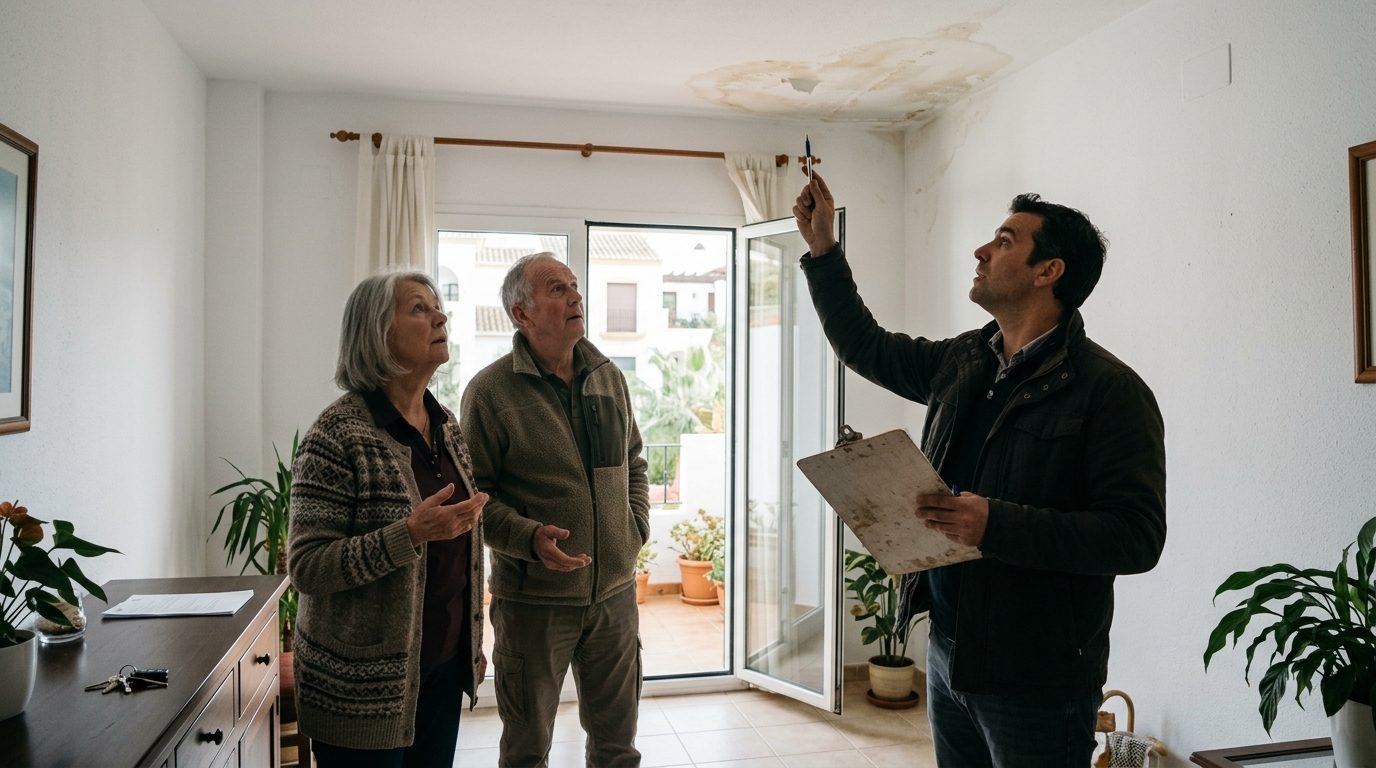
Most policies also include responsabilidad civil (third-party liability), for example if water from your flat damages the neighbour’s ceiling, plus assistance services such as emergency plumbers and locksmiths.
Watch out for infraseguro (underinsurance). If you declare less than the real value, the insurer can reduce any payout in proportion. Many insurers offer a “valor total” option or automatic indexation to avoid this.
Owners, tenants and the community policy
If you own a flat
In an apartment block, the community of owners (comunidad de propietarios) normally insures the common parts: facade, roof, staircases, lifts and shared pipes. The national property law does not make this insurance compulsory everywhere, but some regions do. In the Madrid region and the Valencian Community, for example, residential buildings must be insured against fire and third-party damage. In practice most communities have a policy, and the premium is part of your community fees.
Ask the administrator for a summary of the community policy so you know where it stops. Your own policy should then cover the inside of your flat, your contents and your personal liability. A burst pipe in your bathroom that floods the flat below is normally your responsibility, not the community’s.
If you own a house
For a detached or semi-detached house you insure everything yourself: building, garden walls, pool and contents. Check that outdoor items, pool equipment and solar panels are listed, because some basic policies exclude them.
If you rent
The landlord is responsible for insuring the building. As a tenant you only need a contents and liability policy, which is usually inexpensive. Liability cover is the key part: if you cause a leak or a fire, you could otherwise be asked to pay for the damage. Our guide to renting in Spain as a foreigner covers contracts, deposits and your rights.
Home insurance and your mortgage
If you buy with a Spanish mortgage, the bank can require damage insurance on the property for the life of the loan. Under the mortgage credit law (Law 5/2019), however, it cannot force you to buy that policy from the bank or from an insurer it chooses.
- You can present a policy from another company with equivalent cover, both at signing and at each renewal.
- The bank may not charge you for reviewing that alternative policy, nor worsen the loan terms because you chose it.
- The bank can offer a lower interest rate if you take its insurance. Compare the total cost over several years before you accept.
The Banco de España explains these rights in its customer portal (Spanish).
Floods, storms and the Consorcio de Compensación de Seguros
Spain has a public body that pays for damage from extraordinary events: the Consorcio de Compensación de Seguros. It is funded by a small surcharge included in home, car and other property policies. It covers, among other things:
- Extraordinary floods, including sea surges.
- Earthquakes, tsunamis and volcanic eruptions.
- Atypical cyclonic storms, including tornadoes and wind gusts above 120 km/h.
- Terrorism, riots and civil unrest.
The catch is simple: you only get Consorcio compensation if you have a valid policy covering the damaged property and your premium is paid. A house with no insurance gets nothing from the Consorcio after a flood. The excess that applies to businesses has been removed for private homes and residential communities. Ordinary storms, rain coming through a roof and rising groundwater are not “extraordinary” and are handled, if at all, by your own insurer under your policy terms.
To claim from the Consorcio, you, your insurer or your broker file a claim online, by phone or by email. RACE summarises how the Consorcio works, and Legálitas explains what it covers after floods.
Holiday homes and empty properties
If your Spanish home is empty for months at a time, tell the insurer and choose a policy designed for a second home (segunda residencia). Standard policies often restrict theft and water damage cover when a property is unoccupied for a long continuous period, so read the clause on deshabitación carefully.
- Security: some insurers ask for a reinforced door, window bars or an alarm for theft cover.
- Water: turning off the main tap when you leave can be a policy condition and prevents most leaks.
- Holiday letting: a normal home policy rarely covers paying guests. If you rent to tourists, you need specific cover, and several regions require liability insurance for licensed tourist rentals. Check your regional rules and tell your insurer.
Owners of second homes also have running costs and local taxes to budget for; see our guide to property taxes for foreign owners.
How to make a claim
- Limit the damage: stop the leak, secure doors and windows, and keep damaged items if it is safe to do so.
- Document everything: photos, videos, receipts and a list of what was damaged or stolen.
- Report a theft to the police: insurers need the police report (denuncia) for burglary claims.
- Notify the insurer within 7 days: this is the general deadline in the Spanish insurance contract law, unless your policy gives longer. Most insurers accept claims by app, phone or online.
- Meet the loss adjuster: for larger claims the insurer sends a perito to assess the damage. Do not throw away damaged items or start major repairs before the visit unless it is urgent.
If the insurer rejects your claim or offers too little, complain in writing to its customer service department first. If that fails, you can escalate to the insurance supervisor, the Dirección General de Seguros y Fondos de Pensiones.
Useful links
- Banco de España: can the bank impose its insurance with a mortgage? (Spanish)
- RACE: what the Consorcio de Compensación de Seguros is (Spanish)
- Legálitas: what the Consorcio covers (Spanish)
- Understanding insurance in Spain
- Renting a home in Spain as a foreigner
- Property taxes for foreign owners in Spain
FAQ: home insurance in Spain
Is home insurance compulsory in Spain?
Not for most private homes. It becomes a requirement if you have a mortgage (damage cover on the building), and some regions require residential buildings to be insured against fire and third-party damage.
Do I have to buy home insurance from my mortgage bank?
No. The bank can require cover but must accept an equivalent policy from another insurer, both at signing and at renewal, without charging you for it.
Who pays for flood damage?
Damage from extraordinary floods is paid by the Consorcio de Compensación de Seguros, but only if you have a valid insurance policy on the damaged property with the premium paid.
Do tenants need home insurance?
It is not required by law, but a contents and liability policy is cheap and protects you if you accidentally damage the flat or a neighbour’s property.
Disclaimer: This article is general information only and is not legal or insurance advice. Rules and policy terms differ between insurers and regions – always read the policy conditions and check with the insurer, a registered broker or the official source before you act.
Housing & Utilities
The community of owners (comunidad de propietarios) explained
How Spanish owners’ communities work: fees and reserve fund, the president and AGM, voting rules, unpaid debts when you buy, tourist lets and disputes.
Updated: October 2026
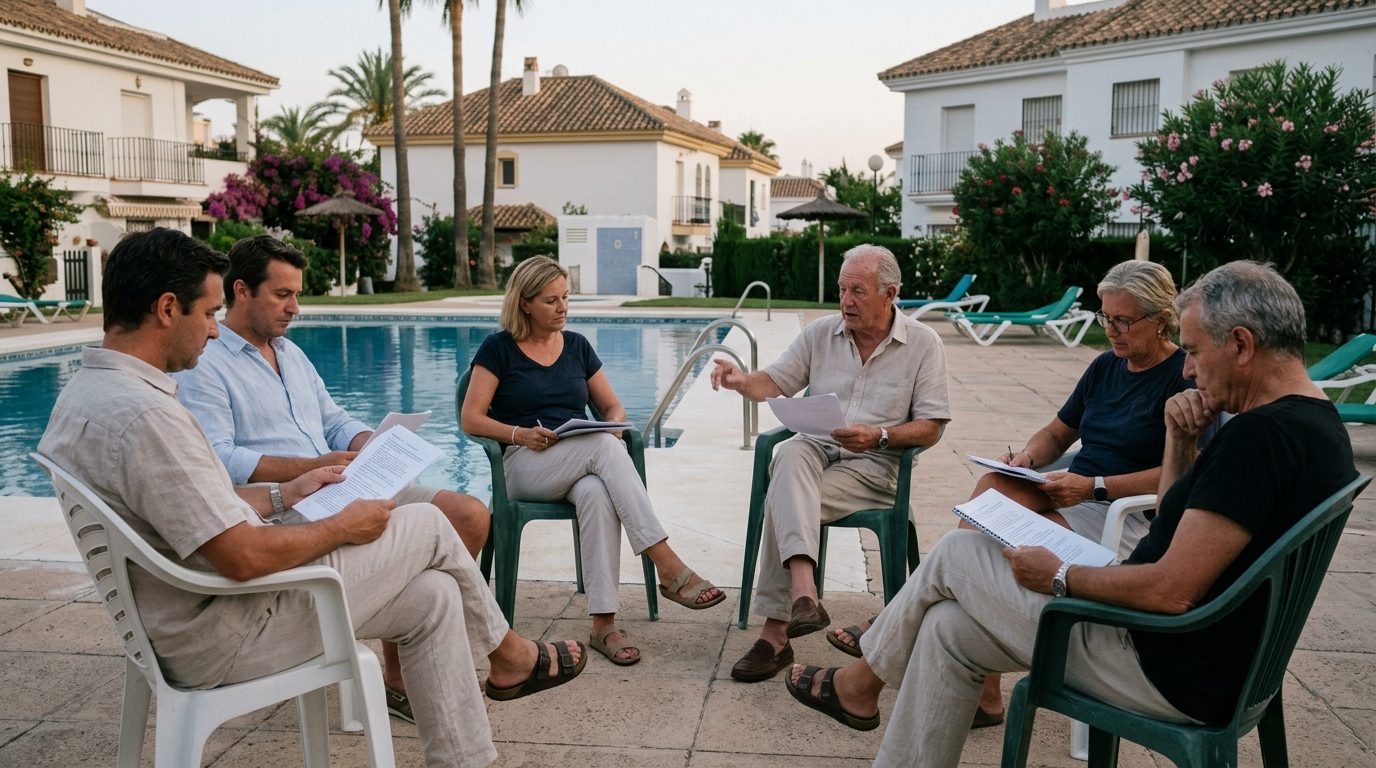
If you buy a flat, a townhouse on a shared urbanisation or almost any home with a communal pool or garden in Spain, you automatically become a member of a comunidad de propietarios. The community decides on repairs, fees and house rules, and it can affect what you may do with your own home. This guide explains how it works, what you pay and how to have your say – even if you live abroad.
What the community is
Buildings and complexes divided into separate homes are governed by the Ley de Propiedad Horizontal (Horizontal Property Law). You own your flat outright, plus a share of the common parts: roof, façade, stairs, lifts, pool, gardens and so on. Your share is your cuota de participación, a percentage written in the deed. It decides how much of the common costs you pay and how much your vote weighs.
Each community also has its own statutes (estatutos) and often internal rules (normas de régimen interior) about things like pets, noise, pool hours, awnings or rentals. Ask for both before you buy.
Who runs it
- General meeting (junta de propietarios): all owners together. This is where the important decisions are taken.
- President: an owner, elected by the meeting, usually for one year. If nobody is elected, the post can go by rotation or by drawing lots, and an owner can only refuse for good reason. The president represents the community, including in court.
- Secretary and administrator: keep the minutes, accounts and paperwork. Most larger communities hire a professional property administrator (administrador de fincas) for both jobs.
Community fees, levies and the reserve fund
Every owner pays regular community fees (cuotas), usually monthly or quarterly, according to their share. Fees cover cleaning, lighting, lifts, insurance of the building, gardening, pool maintenance and the administrator. What a home costs per month varies hugely: a small block without a lift can be cheap, while an urbanisation with pools, gardens and security can cost much more. Ask the seller or administrator for the current fee and the latest budget.
- Reserve fund (fondo de reserva): by law the community must keep a reserve of at least 10% of its last ordinary budget for necessary repairs and certain mandatory works, as the consumer organisation OCU explains.
- Extra levies (derramas): large works such as a new roof, façade repairs or a lift are often paid by a one-off levy on top of the normal fees. Before buying, read the minutes of recent meetings to see whether any derrama has been approved or is being discussed, and agree in the contract who pays it.
- Not paying: owners who are behind on fees can attend meetings but lose their right to vote, and the community can claim the debt through a fast court procedure (proceso monitorio).
Community fees are not a tax, but they are part of your yearly running costs alongside IBI – see taxes for foreign property owners.
Meetings and voting
The community must hold an ordinary general meeting at least once a year to approve the budget and accounts. The notice must reach owners at least six days before an ordinary meeting and include the agenda. Extra meetings can be called by the president or by owners representing a quarter of the owners or shares.
| Type of decision | Usual majority |
|---|---|
| Day-to-day matters, budget, accounts, ordinary repairs | Simple majority of owners and shares present |
| New tourist lets in the building, or a surcharge of up to 20% on tourist flats | Three-fifths of all owners and shares |
| Changing the title deed or statutes | Unanimity |
Some works, such as certain accessibility improvements, have special rules and can be compulsory. If you cannot attend, you can give another person a signed written proxy to vote for you. Owners who were absent are sent the decisions and have a short period to register their disagreement; if they do not, their vote is counted with the majority.
Buying a home in a community: what to check
- Debt certificate: the seller must state in the deed whether community fees are paid and provide a certificate from the secretary, issued within seven days of the request. The notary cannot sign without it unless you expressly waive it – do not.
- Old debts follow the home: the property answers for unpaid fees from the part of the year in which you buy plus the three previous calendar years, as set out in article 9 of the law.
- Minutes and statutes: look for planned works, legal disputes and restrictions, for example on tourist lets or pets.
- Tell the community: after buying, inform the secretary in a way that proves receipt that you are the new owner, and give an address in Spain or an email for notices. If the seller does not report the sale, they stay jointly liable for later debts with you.
These checks fit into the wider legal review described in buying property in Spain step by step.
Tourist lets and the community
Since 3 April 2025, an owner who wants to start a new tourist let in a building needs the community’s approval by a three-fifths majority. Flats already operating legally before then keep their rights, but the community can charge tourist flats up to 20% more in fees from the date of the decision. For the full Andalusian rules, see our guide to the holiday rental licence in Andalucía.
Disagreeing with a decision
You can challenge a decision in court if it breaks the law or the statutes, seriously harms the community in favour of some owners, or seriously harms you without a legal duty to accept it. Deadlines are short – generally three months from the decision, or one year if it is contrary to the law or the statutes – and you must normally be up to date with your fees to do so. Talk to the administrator first, then to a lawyer if needed; see lawyers in Spain.
Useful links
- BOE: Ley 49/1960 de Propiedad Horizontal
- OCU: the community reserve fund explained (Spanish)
- Article 9 of the Horizontal Property Law (owners’ obligations)
- Buying costs in Spain: notary, land registry and transfer tax
- Home insurance in Spain
FAQ: communities of owners
Can I be made president if I live abroad?
Any owner can be elected or chosen by rotation. If it would be genuinely difficult for you, you can ask the meeting or, if needed, a judge to be excused. In practice the administrator does most of the work.
Do I have to pay for the lift if I live on the ground floor?
Usually yes, according to your share, unless the statutes or the title deed exempt ground-floor units. Check those documents before you buy.
Who pays a levy approved before I bought?
It depends on when payments fall due and what your purchase contract says. Agree in writing that the seller pays any derrama already approved, and check the minutes.
Can the community stop me renting out my flat?
It cannot ban ordinary long-term rentals, but it can refuse new tourist lets by not reaching the three-fifths approval, and its statutes may already prohibit them.
Disclaimer: This article is general information only and is not legal advice. Community statutes differ and the law can change – always read your community’s documents and ask an administrator, gestor or lawyer about your situation.








Recycling in Spain: which bin is for what

Making a will in Spain as a foreigner

Córdoba guide: the Mezquita, the patios and life in the city

Understanding the tax system in Spain

Andalucía guide: cities, culture and life in southern Spain

Marbella guide: areas, beaches and everyday life








-

 Banking & Finances2 years ago
Understanding the tax system in Spain
-
Tourist Info2 years ago
Andalucía guide: cities, culture and life in southern Spain
-
Tourist Info2 years ago
Marbella guide: areas, beaches and everyday life
-
Cost of Living2 years ago
Living on a small salary in Spain in 2026
-
Legal Requirements & Documentation2 years ago
How to get your Spanish NIE number in 2026 – step by step
-
Legal Requirements & Documentation2 years ago
Work visa and work permit in Spain 2026 – which one you need and how to apply
-
Tourist Info2 years ago
Benalmádena explained: Pueblo, Arroyo de la Miel and the coast
-
Legal Requirements & Documentation2 years ago
Residency in Spain 2026: how to become a legal resident – step by step