







































































Housing & Utilities
The community of owners (comunidad de propietarios) explained
How Spanish owners’ communities work: fees and reserve fund, the president and AGM, voting rules, unpaid debts when you buy, tourist lets and disputes.




























Updated: October 2026
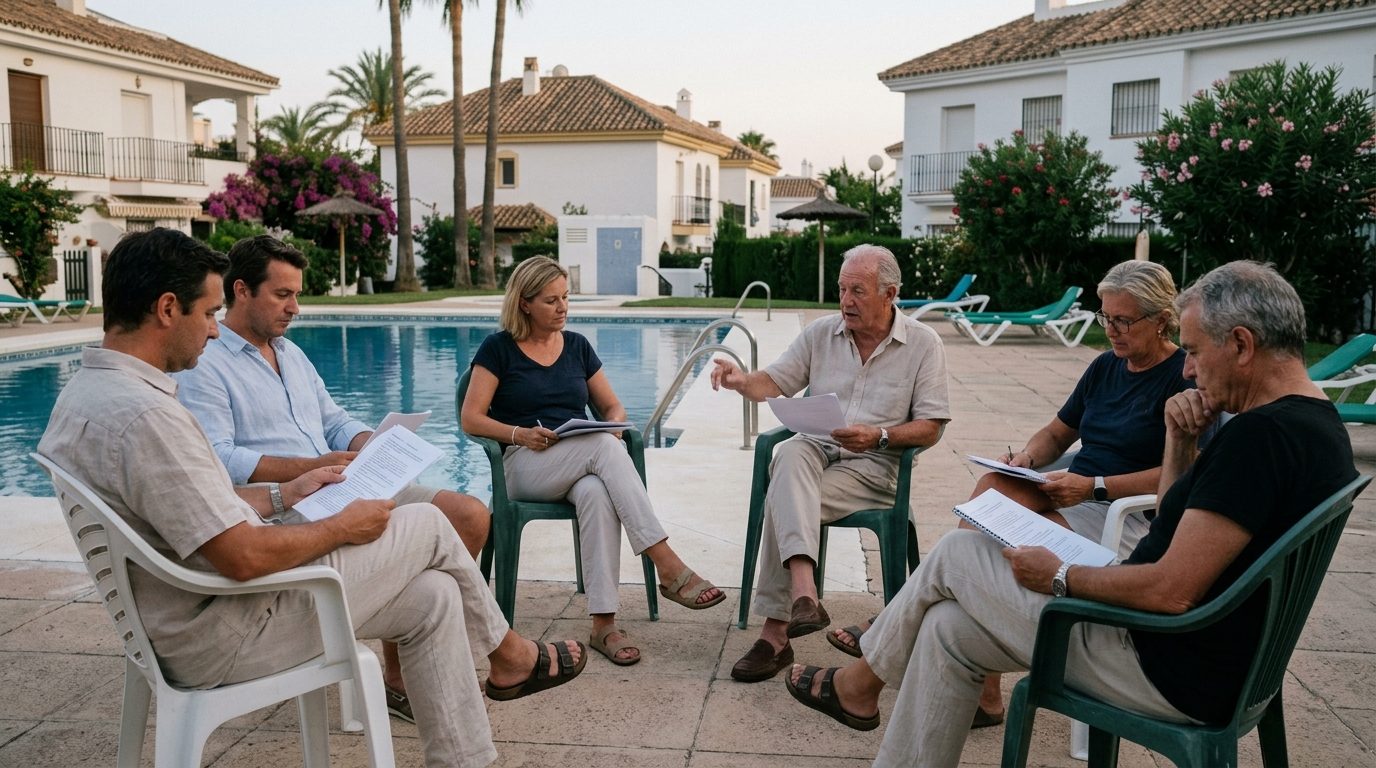
If you buy a flat, a townhouse on a shared urbanisation or almost any home with a communal pool or garden in Spain, you automatically become a member of a comunidad de propietarios. The community decides on repairs, fees and house rules, and it can affect what you may do with your own home. This guide explains how it works, what you pay and how to have your say – even if you live abroad.
What the community is
Buildings and complexes divided into separate homes are governed by the Ley de Propiedad Horizontal (Horizontal Property Law). You own your flat outright, plus a share of the common parts: roof, façade, stairs, lifts, pool, gardens and so on. Your share is your cuota de participación, a percentage written in the deed. It decides how much of the common costs you pay and how much your vote weighs.


 Vivid BusinessA business account for freelancers and companies in SpainOpen your account online, with sub-accounts and cards for your team.Learn more →(ad)

 Buying a home in Spain? Simulate your mortgageSee your monthly payment with Banco Sabadell’s mortgage simulator.Try the simulator →(ad)

 A bank account for autónomos in SpainCuenta Clara Autónomos: no commissions, free debit and credit cards, opened online.See the account →(ad)


 A European bank you open from your phonebunq: an EU-licensed bank with debit cards, managed fully in the app. Sign up in about five minutes.Get started →(ad)


 A mobile bank account with no commissionsB100, the mobile bank from Abanca: everyday account and free debit card, all in the app.Get the app →(ad)
 Online pharmacy & parapharmacySkincare, vitamins, baby care and more – delivered in SpainShop now




















 CAR INSURANCEInsure your car in Spain onlineGet your quote online with Prima Seguros.Get a quote →


Each community also has its own statutes (estatutos) and often internal rules (normas de régimen interior) about things like pets, noise, pool hours, awnings or rentals. Ask for both before you buy.
Who runs it
- General meeting (junta de propietarios): all owners together. This is where the important decisions are taken.
- President: an owner, elected by the meeting, usually for one year. If nobody is elected, the post can go by rotation or by drawing lots, and an owner can only refuse for good reason. The president represents the community, including in court.
- Secretary and administrator: keep the minutes, accounts and paperwork. Most larger communities hire a professional property administrator (administrador de fincas) for both jobs.
Community fees, levies and the reserve fund
Every owner pays regular community fees (cuotas), usually monthly or quarterly, according to their share. Fees cover cleaning, lighting, lifts, insurance of the building, gardening, pool maintenance and the administrator. What a home costs per month varies hugely: a small block without a lift can be cheap, while an urbanisation with pools, gardens and security can cost much more. Ask the seller or administrator for the current fee and the latest budget.
- Reserve fund (fondo de reserva): by law the community must keep a reserve of at least 10% of its last ordinary budget for necessary repairs and certain mandatory works, as the consumer organisation OCU explains.
- Extra levies (derramas): large works such as a new roof, façade repairs or a lift are often paid by a one-off levy on top of the normal fees. Before buying, read the minutes of recent meetings to see whether any derrama has been approved or is being discussed, and agree in the contract who pays it.
- Not paying: owners who are behind on fees can attend meetings but lose their right to vote, and the community can claim the debt through a fast court procedure (proceso monitorio).
Community fees are not a tax, but they are part of your yearly running costs alongside IBI – see taxes for foreign property owners.
Meetings and voting
The community must hold an ordinary general meeting at least once a year to approve the budget and accounts. The notice must reach owners at least six days before an ordinary meeting and include the agenda. Extra meetings can be called by the president or by owners representing a quarter of the owners or shares.
| Type of decision | Usual majority |
|---|---|
| Day-to-day matters, budget, accounts, ordinary repairs | Simple majority of owners and shares present |
| New tourist lets in the building, or a surcharge of up to 20% on tourist flats | Three-fifths of all owners and shares |
| Changing the title deed or statutes | Unanimity |
Some works, such as certain accessibility improvements, have special rules and can be compulsory. If you cannot attend, you can give another person a signed written proxy to vote for you. Owners who were absent are sent the decisions and have a short period to register their disagreement; if they do not, their vote is counted with the majority.
Buying a home in a community: what to check
- Debt certificate: the seller must state in the deed whether community fees are paid and provide a certificate from the secretary, issued within seven days of the request. The notary cannot sign without it unless you expressly waive it – do not.
- Old debts follow the home: the property answers for unpaid fees from the part of the year in which you buy plus the three previous calendar years, as set out in article 9 of the law.
- Minutes and statutes: look for planned works, legal disputes and restrictions, for example on tourist lets or pets.
- Tell the community: after buying, inform the secretary in a way that proves receipt that you are the new owner, and give an address in Spain or an email for notices. If the seller does not report the sale, they stay jointly liable for later debts with you.
These checks fit into the wider legal review described in buying property in Spain step by step.
Tourist lets and the community
Since 3 April 2025, an owner who wants to start a new tourist let in a building needs the community’s approval by a three-fifths majority. Flats already operating legally before then keep their rights, but the community can charge tourist flats up to 20% more in fees from the date of the decision. For the full Andalusian rules, see our guide to the holiday rental licence in Andalucía.
Disagreeing with a decision
You can challenge a decision in court if it breaks the law or the statutes, seriously harms the community in favour of some owners, or seriously harms you without a legal duty to accept it. Deadlines are short – generally three months from the decision, or one year if it is contrary to the law or the statutes – and you must normally be up to date with your fees to do so. Talk to the administrator first, then to a lawyer if needed; see lawyers in Spain.
Useful links
- BOE: Ley 49/1960 de Propiedad Horizontal
- OCU: the community reserve fund explained (Spanish)
- Article 9 of the Horizontal Property Law (owners’ obligations)
- Buying costs in Spain: notary, land registry and transfer tax
- Home insurance in Spain
FAQ: communities of owners
Can I be made president if I live abroad?
Any owner can be elected or chosen by rotation. If it would be genuinely difficult for you, you can ask the meeting or, if needed, a judge to be excused. In practice the administrator does most of the work.
Do I have to pay for the lift if I live on the ground floor?
Usually yes, according to your share, unless the statutes or the title deed exempt ground-floor units. Check those documents before you buy.
Who pays a levy approved before I bought?
It depends on when payments fall due and what your purchase contract says. Agree in writing that the seller pays any derrama already approved, and check the minutes.
Can the community stop me renting out my flat?
It cannot ban ordinary long-term rentals, but it can refuse new tourist lets by not reaching the three-fifths approval, and its statutes may already prohibit them.
Disclaimer: This article is general information only and is not legal advice. Community statutes differ and the law can change – always read your community’s documents and ask an administrator, gestor or lawyer about your situation.









 A European bank you open from your phoneSign up with bunq in about five minutes.Get started →(ad)








 Ad
 A sea-view escape in MallorcaThe Donna Portals – stay by the sea with views over the Mediterranean.See prices →
Vivid BusinessA business account for freelancers and companies in SpainOpen your account online, with sub-accounts and cards for your team.✓ For autónomos and companies
✓ Sub-accounts for budgets and taxes
✓ Cards for your teamLearn more →(ad)


















Cycling on the Costa del Sol: the rules, the helmet law and the 1.5 metre gap

How to order tapas in Andalucía: tapa, media ración or ración?

Traffic fines and driving licence points in Spain: how the system works

Andalucía guide: cities, culture and life in southern Spain

How the Spanish government works: state, regions, provinces and town halls

Living on a small salary in Spain in 2026










-

 Tourist Info2 years ago
Andalucía guide: cities, culture and life in southern Spain
-
Spanish System2 years ago
How the Spanish government works: state, regions, provinces and town halls
-
Cost of Living2 years ago
Living on a small salary in Spain in 2026
-
Cost of Living2 years ago
Family living costs in Spain in 2026: monthly budget and moving-in money
-
Tourist Info2 years ago
Marbella guide: areas, beaches and everyday life
-
Insurance2 years ago
Understanding insurance in Spain: a 2026 guide for expats
-
Banking & Finances2 years ago
Understanding the tax system in Spain
-
Tourist Info2 years ago
Benalmádena explained: Pueblo, Arroyo de la Miel and the coast