













































































Housing & Utilities
Home insurance in Spain explained for owners, tenants and holiday-home owners
Home insurance in Spain explained: what seguro de hogar covers, mortgage rules, typical prices and Consorcio flood cover for owners, tenants and landlords.

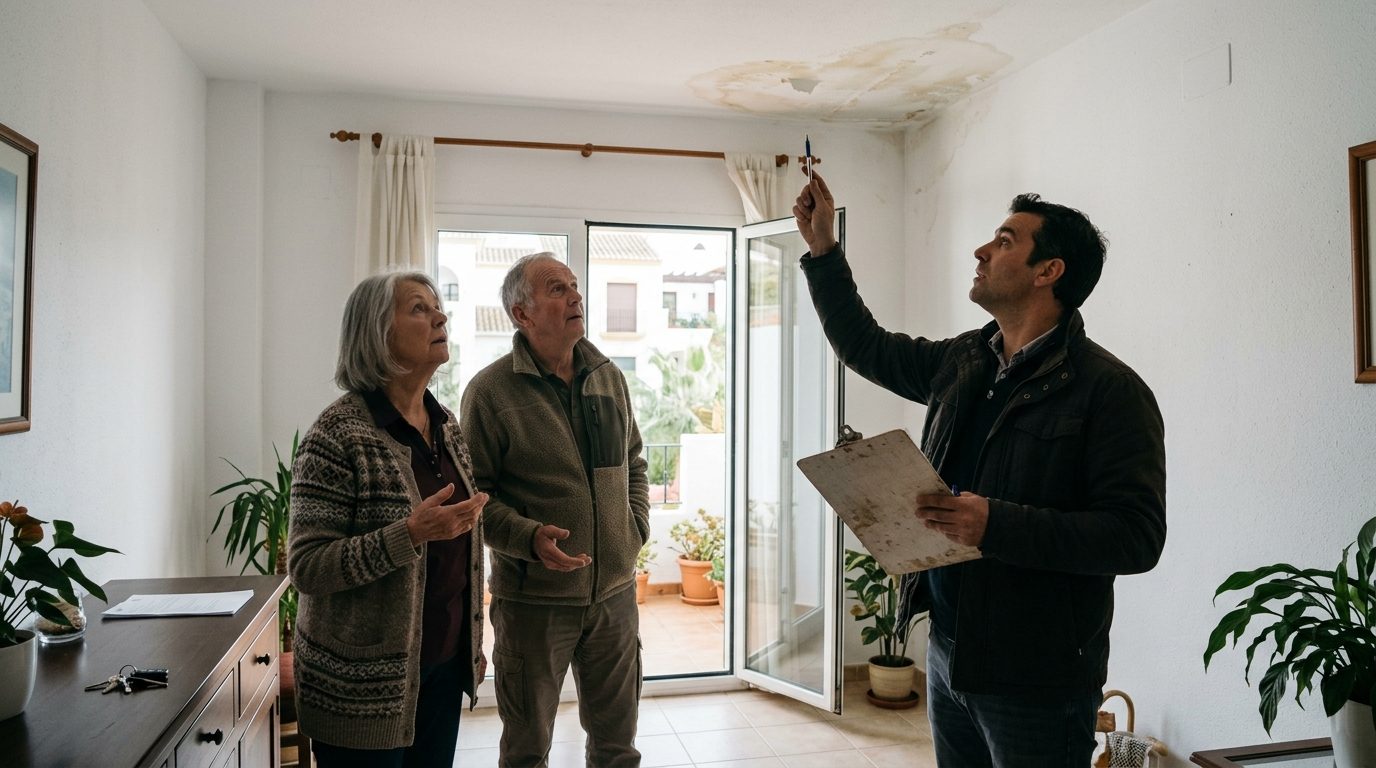



























Home insurance in Spain, called seguro de hogar, is not compulsory for most private households, yet nearly every homeowner and many tenants have it. This guide is for expats who own, rent or keep a holiday home in Spain. It explains what a policy covers, how it fits with your community’s building insurance and your mortgage, who pays after floods and storms, and how to make a claim.
Updated: November 2026
Short answer: home insurance in Spain (seguro de hogar) is not compulsory for most households. The main exception is a mortgage: the property must then be insured against fire and other damage to the building, but you can choose the insurer and you do not have to take the bank’s life or home policy. Owners usually insure the building and contents, tenants insure their contents and liability, and holiday-home owners need a policy that allows long empty periods. Floods and other extraordinary events are paid by the public Consorcio de Compensación de Seguros, but only if you have a valid policy.


 Vivid BusinessA business account for freelancers and companies in SpainOpen your account online, with sub-accounts and cards for your team.Learn more →(ad)

 Buying a home in Spain? Simulate your mortgageSee your monthly payment with Banco Sabadell’s mortgage simulator.Try the simulator →(ad)

 A bank account for autónomos in SpainCuenta Clara Autónomos: no commissions, free debit and credit cards, opened online.See the account →(ad)


 A European bank you open from your phonebunq: an EU-licensed bank with debit cards, managed fully in the app. Sign up in about five minutes.Get started →(ad)


 A mobile bank account with no commissionsB100, the mobile bank from Abanca: everyday account and free debit card, all in the app.Get the app →(ad)
 Online pharmacy & parapharmacySkincare, vitamins, baby care and more – delivered in SpainShop now




















 CAR INSURANCEInsure your car in Spain onlineGet your quote online with Prima Seguros.Get a quote →


If you are new to Spanish insurance in general, start with our overview of insurance in Spain.
Continente and contenido: the two halves of a policy
Every Spanish home policy is built around two insured values. Getting them right is the most important part of buying cover.
- Continente (building): walls, floors, roof, fixed installations such as plumbing and wiring, fitted kitchens and bathrooms. The value should be the cost of rebuilding, not the market price of the property.
- Contenido (contents): furniture, appliances, clothes, electronics and personal belongings. Jewellery and valuables are usually limited unless you declare them.
Most policies also include responsabilidad civil (third-party liability), for example if water from your flat damages the neighbour’s ceiling, plus assistance services such as emergency plumbers and locksmiths.
Watch out for infraseguro (underinsurance). If you declare less than the real value, the insurer can reduce any payout in proportion. Many insurers offer a “valor total” option or automatic indexation to avoid this.
What to insure: owner, tenant, holiday-home owner or landlord
Who needs which cover depends on how you use the property. Use this table as a starting point, then check the details in the sections below.
| You are | What to insure | Typical cover to look for |
|---|---|---|
| Owner of a flat | Inside of your flat (your share of the building not covered by the community) and contents | Water damage, fire, theft, third-party liability, glass, assistance services |
| Owner of a house | The whole building, including garden walls and pool, plus contents | Rebuilding value of the building, outdoor items, pool and solar panels, liability |
| Tenant | Your own belongings only; the landlord insures the building | Contents, third-party liability for damage you cause to the flat or neighbours |
| Holiday-home owner | Building (or flat interior) and contents of a home that is empty for long periods | Second-home (segunda residencia) policy, theft cover while unoccupied, water damage |
| Landlord (long-term or holiday let) | Building and any furniture you provide | Landlord or rental cover, liability towards tenants or guests, optional rent default cover; specific cover for tourist rentals |
Owners, tenants and the community policy
If you own a flat
In an apartment block, the community of owners (comunidad de propietarios) normally insures the common parts: facade, roof, staircases, lifts and shared pipes. The national property law does not make this insurance compulsory everywhere, but some regions do. In the Madrid region and the Valencian Community, for example, residential buildings must be insured against fire and third-party damage. In practice most communities have a policy, and the premium is part of your community fees.
Ask the administrator for a summary of the community policy so you know where it stops. Your own policy should then cover the inside of your flat, your contents and your personal liability. A burst pipe in your bathroom that floods the flat below is normally your responsibility, not the community’s.
If you own a house
For a detached or semi-detached house you insure everything yourself: building, garden walls, pool and contents. Check that outdoor items, pool equipment and solar panels are listed, because some basic policies exclude them.
If you rent
The landlord is responsible for insuring the building. As a tenant you only need a contents and liability policy, which is usually inexpensive. Liability cover is the key part: if you cause a leak or a fire, you could otherwise be asked to pay for the damage. Our guide to renting in Spain as a foreigner covers contracts, deposits and your rights.
Home insurance and your mortgage
If you buy with a Spanish mortgage, the bank can require damage insurance on the property for the life of the loan. Under the mortgage credit law (Law 5/2019), however, it cannot force you to buy that policy from the bank or from an insurer it chooses.
The legal requirement only covers the building (continente) against fire and other damage. It comes from the mortgage market rules (Law 2/1981, article 8, and Royal Decree 716/2009, article 10). Contents cover is optional, and so is life insurance linked to the mortgage: banks often offer it with a discount on the interest rate, but no law makes it compulsory. Whatever policy you choose, the bank will normally ask to be named as beneficiary for the building cover. Legálitas explains the mortgage insurance requirement (Spanish).
- You can present a policy from another company with equivalent cover, both at signing and at each renewal.
- The bank may not charge you for reviewing that alternative policy, nor worsen the loan terms because you chose it.
- The bank can offer a lower interest rate if you take its insurance. Compare the total cost over several years before you accept.
The Banco de España explains these rights in its customer portal (Spanish).
Floods, storms and the Consorcio de Compensación de Seguros
Spain has a public body that pays for damage from extraordinary events: the Consorcio de Compensación de Seguros. It is funded by a small surcharge included in home, car and other property policies. It covers, among other things:
- Extraordinary floods, including sea surges.
- Earthquakes, tsunamis and volcanic eruptions.
- Atypical cyclonic storms, including tornadoes and wind gusts above 120 km/h.
- Terrorism, riots and civil unrest.
The catch is simple: you only get Consorcio compensation if you have a valid policy covering the damaged property and your premium is paid. A house with no insurance gets nothing from the Consorcio after a flood. The excess that applies to businesses has been removed for private homes and residential communities. Ordinary storms, rain coming through a roof and rising groundwater are not “extraordinary” and are handled, if at all, by your own insurer under your policy terms.
To claim from the Consorcio, you, your insurer or your broker file a claim online, by phone or by email. RACE summarises how the Consorcio works, and Legálitas explains what it covers after floods.
Holiday homes and empty properties
If your Spanish home is empty for months at a time, tell the insurer and choose a policy designed for a second home (segunda residencia). Standard policies often restrict theft and water damage cover when a property is unoccupied for a long continuous period, so read the clause on deshabitación carefully.
- Security: some insurers ask for a reinforced door, window bars or an alarm for theft cover.
- Water: turning off the main tap when you leave can be a policy condition and prevents most leaks.
- Holiday letting: a normal home policy rarely covers paying guests. If you rent to tourists, you need specific cover, and several regions require liability insurance for licensed tourist rentals. Check your regional rules and tell your insurer.
Owners of second homes also have running costs and local taxes to budget for; see our guide to property taxes for foreign owners.
How much does home insurance cost in Spain?
Prices depend on the size, age and location of the property, the insured values for building and contents, and the extras you add. Published comparisons give an idea of the range:
- Comparison site Kelisto found that the cheapest policies for a 100 m² flat in Madrid averaged about €202 a year in August 2025, with typical quotes for that profile between roughly €100 and €320 a year.
- A Selectra study of more than 500 quotes in 52 provincial capitals (April 2026), based on a 70 m² flat built in the 1970s, found average prices from about €230 a year in Huesca to about €357 a year in Melilla, with Barcelona and Tarragona among the most expensive provinces at around €295.
Contents-only cover for tenants is usually cheaper, because the building is not included. A second home, a pool, high-value contents or a coastal or flood-prone location can push the price up. Always compare the insured values and excesses, not only the premium.
What to check before you buy a policy
- Building value: is the continente value based on rebuilding cost, not market price?
- Contents value: does it match what you own, and are jewellery, art and electronics declared or limited?
- Underinsurance rule: does the policy offer “valor total”, first-loss cover or automatic indexation to avoid infraseguro?
- Water damage: are leak detection, repairs to pipes and damage to neighbours included, and with what limits?
- Liability: how high is the responsabilidad civil limit, and does it cover your family and pets?
- Empty periods: how many consecutive days can the home be unoccupied before theft or water cover is restricted?
- Letting: does the policy allow long-term tenants or tourist guests, or do you need separate cover?
- Excess (franquicia): is there an excess per claim, and on which covers?
- Exclusions: are pools, solar panels, outbuildings, garden items and wear and tear covered or excluded?
- Mortgage: if you have a loan, does the policy meet the bank’s conditions and name the bank as beneficiary for the building?
- Language and service: can you claim in English, by app or phone, and is there 24-hour assistance?
- Cancellation: how and when can you cancel before the annual renewal?
How to make a claim
- Limit the damage: stop the leak, secure doors and windows, and keep damaged items if it is safe to do so.
- Document everything: photos, videos, receipts and a list of what was damaged or stolen.
- Report a theft to the police: insurers need the police report (denuncia) for burglary claims.
- Notify the insurer within 7 days: this is the general deadline in the Spanish insurance contract law, unless your policy gives longer. Most insurers accept claims by app, phone or online.
- Meet the loss adjuster: for larger claims the insurer sends a perito to assess the damage. Do not throw away damaged items or start major repairs before the visit unless it is urgent.
If the insurer rejects your claim or offers too little, complain in writing to its customer service department first. If that fails, you can escalate to the insurance supervisor, the Dirección General de Seguros y Fondos de Pensiones.
Useful links
- Banco de España: can the bank impose its insurance with a mortgage? (Spanish)
- RACE: what the Consorcio de Compensación de Seguros is (Spanish)
- Legálitas: what the Consorcio covers (Spanish)
- Understanding insurance in Spain
- Renting a home in Spain as a foreigner
- Property taxes for foreign owners in Spain
- Legálitas: is home insurance required with a mortgage? (Spanish)
- Kelisto: home insurance prices in Spain (Spanish)
- Selectra: home insurance prices by province, 2026 (Spanish)
Frequently asked questions
Is home insurance compulsory in Spain?
Not for most private homes. It becomes a requirement if you have a mortgage, when the building must be insured against fire and other damage, and some regions require residential buildings to be insured against fire and third-party damage. Tenants are not required by law to have it.
Do I have to buy home insurance from my mortgage bank?
No. The bank can require cover on the building but must accept an equivalent policy from another insurer, both at signing and at renewal, without charging you for it. Life insurance linked to a mortgage is optional.
How much does home insurance cost in Spain?
It depends on the property and the cover. Kelisto found the cheapest policies for a 100 m² flat in Madrid averaged about €202 a year in August 2025, and a Selectra study from April 2026 found provincial averages of about €230 to €357 a year for a 70 m² flat.
Who pays for flood damage in Spain?
Damage from extraordinary floods is paid by the Consorcio de Compensación de Seguros, but only if you have a valid insurance policy on the damaged property with the premium paid. No excess applies to private homes.
Do tenants need home insurance in Spain?
It is not required by law, but a contents and liability policy is cheap and protects you if you accidentally damage the flat or a neighbour’s property. The landlord insures the building.
Do I need special insurance for a holiday home in Spain?
Usually yes. Choose a second-home policy that allows the property to be empty for long periods, and check the theft and water conditions. If you let the home to tourists, you need specific cover for paying guests.
Disclaimer: This article is general information only and is not legal or insurance advice. Rules and policy terms differ between insurers and regions – always read the policy conditions and check with the insurer, a registered broker or the official source before you act.









 A European bank you open from your phoneSign up with bunq in about five minutes.Get started →(ad)








 Ad
 A sea-view escape in MallorcaThe Donna Portals – stay by the sea with views over the Mediterranean.See prices →
Vivid BusinessA business account for freelancers and companies in SpainOpen your account online, with sub-accounts and cards for your team.✓ For autónomos and companies
✓ Sub-accounts for budgets and taxes
✓ Cards for your teamLearn more →(ad)


















Cycling on the Costa del Sol: the rules, the helmet law and the 1.5 metre gap

How to order tapas in Andalucía: tapa, media ración or ración?

Traffic fines and driving licence points in Spain: how the system works

Andalucía guide: cities, culture and life in southern Spain

How the Spanish government works: state, regions, provinces and town halls

Living on a small salary in Spain in 2026











-

 Tourist Info2 years ago
Andalucía guide: cities, culture and life in southern Spain
-
Spanish System2 years ago
How the Spanish government works: state, regions, provinces and town halls
-
Cost of Living2 years ago
Living on a small salary in Spain in 2026
-
Cost of Living2 years ago
Family living costs in Spain in 2026: monthly budget and moving-in money
-
Tourist Info2 years ago
Marbella guide: areas, beaches and everyday life
-
Insurance2 years ago
Understanding insurance in Spain: a 2026 guide for expats
-
Banking & Finances2 years ago
Understanding the tax system in Spain
-
Tourist Info2 years ago
Benalmádena explained: Pueblo, Arroyo de la Miel and the coast