
































































Cost of Living
Smart home gadgets that cut your electricity bill in Spain
How Spanish electricity tariffs work and the smart plugs, timers and appliances that help you use cheaper hours and lower your bill.








Updated: October 2026
Electricity in Spain is priced by the hour, and many homes heat and cool with electric air conditioning. That makes smart gadgets more useful here than in many other countries: moving the washing machine or water heater to cheaper hours, and switching off what you do not use, can make a real difference to your bill. Here are the gadgets worth having and how to use them.
First: understand your tariff
Most homes are on the 2.0TD access tariff, which splits the day into three periods (mainland and Balearics):





 Online pharmacy & parapharmacySkincare, vitamins, baby care and more – delivered in SpainShop now
Vivid BusinessA business account for freelancers and companies in SpainOpen your account online, with sub-accounts and cards for your team.Learn more →(ad)
 Buying a home in Spain? Simulate your mortgageSee your monthly payment with Banco Sabadell’s mortgage simulator.Try the simulator →(ad)
 A bank account for autónomos in SpainCuenta Clara Autónomos: no commissions, free debit and credit cards, opened online.See the account →(ad)
 A European bank you open from your phonebunq: an EU-licensed bank with debit cards, managed fully in the app. Sign up in about five minutes.Get started →(ad)
 A mobile bank account with no commissionsB100, the mobile bank from Abanca: everyday account and free debit card, all in the app.Get the app →(ad)


- Peak (punta): 10:00–14:00 and 18:00–22:00 on weekdays – most expensive.
- Mid (llano): 08:00–10:00, 14:00–18:00 and 22:00–24:00 on weekdays.
- Off-peak (valle): 00:00–08:00 on weekdays and all day at weekends and national holidays – cheapest.
On the regulated PVPC tariff the energy price also changes every hour; on many free-market contracts you pay a fixed price or different prices per period. Check your bill or your supplier’s app. More in our guide to electricity, water, gas and internet bills.
Smart gadgets that save energy
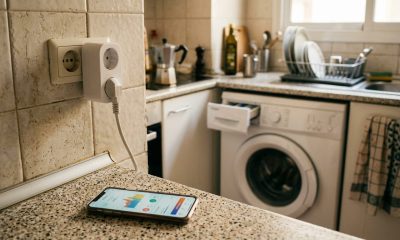
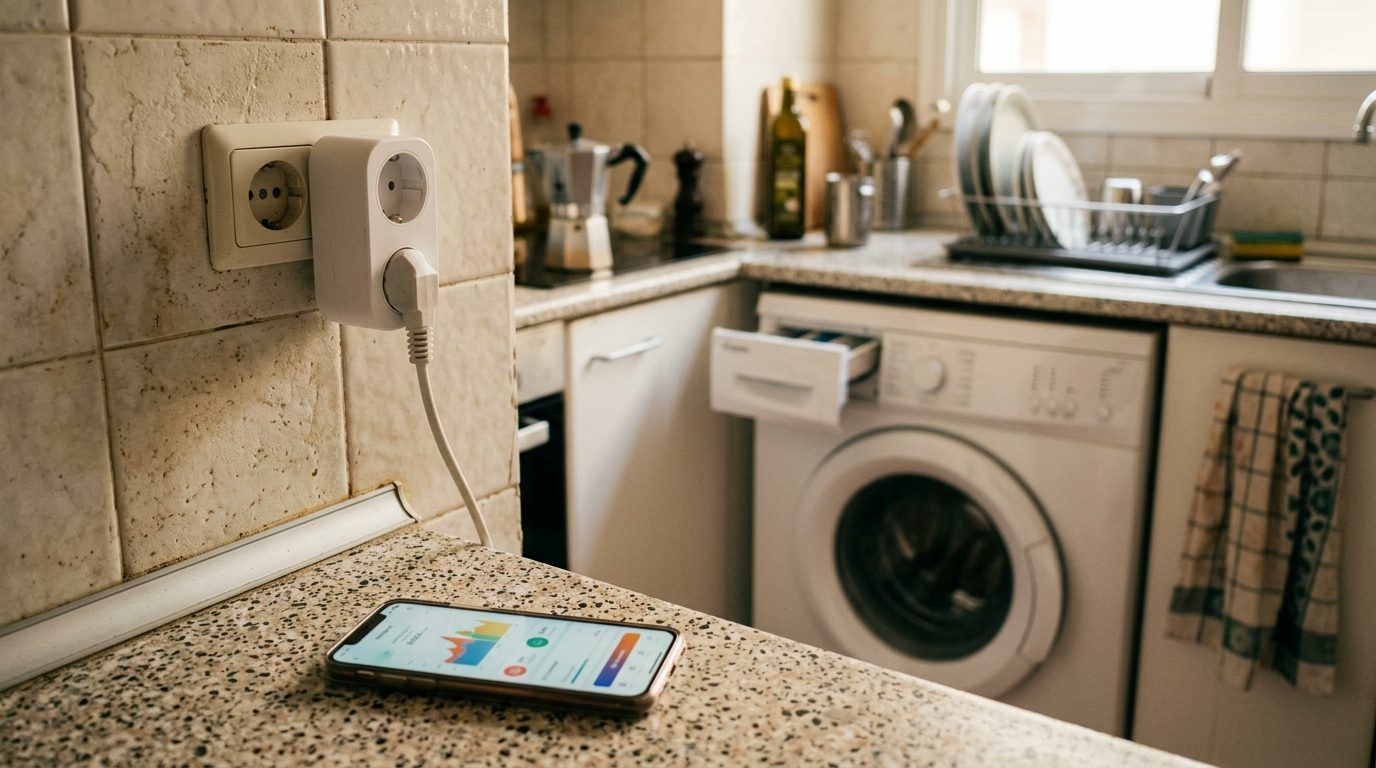
- Smart plugs with a timer and energy meter. Plug in the washing machine, dishwasher or a heater and set it to run in off-peak hours. The app shows how much each device really uses – often an eye-opener.
- Timer for the electric water heater (termo). Many flats have an electric termo that keeps water hot all day. Heating it only in off-peak hours, or once a day, cuts waste. Ask an electrician to fit a timer or smart switch.
- Smart thermostat or Wi-Fi control for air conditioning. Split AC units heat and cool most Spanish homes. A Wi-Fi module or smart IR controller lets you switch them on half an hour before you get home instead of leaving them on.
- LED bulbs and smart lighting. Replacing old halogen spots with LED is one of the quickest savings; lighting specialists such as El Maestro de la Iluminación (ad) sell LED bulbs and fittings.
- Energy monitor. A clamp-on monitor in the fuse box shows live consumption for the whole home and helps you find “energy vampires”.
- Dehumidifier with humidity control. Coastal homes get damp in winter. A dehumidifier makes rooms feel warmer at a lower temperature and protects against mould.
When to replace appliances
Old fridges, freezers and air conditioners can use far more electricity than modern ones. When you replace them, look at the EU energy label and, for AC, choose an inverter model with a good seasonal efficiency rating. Spanish retailers such as Electropolis (ad) and Kyoto Electrodomésticos (ad) sell appliances online with delivery in Spain. Remember that the shop must take your old appliance back when you buy a new equivalent one.
Simple habits that cost nothing
- Run the washing machine, dishwasher and oven at weekends or after 22:00 where you can.
- Set the AC to around 26 °C in summer and 20 °C in winter – each degree makes a difference.
- Close shutters (persianas) in the heat of the day in summer and at night in winter.
- Switch devices off at the plug instead of leaving them on standby.
Working from home? See our guide to buying a laptop and home office equipment in Spain.
FAQ: saving electricity in Spain
When is electricity cheapest in Spain?
On the 2.0TD tariff, from midnight to 08:00 on weekdays and all day at weekends and national holidays.
Do smart plugs really save money?
They save money when you use them to move consumption to cheaper hours or to switch off devices on standby. The plug itself uses very little power.
Is air conditioning expensive to run for heating?
Modern inverter heat pumps are among the most efficient ways to heat with electricity. Old units and portable electric heaters cost much more to run.
Disclaimer: Tariff periods and prices can change; check your contract and bill. This article is general information. Links marked “(ad)” are affiliate links – NewInSpain may earn a commission at no extra cost to you.







Cost of Living
Buying a laptop and home office equipment in Spain
Spanish keyboards, plugs, the three-year warranty, summer heat and recycling: what to know before you buy a laptop or set up a home office in Spain.

Updated: October 2026
Whether you work remotely, study online or simply need a computer for banking and the endless online forms of Spanish bureaucracy, you will probably buy a laptop or set up a home office here sooner or later. Most of it works just like at home – but there are a few Spanish details worth knowing before you spend money: the keyboard, the plugs, the warranty, the heat and what to do with your old devices.
Bring your laptop or buy one in Spain?
If your current laptop works well, bring it. Laptop chargers are almost always rated for 100–240 V, so they work on the Spanish 230 V / 50 Hz grid – you only need a plug adapter or a new cable. Spain uses the European type C and type F sockets (two round pins), the same as most of mainland Europe. If you come from the UK, Ireland or the US, buy a proper adapter or a replacement power cable rather than relying on cheap travel adapters for a device that is plugged in all day.
Online pharmacy & parapharmacySkincare, vitamins, baby care and more – delivered in SpainShop now
Vivid BusinessA business account for freelancers and companies in SpainOpen your account online, with sub-accounts and cards for your team.Learn more →(ad)
Buying a home in Spain? Simulate your mortgageSee your monthly payment with Banco Sabadell’s mortgage simulator.Try the simulator →(ad)
A bank account for autónomos in SpainCuenta Clara Autónomos: no commissions, free debit and credit cards, opened online.See the account →(ad)
A European bank you open from your phonebunq: an EU-licensed bank with debit cards, managed fully in the app. Sign up in about five minutes.Get started →(ad)
A mobile bank account with no commissionsB100, the mobile bank from Abanca: everyday account and free debit card, all in the app.Get the app →(ad)
Buying in Spain makes sense when your laptop is old anyway, when you want a local warranty, or when you need to replace a desktop that is too heavy to move.
The Spanish keyboard: check before you pay
Laptops sold in Spain normally come with a Spanish keyboard layout. It has the letter ñ to the right of L, a different position for many symbols (@, #, quotation marks, brackets) and a key for accents. Touch typists used to a UK, US, German or Scandinavian layout often find it frustrating.
- Many shops only stock the Spanish layout. Some manufacturers let you configure a different layout when you order directly from their own online store – check before you pay.
- You can always switch the layout in Windows, macOS or Linux, but the printed keys will not match. Keyboard stickers are a cheap fix.
- For a home office, an external keyboard in your preferred layout solves the problem and is better for your posture anyway.
What to look for in a work laptop
- Memory: 16 GB RAM is a comfortable minimum for video calls, many browser tabs and office software. 8 GB quickly feels slow.
- Storage: an SSD of at least 512 GB, or 256 GB if you keep everything in the cloud.
- Battery and weight: matter if you plan to work from cafés, co-working spaces or on the train.
- Webcam and microphone: a 1080p webcam makes a real difference if you spend your day in meetings.
- Cooling: Spanish summers are hot. A laptop that throttles at 30 °C indoors is a daily annoyance – read reviews that mention heat and fan noise.
- Ports: at least one USB-C port with charging and display output makes it easy to connect a monitor with one cable.
Home office equipment worth buying
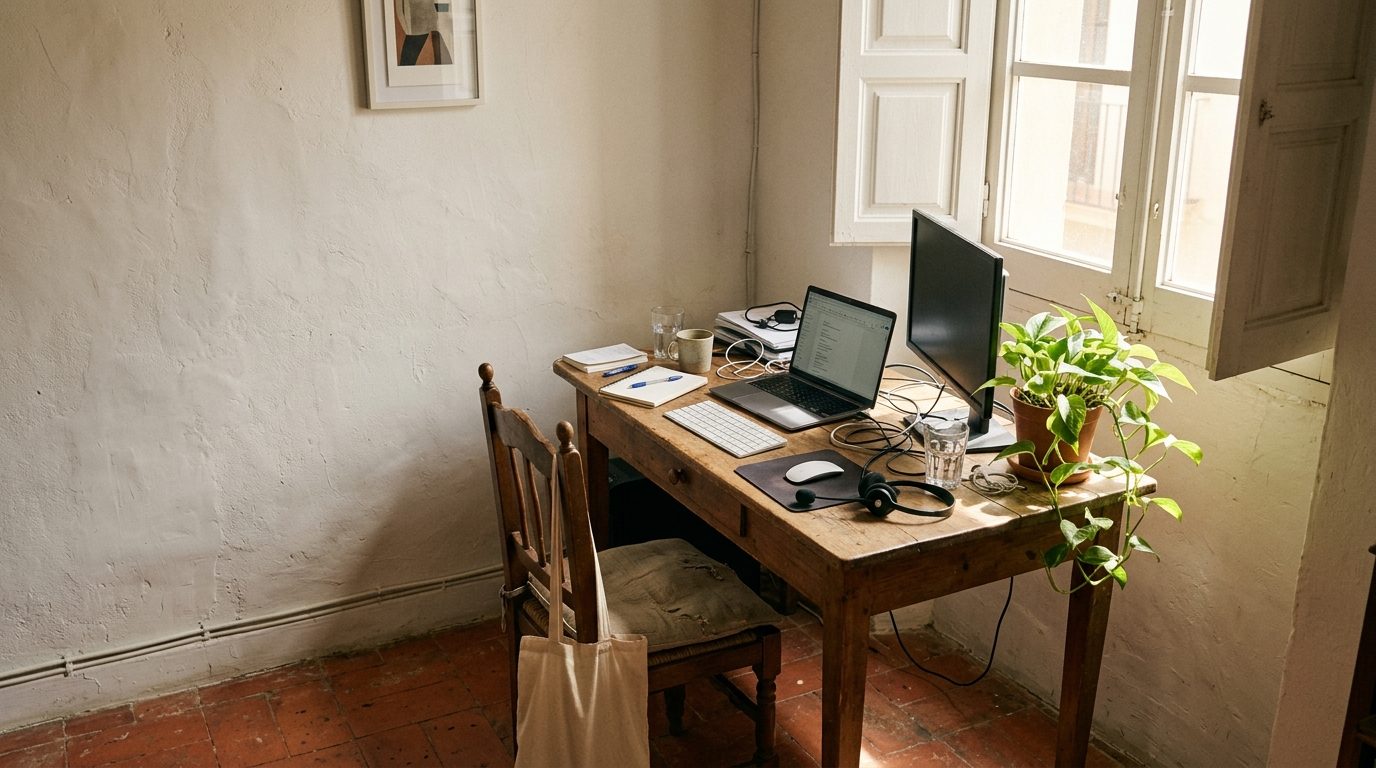
- External monitor: a 24–27 inch screen at eye level is the single biggest upgrade for long working days.
- Keyboard and mouse: in your own layout, if the laptop has a Spanish one.
- Headset: Spanish homes often have tiled floors and little soft furnishing, so rooms echo. A headset with a good microphone helps your colleagues more than a better webcam.
- Chair and desk: many furnished rentals come with a dining chair at best. An adjustable office chair is worth it if you work from home every day.
- Surge protector: storms and power cuts happen. A surge-protected power strip is cheap insurance for your equipment; a small UPS (uninterruptible power supply) keeps a router or desktop running through short outages.
- Fan or air conditioning: the room you work in will decide how productive you are in July and August.
Internet: the part that matters most
Spain has one of the most extensive fibre networks in Europe, and in most towns you can get symmetric fibre at a reasonable price. Check coverage at the exact address before you sign a rental contract – rural houses and some older buildings may only have 4G/5G home internet. Our guide to the best internet and mobile providers in Spain compares the main operators, and utility bills in Spain explains what you will pay each month.
Where to buy: shops, online and refurbished
- Electronics chains and department stores have laptops on display, so you can try the keyboard and screen before you buy.
- Online shops often have a wider range and better prices. Compare the final price including delivery.
- Manufacturers’ own stores are the best place to look for other keyboard layouts and custom configurations.
- Refurbished devices from professional sellers are a good way to save money; they still come with a legal warranty (see below).
- Second-hand from private sellers (Wallapop and similar) can be cheap but carries no legal warranty. Meet in person and test the device first.
Your rights as a buyer in Spain
- Three-year legal warranty: since 1 January 2022, new goods bought from a business in Spain have a minimum legal guarantee of three years from delivery. If a fault appears within the first two years, it is presumed to have existed when you bought it.
- Refurbished and second-hand from a business: the seller may shorten the guarantee, but not below one year.
- 14 days to change your mind online: for purchases made online or by phone you can withdraw within 14 days without giving a reason. This does not apply to purchases in a physical shop, where returns depend on the shop’s own policy.
- Keep the invoice (factura): you need it for warranty claims. If you are self-employed, ask for a full invoice with your NIF/NIE so you can deduct the purchase.
Prices in shops include VAT (IVA) at 21%. In the Canary Islands, IGIC applies instead at a lower rate.
Recycling your old devices
Electronic devices must not go in the normal rubbish. When you buy a new device, the shop is generally obliged to take back an equivalent old one free of charge, and large electronics shops must accept very small devices even without a purchase. You can also take old electronics to your town’s recycling point (punto limpio). Wipe your data first.
Working for yourself? Get a professional address
If you freelance or run a small business from your home office, a professional email address on your own domain looks better to clients than a free webmail address. Spanish providers such as Nominalia (ad) offer domains, email and hosting with Spanish-language support. For the paperwork side of freelancing, see our guide to becoming autónomo in Spain.
Useful links
- European Consumer Centre Spain: guarantees (Spanish)
- Working remotely for a foreign company while living in Spain
- Best internet and mobile providers in Spain
- Cost of living in Spain in 2026
FAQ: laptops and home office equipment in Spain
Can I buy a laptop with an English keyboard in Spain?
It is possible but not always easy. Most shops sell the Spanish layout. Look at manufacturers’ own online stores, which sometimes let you choose the layout, or use an external keyboard.
Will my UK or US laptop charger work in Spain?
Almost certainly – most laptop chargers accept 100–240 V. Check the label on the charger. You only need a type C/F plug adapter or a replacement cable.
How long is the warranty on electronics in Spain?
New products bought from a business have a three-year legal guarantee. For second-hand or refurbished goods from a business it can be shortened, but not below one year.
Can I return a laptop I bought online?
Yes, within 14 days of receiving it, without giving a reason, as long as the shop is a business selling at a distance. Check how the shop wants the product returned.
Disclaimer: This article is general information, not legal or financial advice. Links marked “(ad)” are affiliate links – NewInSpain may earn a commission at no extra cost to you. Prices, products and shop policies change; check before you buy.
Cost of Living
Spanish supermarkets compared: Mercadona, Lidl, Carrefour and more
A neutral comparison of Spain’s main supermarket chains: strengths, own brands, loyalty apps, which is cheapest and how online delivery works.

Updated: October 2026
Your weekly shop is one of the biggest regular costs after rent, and Spain has a wide choice of supermarket chains, each with its own style. This guide is for newcomers trying to work out where to shop. It compares the main national chains, explains own-brand ranges and loyalty apps, and covers online shopping and home delivery, so you can pick the mix that suits your budget and your neighbourhood.
The main chains at a glance
| Chain | Typical strengths | Own brands and loyalty | Online shopping |
|---|---|---|---|
| Mercadona | Huge network, consistent stores, strong fresh and ready-meal sections | Hacendado (food), Deliplus (beauty), Bosque Verde (cleaning); no loyalty card or coupons | Own online shop with home delivery in many areas |
| Lidl | Discount prices, in-store bakery, weekly non-food offers | Mostly own brands; Lidl Plus app with coupons and points | Online shop focused on non-food |
| Aldi | Compact discount stores, short shopping trip | Mostly own brands | Limited |
| Carrefour | Hypermarkets with very wide range, including international food and household goods; smaller Market and Express stores | Carrefour brand, including organic lines; Club Carrefour loyalty scheme | Wide delivery coverage and click and collect |
| Dia | Small neighbourhood stores close to home | Dia own brand; Club Dia loyalty scheme | Online orders, often same-day in cities |
| Alcampo | Large hypermarkets, often ranked among the cheapest | Alcampo brand; loyalty scheme | Home delivery and collection |
| El Corte Inglés / Hipercor | Premium and imported products, gourmet section | Own premium ranges | Home delivery in many cities |
Strong regional chains are worth knowing too, and in some areas they are the most convenient option: Consum in the Valencia region and along the east coast, Eroski in the Basque Country and the north, Gadis in Galicia, Ahorramas in Madrid, BonÀrea and Bonpreu in Catalonia, and Covirán and Mas in Andalucía. Many towns also have their own local chains with very competitive prices.
Online pharmacy & parapharmacySkincare, vitamins, baby care and more – delivered in SpainShop now
Vivid BusinessA business account for freelancers and companies in SpainOpen your account online, with sub-accounts and cards for your team.Learn more →(ad)
Buying a home in Spain? Simulate your mortgageSee your monthly payment with Banco Sabadell’s mortgage simulator.Try the simulator →(ad)
A bank account for autónomos in SpainCuenta Clara Autónomos: no commissions, free debit and credit cards, opened online.See the account →(ad)
A European bank you open from your phonebunq: an EU-licensed bank with debit cards, managed fully in the app. Sign up in about five minutes.Get started →(ad)
A mobile bank account with no commissionsB100, the mobile bank from Abanca: everyday account and free debit card, all in the app.Get the app →(ad)
Which supermarket is cheapest?
The best independent source is the annual price survey by consumer organisation OCU. Its 2026 supermarket study, published in September 2026, visited 690 shops in 38 cities plus online supermarkets. Its main findings:
- Prices vary more by shop than by chain. OCU puts the average possible saving from choosing the cheapest supermarket in your town at around 1,310 euros a year, and much more in big cities such as Madrid.
- Regional and discount chains often win. A small regional chain came out cheapest overall, with Alcampo and Carrefour’s discount format Supeco close behind. Lidl was the cheapest option in more towns than the year before.
- Own brands keep getting cheaper. OCU’s basket of the cheapest products in each shop fell in price on average, with the biggest drops at Mercadona and Lidl, while manufacturer brands rose.
Rankings change every year and depend on what you buy, so treat them as a guide. Part of the full OCU ranking is only open to members, but the free summary already shows which chains are cheap in many towns.
Own brands: the marca blanca habit
Spanish shoppers buy a lot of own-brand products, known as marca blanca or marca de distribuidor. Many of them are made by well-known Spanish producers, and quality is usually good. Some own-brand items have a loyal following, from Mercadona’s ready meals and cosmetics to Lidl’s bakery and weekly speciality food weeks.
A practical approach is to try own brands for basics such as milk, pasta, rice, tinned tomatoes and cleaning products, and keep branded products where you notice a real difference. The packaging lists the producer and a health registration number, so you can often see who makes the product.
Loyalty apps, offers and ways to save
- Apps and cards: Lidl, Carrefour, Dia, Alcampo, Eroski and Consum run loyalty schemes with personalised coupons or money back. Mercadona is the big exception: it does not run promotions and aims for stable everyday prices instead. You can find what the Lidl app offers on its website (in Spanish).
- Weekly leaflets: most chains publish offers online every week. “2ª unidad al 50%” means the second unit is half price, and “3×2” means three for the price of two.
- Compare unit prices: shelf labels must show the price per kilo or litre (precio por kilo/litro), which is the fairest way to compare pack sizes.
- Use the market as well: for fruit, vegetables, fish and meat, the local mercado municipal and weekly street market can beat supermarket quality and price, especially for seasonal produce.
- Bring your bags: shops must charge for plastic bags, so keep reusable bags or a trolley handy.
Online shopping and home delivery
Online grocery shopping has grown fast in Spain, but coverage still depends on your postcode. Check before you rely on it, especially if you live in a village or an urbanisation outside town.
- Mercadona: runs its own online shop from dedicated warehouses in several big cities. Orders have a minimum amount and a service charge, delivery starts the next day depending on slots, and you pay by card online. See Mercadona’s online shopping FAQ in English. The old service of delivering in-store purchases to your home is being phased out and is only offered by some stores.
- Carrefour: has one of the widest online grocery services, including the Balearic and Canary Islands, with home delivery or collection in store via carrefour.es.
- Dia, Alcampo, Eroski, Consum and El Corte Inglés: all offer online orders in many areas, with options from same-day delivery in cities to collection points.
- Lidl: its online shop is mainly for non-food items such as household goods, tools and clothing; for groceries you still go to the store.
- Delivery apps: Glovo, Uber Eats and Amazon deliver from some supermarkets and convenience stores in larger cities, usually at higher prices than the shop.
Delivery fees, minimum orders and free-delivery thresholds change often and differ by chain, so compare them on each website before your first order. Some online shops expect a Spanish phone number, and cards issued abroad are occasionally declined; see our guide to opening a bank account in Spain.
Practical tips for your first shop
- Check opening hours: large supermarkets usually open all day from Monday to Saturday, but Sunday opening depends on your region.
- Use gloves or bags for fruit: in many shops you take a plastic glove or bag to pick loose fruit and vegetables, and some still ask you to weigh and label them yourself.
- Fresh counters: at the meat, fish and cheese counters, take a number from the machine and wait your turn. Staff will clean and cut fish for free if you ask.
- Look for home comforts: Carrefour, El Corte Inglés and supermarkets in expat areas usually stock the widest range of international products.
For a full picture of household spending, see our guides to the cost of living in Spain and family living costs.
Useful links
- OCU: the cheapest supermarkets of 2026 (Spanish)
- Mercadona: online shopping FAQ
- Carrefour Spain online shop
- Cost of living in Spain
- Living on a small salary in Spain
FAQ: supermarkets in Spain
Which supermarket is the cheapest in Spain?
It depends on your town and what you buy. OCU’s yearly study shows that discount and regional chains are often cheapest, and that choosing the right shop locally matters more than the chain name.
Does Mercadona have a loyalty card?
No. Mercadona does not run a loyalty card, coupons or promotions. Most other big chains do, usually through an app.
Can I order groceries online if I live outside a city?
Often yes, but coverage depends on your postcode. Enter it on each chain’s website before ordering, and compare delivery fees and minimum order amounts.
Where can I find food from home?
Large Carrefour hypermarkets and El Corte Inglés usually have the biggest international sections. In expat areas, local supermarkets and specialist shops also stock British, Dutch, German and Scandinavian products.
Disclaimer: This article is general information only and is not sponsored by any supermarket. Prices, delivery areas, fees and loyalty schemes change often – always check the chain’s own website before you shop.
Cost of Living
Electricity, water, gas and internet bills in Spain in 2026
How Spanish household bills work in 2026: electricity power and tariffs, PVPC vs free market, water, butane, community fees and tips to save.
Updated: October 2026
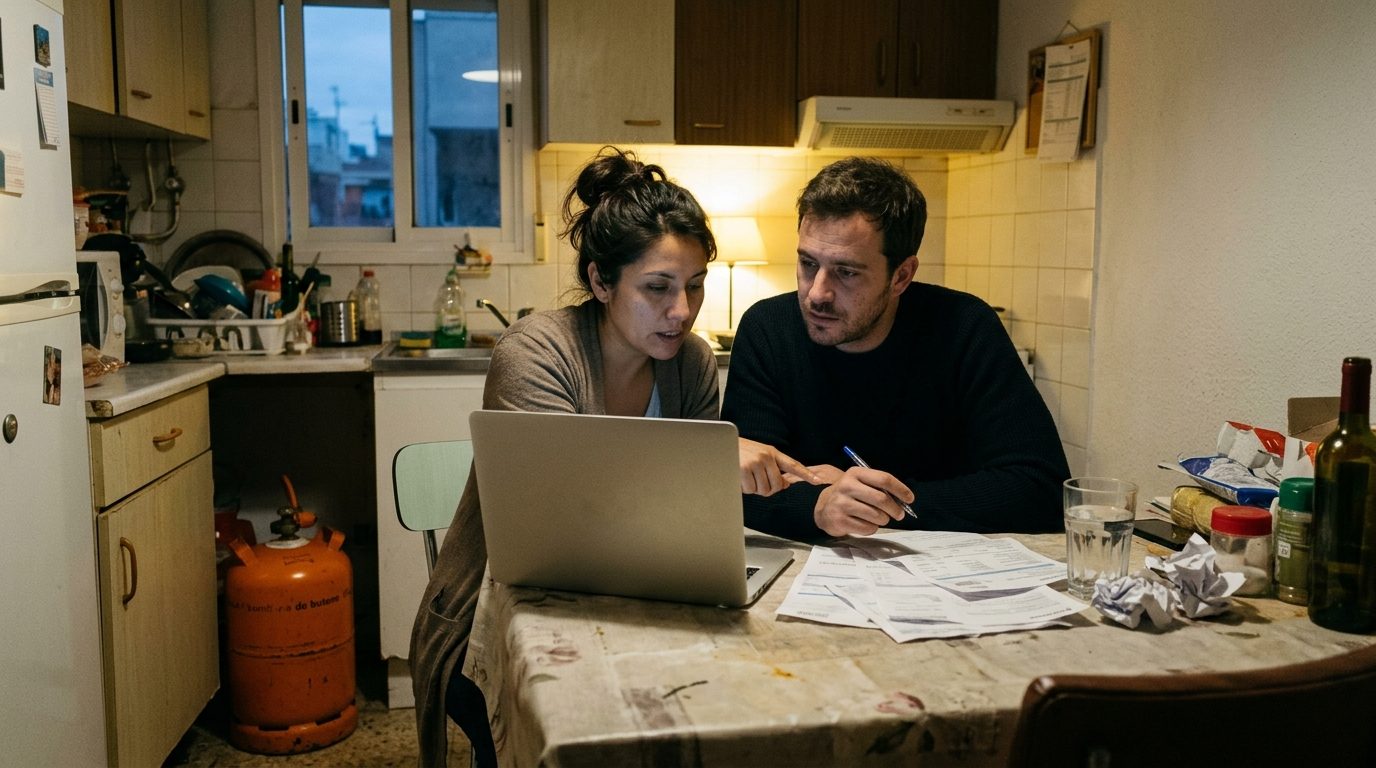
Household bills in Spain work differently from what many newcomers expect. Electricity is split into a fixed charge for power and a variable charge for use, water is run by your town, and many homes still cook with butane bottles. This guide explains how each bill works in 2026, what recent official and consumer figures show, and practical ways to keep costs down.
For the bigger picture of rent, food and transport, see our cost of living guide for Spain.
Online pharmacy & parapharmacySkincare, vitamins, baby care and more – delivered in SpainShop now
Vivid BusinessA business account for freelancers and companies in SpainOpen your account online, with sub-accounts and cards for your team.Learn more →(ad)
Buying a home in Spain? Simulate your mortgageSee your monthly payment with Banco Sabadell’s mortgage simulator.Try the simulator →(ad)
A bank account for autónomos in SpainCuenta Clara Autónomos: no commissions, free debit and credit cards, opened online.See the account →(ad)
A European bank you open from your phonebunq: an EU-licensed bank with debit cards, managed fully in the app. Sign up in about five minutes.Get started →(ad)
A mobile bank account with no commissionsB100, the mobile bank from Abanca: everyday account and free debit card, all in the app.Get the app →(ad)
How an electricity bill works
A Spanish electricity bill (factura de la luz) has two main parts, plus taxes:
- Término de potencia: a fixed daily charge for the contracted power in kW, the maximum you can draw at once. Too low and the trip switch cuts out when the oven and the washing machine run together; too high and you pay for capacity you never use.
- Término de energía: what you pay per kWh actually consumed.
- Other items: meter rental, the electricity tax (impuesto especial sobre la electricidad) and VAT.
Taxes have moved around in 2026. VAT on electricity was cut temporarily to 10% in spring, then returned to 21% from June, with the electricity tax back at about 5.1%. A decree in force since 1 October 2026 allows the reduced rates to return for some months if energy prices rise sharply, so check the tax lines on each bill.
Regulated PVPC or the free market
Households with up to 10 kW can choose between two kinds of contract:
- PVPC (precio voluntario para el pequeño consumidor): the regulated tariff, sold only by a handful of “reference” suppliers (comercializadoras de referencia). The price changes every hour and follows the wholesale market, although since January 2026 it is partly linked to futures prices to soften the peaks. It is also required for the social discount (bono social).
- Mercado libre (free market): each company sets its own prices, often fixed for 12 months, sometimes with different prices by time of day. More predictable, but read the small print on price reviews and extra services.
Switching between suppliers is free, does not cut your supply and keeps the same supply point number (CUPS).
Tariff periods
Most homes are on the 2.0TD access tariff, which divides the day into three periods on the mainland, the Balearic and the Canary Islands:
| Period | Monday to Friday | Weekends and national holidays |
|---|---|---|
| Punta (peak, most expensive) | 10:00–14:00 and 18:00–22:00 | – |
| Llano (mid) | 08:00–10:00, 14:00–18:00 and 22:00–24:00 | – |
| Valle (off-peak, cheapest) | 00:00–08:00 | All day |
What a typical bill looks like
The consumer organisation OCU calculates a reference bill every month for a household on the PVPC with 4.6 kW contracted and 292 kWh of use. For consumption in July 2026 it put that bill at 77.84 euros, up from 66.63 euros in June, as wholesale prices rose. Your own bill depends on the size of your home, air conditioning or electric heating, and your contract.
The bono social
Low-income households, large families and some pensioners can apply for the electricity bono social through a reference supplier. The standard discount is 35% for vulnerable and 50% for severely vulnerable consumers, temporarily raised to 42.5% and 57.5% until 31 December 2026. You must be on the PVPC, have no more than 10 kW and apply for your main home. The Ministry for the Ecological Transition explains the rules.
Water, gas and butane
Water
Water is a municipal service, run either by the town hall or by a company on its behalf, so prices vary a lot between towns. Bills usually arrive every two or three months and combine a fixed service charge, consumption in price blocks (the more you use, the higher the price per cubic metre), sewage and treatment, and sometimes a regional water levy. In many towns the waste collection fee also appears on the water bill. In flats with a single shared meter, the community divides the water cost and includes it in the fees.
Natural gas
Piped natural gas is common in big cities and in the north, less so on the coast. Like electricity, there is a regulated option (TUR, tarifa de último recurso) and free-market offers, and the bill has a fixed part and a part based on use.
Butane bottles
Many homes in Andalusia and other warm regions use orange 12.5 kg butane bottles for cooking, hot water or portable heaters. The maximum price is regulated and reviewed every two months, on the third Tuesday of the month. Since 15 September 2026 it has been 18.84 euros per bottle on the mainland, and the government has set a ceiling of 19.55 euros until June 2027. You can order delivery from the distributor or buy at some petrol stations.
Internet and mobile
Fibre is widely available in Spanish towns, and most providers sell fibre and mobile bundles, often with a 12-month commitment. Check whether the price is an introductory offer and what it will be afterwards. Our guide to internet and mobile providers in Spain compares the main options.
Community fees, IBI and rubbish tax
Owners pay several housing costs that are not utilities but should be in the monthly budget:
- Community fees (cuota de comunidad): pay for cleaning, lifts, gardens, pool, building insurance and the administrator. They depend on the building’s services and your share of ownership, so ask for the latest community accounts before you buy or rent.
- IBI: the annual municipal property tax, normally paid by the owner, although some rental contracts pass it on to the tenant.
- Basura (waste fee): since the 2022 waste law, councils must charge a fee that covers the real cost of collecting and treating rubbish, so many towns have raised it since 2025. It may come as a separate bill, with IBI or on the water bill.
Our guide to property taxes for foreign owners explains IBI and other owner taxes in more detail.
Tips to cut your bills
- Check your contracted power: if the switch never trips, you may be able to lower it and cut the fixed charge. Changes can be limited to once a year.
- Shift use to off-peak hours: run the washing machine, dishwasher and electric car charging at night or at weekends.
- Compare offers neutrally: the CNMC energy comparator lists regulated and free-market offers verified by the regulator.
- Say no to extras: maintenance services and insurance added to energy contracts are optional.
- Use shade and fans: blinds closed in the afternoon and ceiling fans reduce air conditioning use in summer.
- Read the meter on arrival: when you move in, note the readings and change the contracts into your name, so you do not pay for the previous occupant.
Useful links
- CNMC: energy offers comparator (Spanish)
- MITECO: what the bono social is
- OCU: electricity bill for July 2026 (Spanish)
- Cost of living in Spain
- Internet and mobile providers in Spain
- Property taxes for foreign owners in Spain
FAQ: household bills in Spain
Is the PVPC cheaper than a fixed-price contract?
It depends on the market and on when you use electricity. The PVPC can be cheaper if you shift use to off-peak hours, while a fixed price gives predictability when wholesale prices rise.
How much does a butane bottle cost in Spain?
Since 15 September 2026 the regulated maximum price of a 12.5 kg bottle on the mainland is 18.84 euros. It is reviewed every two months.
Who pays the water bill when I rent?
Usually the tenant pays for consumption, either directly to the water company or through the landlord. Your rental contract should say which bills are included in the rent.
Can foreigners get the bono social?
Residents who meet the income or family criteria can apply for their main home, with proof of registration on the padrón and identity documents for everyone in the household.
Disclaimer: This article is general information only. Prices, taxes and tariffs change often – always check your contract, your supplier and the official source before you act.



 Ad
 A sea-view escape in MallorcaThe Donna Portals – stay by the sea with views over the Mediterranean.See prices →

 Vivid BusinessA business account for freelancers and companies in SpainOpen your account online, with sub-accounts and cards for your team.✓ For autónomos and companies
✓ Sub-accounts for budgets and taxes
✓ Cards for your teamLearn more →(ad)
 A European bank you open from your phoneSign up with bunq in about five minutes.Get started →(ad)


Smart home gadgets that cut your electricity bill in Spain

Dog beaches on the Costa del Sol: where your dog is allowed

Adopting a dog or cat in Spain: shelters, rules and how it works

Andalucía guide: cities, culture and life in southern Spain

Understanding the tax system in Spain

Marbella guide: areas, beaches and everyday life






-

 Tourist Info2 years ago
Andalucía guide: cities, culture and life in southern Spain
-
Banking & Finances2 years ago
Understanding the tax system in Spain
-
Tourist Info2 years ago
Marbella guide: areas, beaches and everyday life
-
Cost of Living2 years ago
Living on a small salary in Spain in 2026
-
Spanish System2 years ago
How the Spanish government works: state, regions, provinces and town halls
-
Tourist Info2 years ago
Benalmádena explained: Pueblo, Arroyo de la Miel and the coast
-
Cost of Living2 years ago
Family living costs in Spain in 2026: monthly budget and moving-in money
-
Insurance2 years ago
Understanding insurance in Spain: a 2026 guide for expats