


































































Transportation
Renting a car in Spain: what to check before you sign
Licence, deposit, fuel policy, insurance excess, damage checks, tolls and low-emission zones: what to check before you rent a car in Spain.








Renting a car is often the easiest way to explore Spain, collect visitors from the airport or get by while you wait for your own car. Most rentals go smoothly, but the problems people do run into are usually the same: a debit card that the desk will not accept, a fuel policy nobody explained, a scratch you are blamed for, or a fine that turns up weeks later. This checklist covers what to look at before you sign, from your licence to the low-emission zones now found in Spanish cities.
Check that your licence is valid
According to the DGT, Spain’s traffic authority, a driving licence issued in an EU or EEA country is valid in Spain for as long as it is in force. Licences from other countries are valid if they are in force and you meet the Spanish minimum age for that category. Some visitors also need an International Driving Permit, depending on the country that issued the licence, so check before you travel.
If you have moved to Spain, the picture changes: a non-EU licence can only be used for up to six months after you become a resident. After that you need to exchange it or take a Spanish test. Our guide to driving licence rules for EU, UK and non-EU drivers explains the details.







 Online pharmacy & parapharmacySkincare, vitamins, baby care and more – delivered in SpainShop now
Vivid BusinessA business account for freelancers and companies in SpainOpen your account online, with sub-accounts and cards for your team.Learn more →(ad)
 Buying a home in Spain? Simulate your mortgageSee your monthly payment with Banco Sabadell’s mortgage simulator.Try the simulator →(ad)
 A bank account for autónomos in SpainCuenta Clara Autónomos: no commissions, free debit and credit cards, opened online.See the account →(ad)
 A European bank you open from your phonebunq: an EU-licensed bank with debit cards, managed fully in the app. Sign up in about five minutes.Get started →(ad)
 A mobile bank account with no commissionsB100, the mobile bank from Abanca: everyday account and free debit card, all in the app.Get the app →(ad)


Rental companies also set their own conditions, such as a minimum age, a minimum number of years with a licence and extra charges for young drivers or additional drivers. These are in the terms, not the headline price, so read them before you pay.
Deposit and payment card
Most companies block a deposit on your card when you pick up the car and release it after you return it. The amount depends on the company, the car and the insurance you choose.
- Credit or debit: many companies require a credit card in the main driver’s name. Some accept debit cards only with their full insurance, and some not at all. Check this before you book.
- Card limit: make sure your available limit covers the deposit plus any spending you plan on the trip.
- Release time: it can take several days for the blocked amount to reappear on your card after you return the car.
Comparison sites help you see the conditions of several companies side by side. VIP Cars (ad) is a car rental comparison service where you can compare offers and read the rental terms before you book.
Fuel policy and extras
The fuel policy can change the real price of a rental a lot. The most common types are:







- Full to full: you get the car with a full tank and return it full. Usually the fairest option. Keep the receipt from a petrol station near the drop-off point.
- Full to empty (pre-paid fuel): you pay for a full tank at pick-up, often with a service fee, and get no refund for fuel you do not use. This rarely pays off on short trips.
- Same to same: you return the car with the same level as when you got it. Photograph the fuel gauge at pick-up.
Also check the price of child seats, an additional driver, one-way drop-off, out-of-hours collection and taking the car to another country. Under EU consumer rules, you should be shown the full price including unavoidable charges before you pay.
Insurance and the excess
Every rental car in the EU must have third-party liability insurance, and the cost must be included in the rental price. What varies is the cover for damage to the rental car itself. The basic cover usually comes with an excess (franquicia): the amount you pay yourself if the car is damaged or stolen.
- Ask what the excess is in euros, and what is excluded. Tyres, windows, mirrors, the underside of the car and keys are often not covered.
- The desk may offer extra cover to reduce the excess to zero. It can be worth it, but compare the price with the deposit you would otherwise have blocked.
- Separate excess insurance from a third party can be cheaper, but then you usually pay the rental company first and claim the money back later.
If you live in Spain and will soon buy your own car, our guide to car insurance in Spain for expats explains the types of cover.
Damage check at pick-up and return
Disputes about damage are the most common rental complaint. Protect yourself with a few minutes of checks:
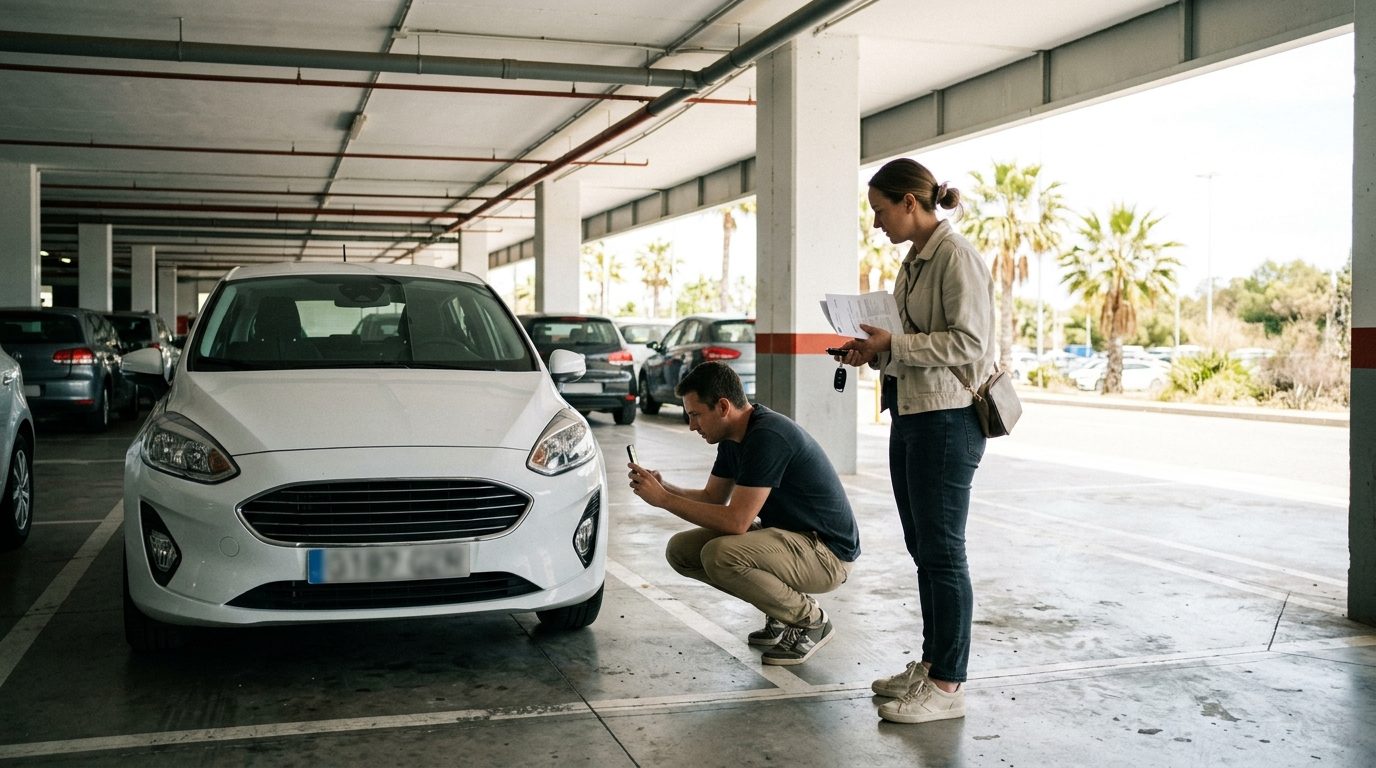
- Walk around the car and film it slowly in daylight, including wheels, bumpers, windscreen and roof.
- Make sure every scratch and dent is marked on the damage form before you drive away. If staff say “small marks do not matter”, ask them to write that down.
- Photograph the dashboard with mileage and fuel level.
- On return, ask for the car to be checked with you and get a signed return document. If you drop the keys off out of hours, film the car in the car park.
If you disagree with a charge, complain in writing to the company first. Businesses in Andalucía must offer an official complaint form (hoja de reclamaciones). If you rented from a company based in another EU country, the European Consumer Centre in your country can also help.
Tolls, fines and low-emission zones
Most Spanish motorways are free, but some are still toll roads. On the Costa del Sol, the AP-7 between Málaga and Guadiaro and the AP-46 to Las Pedrizas charge tolls, while the A-7 runs along the coast without tolls. Ask the rental company whether the car has an electronic toll device and how they charge for it.
Speed cameras and parking fines are sent to the rental company, which passes your details to the authorities and usually adds an administration fee. Read that fee in the terms.
Since Spain’s climate change law of 2021, larger towns must set up low-emission zones (zonas de bajas emisiones, ZBE). Access depends on the car’s DGT environmental label: CERO, ECO, C or B. Málaga, for example, has a camera-controlled ZBE in the centre, and cars without a label can be fined. Its rules have been challenged in court in 2026 and may change. Rental cars are usually recent models with a label, but if you rent an older or cheaper car, ask which label it has and check the rules of the cities you plan to visit.
Picking up your car at the airport? Our guide to airports in Spain and how to get into town covers the main airports.
FAQ: renting a car in Spain
Can I rent a car in Spain with a debit card?
Sometimes. Many companies require a credit card for the deposit, and others accept debit cards only if you buy their full insurance. Check the payment conditions before you book, not at the desk.
Is insurance included in the rental price?
Third-party liability insurance must be included. Cover for damage to the rental car usually comes with an excess that you pay yourself, unless you buy extra cover.
Which fuel policy is best?
For most trips, “full to full” is the fairest, because you only pay for the fuel you use. Keep the petrol station receipt as proof.
Can a rental car enter a low-emission zone?
Usually yes, because most rental cars have a DGT environmental label. Cars without a label can be fined in some cities, including Málaga, so ask the company which label your car has.
Useful links
- DGT: foreign licences valid in Spain (Spanish)
- Your Europe: renting a car in another EU country
- Málaga City Council: low-emission zone (Spanish)
Disclaimer: This article is general information, not legal or financial advice. Rules and prices change, so check with the official source before you decide. Links marked “(ad)” are affiliate links – NewInSpain may earn a commission at no extra cost to you.


Transportation
Winter tyres in Spain: when you need them and where to buy
When winter tyres or snow chains are required in Spain, what the 3PMSF and M+S markings mean, and how to buy and fit tyres.

Updated: October 2026
Most of coastal Spain never sees snow, so many newcomers are surprised to learn that winter tyres are a topic here at all. But Spain is one of the most mountainous countries in Europe, and if you drive to the Sierra Nevada, the Pyrenees or across the central plateau in winter, the rules on tyres and chains can apply to you. This guide explains when you need winter tyres or chains, what the markings on your tyres mean, and how to buy and fit new tyres in Spain.
Are winter tyres compulsory in Spain?
There is no general winter tyre season in Spain, unlike in Germany or the Nordic countries. You can drive all year on normal summer tyres. The obligation only applies on specific roads, when signs tell you so.
Online pharmacy & parapharmacySkincare, vitamins, baby care and more – delivered in SpainShop now
Vivid BusinessA business account for freelancers and companies in SpainOpen your account online, with sub-accounts and cards for your team.Learn more →(ad)
Buying a home in Spain? Simulate your mortgageSee your monthly payment with Banco Sabadell’s mortgage simulator.Try the simulator →(ad)
A bank account for autónomos in SpainCuenta Clara Autónomos: no commissions, free debit and credit cards, opened online.See the account →(ad)
A European bank you open from your phonebunq: an EU-licensed bank with debit cards, managed fully in the app. Sign up in about five minutes.Get started →(ad)
A mobile bank account with no commissionsB100, the mobile bank from Abanca: everyday account and free debit card, all in the app.Get the app →(ad)
Since the 2025 reform of the traffic rules (Real Decreto 465/2025), road authorities can post a sign that requires winter tyres on a stretch of road. Before that, the classic sign in snowy conditions only required snow chains. In practice you will meet these signs on mountain passes, ski resort access roads and high roads in the interior when snow or ice is expected. Without the sign, there is no obligation.
If you ignore a sign that requires chains or winter tyres, the fine is normally 200 euros, and in heavy snow the Guardia Civil can stop you from continuing your journey.
What the markings on your tyres mean
- 3PMSF (a mountain with a snowflake): a true winter tyre, tested for snow. This is the marking that counts when winter tyres are required, and many all-season tyres also carry it.
- M+S (mud and snow): an older marking set by the manufacturer, without a standard snow test. It may be accepted in light conditions, but in heavy snow you can still be asked to fit chains.
- No marking: a summer tyre. Carry chains if you plan to drive into the mountains in winter.
Whatever tyres you have, the legal minimum tread depth in Spain is 1.6 mm. For winter driving, most experts recommend replacing tyres well before that point, as grip on wet and icy roads drops quickly once the tread is worn.
Who actually needs winter tyres?
- You live on the coast and stay there: good summer or all-season tyres are enough. Check tread and pressure before the rainy season, as the first autumn rains make roads very slippery.
- You go skiing or drive to the mountains a few times a year: all-season tyres with the 3PMSF marking are a practical choice, or carry snow chains (or textile snow socks) in the boot.
- You live inland or in the mountains: in places such as Granada province, the Pyrenees, Castilla y León or Teruel, proper winter tyres from November to March are worth it.
Buying and fitting tyres in Spain
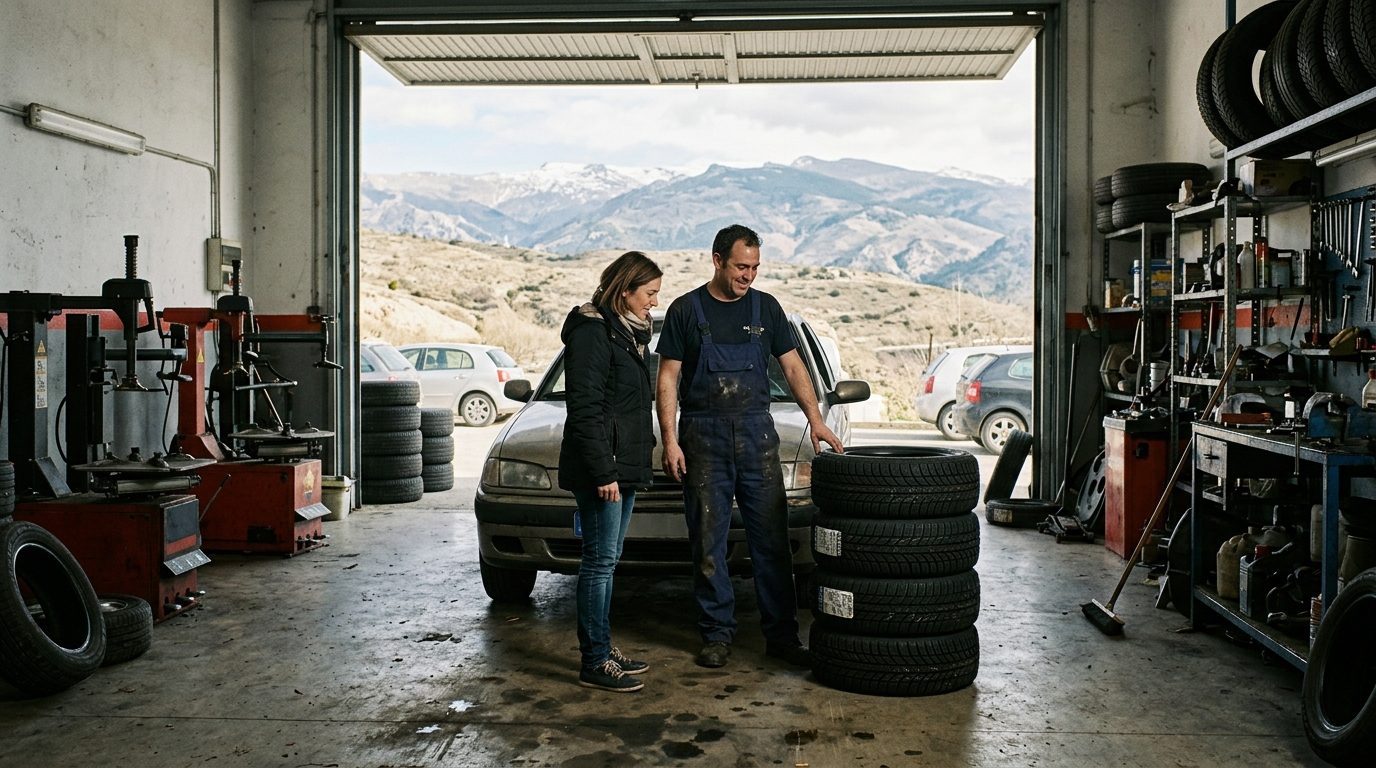
Tyres are sold by local garages (talleres), large chains and online shops. Buying online is often cheaper: you order the tyres, have them delivered to a garage near you and pay the garage a fitting fee, which normally includes balancing and disposal of the old tyres.
You can compare brands and prices for summer, winter and all-season tyres at Neumaticos (ad). Before you order, check the size on the sidewall of your current tyres (for example 205/55 R16 91V) and ask your garage what they charge for fitting tyres bought online.
Your tyres are also checked at the ITV inspection. Worn, damaged or mismatched tyres are a common reason for failing. If you are about to buy a car in Spain, look at the tyres too: replacing four tyres can easily add a few hundred euros to the price.
Tips for winter driving in Spain
- Check the DGT traffic information before you drive into the mountains. Roads can be closed to vehicles without chains or winter tyres at short notice.
- Practise fitting your chains at home on a dry day, not for the first time at the side of a snowy road.
- Keep a blanket, water, a charged phone and a full tank when driving to ski resorts. Queues can be long when roads close.
- Remember that winter tyres wear faster on warm, dry roads. On the coast, change back in spring.
Useful links
- DGT (Dirección General de Tráfico): traffic information and rules
- Real Decreto 465/2025 amending the traffic regulations (ICAB summary)
FAQ: winter tyres in Spain
Do I have to change to winter tyres in winter in Spain?
No. There is no national winter tyre season. You only need winter tyres or chains on roads where a sign requires them, mostly in the mountains.
Are all-season tyres accepted as winter tyres?
All-season tyres with the 3PMSF symbol (a mountain with a snowflake) count as winter tyres. All-season tyres with only M+S may not be enough in heavy snow.
What is the fine for not having chains or winter tyres?
Normally 200 euros when a sign requires them, and the police can stop you from continuing in severe conditions.
What is the minimum tread depth in Spain?
1.6 mm across the main grooves of the tyre. Many experts recommend changing earlier, especially before winter.
Disclaimer: This article is general information only. Traffic rules can change and road conditions vary – always follow the signs and check the DGT before you travel.




 Ad
 A sea-view escape in MallorcaThe Donna Portals – stay by the sea with views over the Mediterranean.See prices →

 Vivid BusinessA business account for freelancers and companies in SpainOpen your account online, with sub-accounts and cards for your team.✓ For autónomos and companies
✓ Sub-accounts for budgets and taxes
✓ Cards for your teamLearn more →(ad)
 A European bank you open from your phoneSign up with bunq in about five minutes.Get started →(ad)


Renting a car in Spain: what to check before you sign

Rebajas: when the sales start in Spain and your rights

Processionary caterpillars in Spain: a danger to dogs

Andalucía guide: cities, culture and life in southern Spain

Understanding the tax system in Spain

Marbella guide: areas, beaches and everyday life








-

 Tourist Info2 years ago
Andalucía guide: cities, culture and life in southern Spain
-
Banking & Finances2 years ago
Understanding the tax system in Spain
-
Tourist Info2 years ago
Marbella guide: areas, beaches and everyday life
-
Cost of Living2 years ago
Living on a small salary in Spain in 2026
-
Spanish System2 years ago
How the Spanish government works: state, regions, provinces and town halls
-
Tourist Info2 years ago
Benalmádena explained: Pueblo, Arroyo de la Miel and the coast
-
Cost of Living2 years ago
Family living costs in Spain in 2026: monthly budget and moving-in money
-
Insurance2 years ago
Understanding insurance in Spain: a 2026 guide for expats