






















Spanish Cuisine
How to order coffee in Málaga (and the rest of Spain)
Solo, cortado, mitad, sombra or nube? A practical guide to ordering coffee like a local in Málaga and across Spain, from the basic Spanish terms to Málaga’s own unique system.




























Ordering a coffee should be the easiest thing in the world, but in Spain – and especially in Málaga – it comes with its own vocabulary. Here is how to get exactly the coffee you want, whether you are in a beach chiringuito in Fuengirola or a classic café in the centre of Málaga.
Updated: November 2026
The basics used all over Spain
These terms work in any bar from Galicia to Cádiz:


 Vivid BusinessA business account for freelancers and companies in SpainOpen your account online, with sub-accounts and cards for your team.Learn more →(ad)

 Buying a home in Spain? Simulate your mortgageSee your monthly payment with Banco Sabadell’s mortgage simulator.Try the simulator →(ad)
 A bank account for autónomos in SpainCuenta Clara Autónomos: no commissions, free debit and credit cards, opened online.See the account →(ad)


 A European bank you open from your phonebunq: an EU-licensed bank with debit cards, managed fully in the app. Sign up in about five minutes.Get started →(ad)


 A mobile bank account with no commissionsB100, the mobile bank from Abanca: everyday account and free debit card, all in the app.Get the app →(ad)
 Online pharmacy & parapharmacySkincare, vitamins, baby care and more – delivered in SpainShop now














 CAR INSURANCEInsure your car in Spain onlineGet your quote online with Prima Seguros.Get a quote →


- Café solo – a short black coffee, similar to an espresso.
- Cortado – a solo "cut" with a small splash of milk.
- Café con leche – roughly half coffee, half hot milk. The classic breakfast coffee.
- Café americano – a solo topped up with hot water.
- Carajillo – coffee with a shot of brandy, rum or another spirit.
- Bombón – coffee with sweetened condensed milk, popular in the east of Spain.
- Descafeinado – decaf. You may be asked ¿de máquina o de sobre? – from the machine or an instant sachet.
- Café con hielo – a coffee served with a glass of ice so you can pour it over yourself.
Málaga's own system
Málaga has a unique way of ordering coffee that confuses even visitors from Madrid. It was popularised by the historic Café Central on Plaza de la Constitución, whose tiled wall illustrated nine ways to order. The café closed in 2022, but the names live on in bars all over the city.
The idea is simple: each name tells the waiter how much coffee and how much milk you want. From most coffee to least:
- Solo – black coffee, no milk.
- Largo – mostly coffee with a little milk.
- Semilargo – a bit less coffee than a largo.
- Solo corto – a solo in a larger glass, with a little less coffee.
- Mitad – half coffee, half milk.
- Corto – a bit less coffee than a mitad.
- Entrada – mostly milk with some coffee.
- Sombra – milk with just a "shadow" of coffee.
- Nube – a "cloud": almost all milk with a drop of coffee.
You do not have to memorise it. "Un mitad" or "una nube" in a Málaga bar will make you sound like a local, and if you get it wrong, the waiter will simply ask.
Milk, glass and temperature
- Leche fría or caliente – cold or hot milk. Ask for leche templada if you want it warm.
- Leche desnatada / semidesnatada – skimmed / semi-skimmed. Many bars also have leche sin lactosa (lactose-free) and plant milks such as bebida de avena (oat).
- En vaso or en taza – in a glass or a cup. Many locals prefer their coffee in a glass.
- Sacarina or azúcar – sweetener or sugar. Sugar sachets usually come automatically.
Coffee etiquette
- Breakfast is the big coffee moment. A café con leche or mitad with a tostada (toast with olive oil and tomato) is a typical breakfast.
- Milky coffees are mostly a morning thing. After lunch, most Spaniards switch to a solo or cortado – but nobody will stop you.
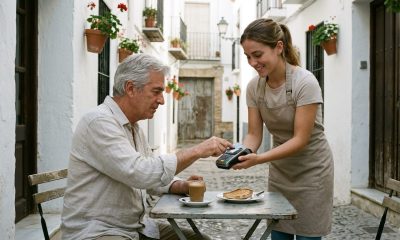
- Standing at the bar is common and quick. You usually pay at the end, not when you order.
- Takeaway is para llevar. Classic bars may not have takeaway cups, but chains and modern cafés do.
Want to learn more?
If you are getting used to bar culture, see our guides to how to order tapas in Andalucía, Spanish drinking culture and opening hours and mealtimes in Spain.









 A European bank you open from your phoneSign up with bunq in about five minutes.Get started →(ad)


 Ad
 A sea-view escape in MallorcaThe Donna Portals – stay by the sea with views over the Mediterranean.See prices →
Vivid BusinessA business account for freelancers and companies in SpainOpen your account online, with sub-accounts and cards for your team.✓ For autónomos and companies
✓ Sub-accounts for budgets and taxes
✓ Cards for your teamLearn more →(ad)














How to order coffee in Málaga (and the rest of Spain)

Málaga museums guide: what to see and when entry is free

Winter on the Costa del Sol: what the weather is really like and what to pack

Andalucía guide: cities, culture and life in southern Spain

How the Spanish government works: state, regions, provinces and town halls

Living on a small salary in Spain in 2026






-

 Tourist Info2 years ago
Andalucía guide: cities, culture and life in southern Spain
-
Spanish System2 years ago
How the Spanish government works: state, regions, provinces and town halls
-
Cost of Living2 years ago
Living on a small salary in Spain in 2026
-
Cost of Living2 years ago
Family living costs in Spain in 2026: monthly budget and moving-in money
-
Tourist Info2 years ago
Marbella guide: areas, beaches and everyday life
-
Insurance2 years ago
Understanding insurance in Spain: a 2026 guide for expats
-
Banking & Finances2 years ago
Understanding the tax system in Spain
-
Tourist Info2 years ago
Benalmádena explained: Pueblo, Arroyo de la Miel and the coast