


































































Spanish System
Spain’s general election on 29 November: parties, polls and what expats need to know
The three main parties, the latest polls, who can vote on 29 November and what the election means for expats.




























Updated: November 2026
Spain goes to the polls on Sunday 29 November 2026. The general election was called early by Prime Minister Pedro Sánchez. If you have moved here recently, you may wonder who is standing, what the polls say, whether you can vote, what happens on the day and whether anything changes for you. Here is a short, neutral guide.
What is being elected
Voters elect the Spanish parliament, the Cortes Generales: the Congress of Deputies (Congreso de los Diputados, 350 seats) and the Senate (Senado). The new Congress then votes on who becomes prime minister. A party or group of parties needs 176 seats for an absolute majority in Congress.


 Vivid BusinessA business account for freelancers and companies in SpainOpen your account online, with sub-accounts and cards for your team.Learn more →(ad)

 Buying a home in Spain? Simulate your mortgageSee your monthly payment with Banco Sabadell’s mortgage simulator.Try the simulator →(ad)

 A bank account for autónomos in SpainCuenta Clara Autónomos: no commissions, free debit and credit cards, opened online.See the account →(ad)


 A European bank you open from your phonebunq: an EU-licensed bank with debit cards, managed fully in the app. Sign up in about five minutes.Get started →(ad)


 A mobile bank account with no commissionsB100, the mobile bank from Abanca: everyday account and free debit card, all in the app.Get the app →(ad)
 Online pharmacy & parapharmacySkincare, vitamins, baby care and more – delivered in SpainShop now




















 CAR INSURANCEInsure your car in Spain onlineGet your quote online with Prima Seguros.Get a quote →


The three biggest parties and what they propose
Three parties lead the polls. Below is a short summary of some of their main proposals, based on their election programmes as reported in the Spanish press. It is not a full list, and we do not take sides.
PP (Partido Popular) – Alberto Núñez Feijóo
- Housing: build one million homes and repeal the current Housing Law. Tax incentives for landlords who renew leases for three years with rent increases below inflation, and 4 % VAT on renovating your main home.
- Immigration: stronger border control, faster returns of people who enter irregularly and stricter rules for Spanish nationality.
- Taxes and economy: tax cuts for families, young people and businesses, no VAT for self-employed people who bill under €85,000 a year, an audit of public spending and an infrastructure plan.
PSOE (Partido Socialista) – Pedro Sánchez
- Housing: 1 % of GDP for social housing, a public stock of 100,000 homes, more protection for tenants and small landlords and measures against speculation.
- Taxes: higher taxes on the highest incomes and large companies.
- Pensions and welfare: pensions rising with inflation (CPI) as a guaranteed commitment, protecting the minimum wage, and a €200 monthly childcare benefit.
- Other: stronger public healthcare and education, and investment in rail safety, AI and renewable energy.
Vox – Santiago Abascal
- Housing: repeal the current Housing Law, build more homes, make first-home purchases easier and evict illegal occupiers (okupas) within 24 hours.
- Immigration: ban mass regularisations, end regularisation through “social roots” (arraigo), more deportations of people without papers, and priority for Spaniards in some benefits and protected housing.
- Taxes and economy: lower income tax, VAT and corporate tax, lower energy taxes and keeping existing nuclear plants.
Other parties are also standing, including the left-wing coalition Frente Amplio (Ada Colau) and regional parties such as ERC and EH Bildu.
What the polls say
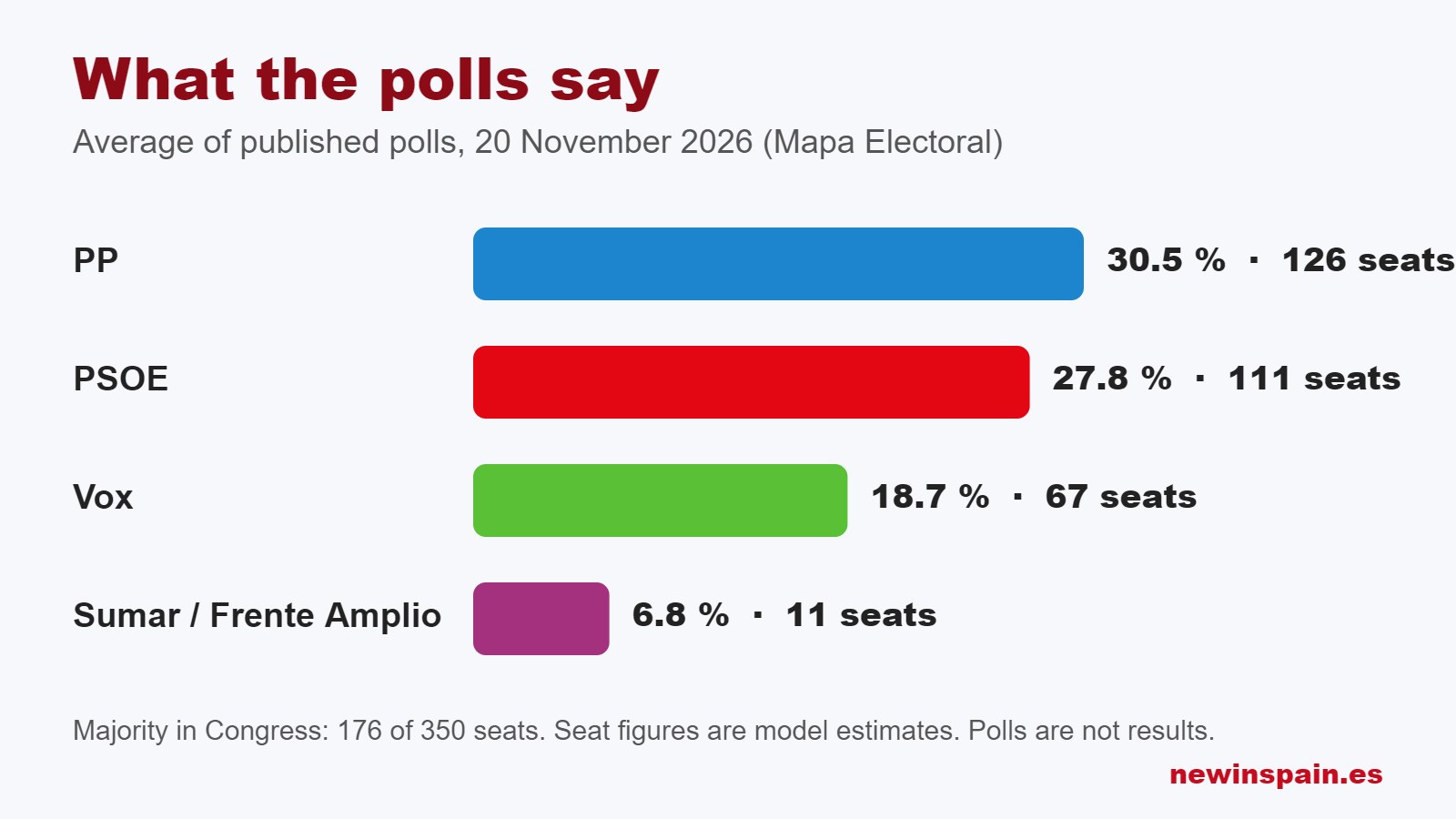
Polls published on 19 November 2026 put the parties in this order. Polls are estimates, not results, and they can be wrong.
| Poll (publisher) | PP | PSOE | Vox |
|---|---|---|---|
| 40dB. (El País / Cadena SER) | 32.2 % | 30.2 % | 17.6 % |
| Sigma Dos (El Mundo) | 31.0 % | 27.1 % | 19.4 % |
| Metroscopia | 30.0 % | 30.0 % | 19.0 % |
| EM-Analytics (Electomanía) | 30.4 % | 27.6 % | 18.7 % |
| Data10 (OKDiario) | 31.5 % | 26.9 % | 19.4 % |
Mapa Electoral’s average of the polls on 20 November was PP 30.5 %, PSOE 27.8 % and Vox 18.7 %. In the seat estimates no party reaches the 176 seats needed for a majority on its own, so the next government will most likely depend on support from other parties. Spanish law does not allow new polls to be published in the last five days before the vote.
Can foreign residents vote?
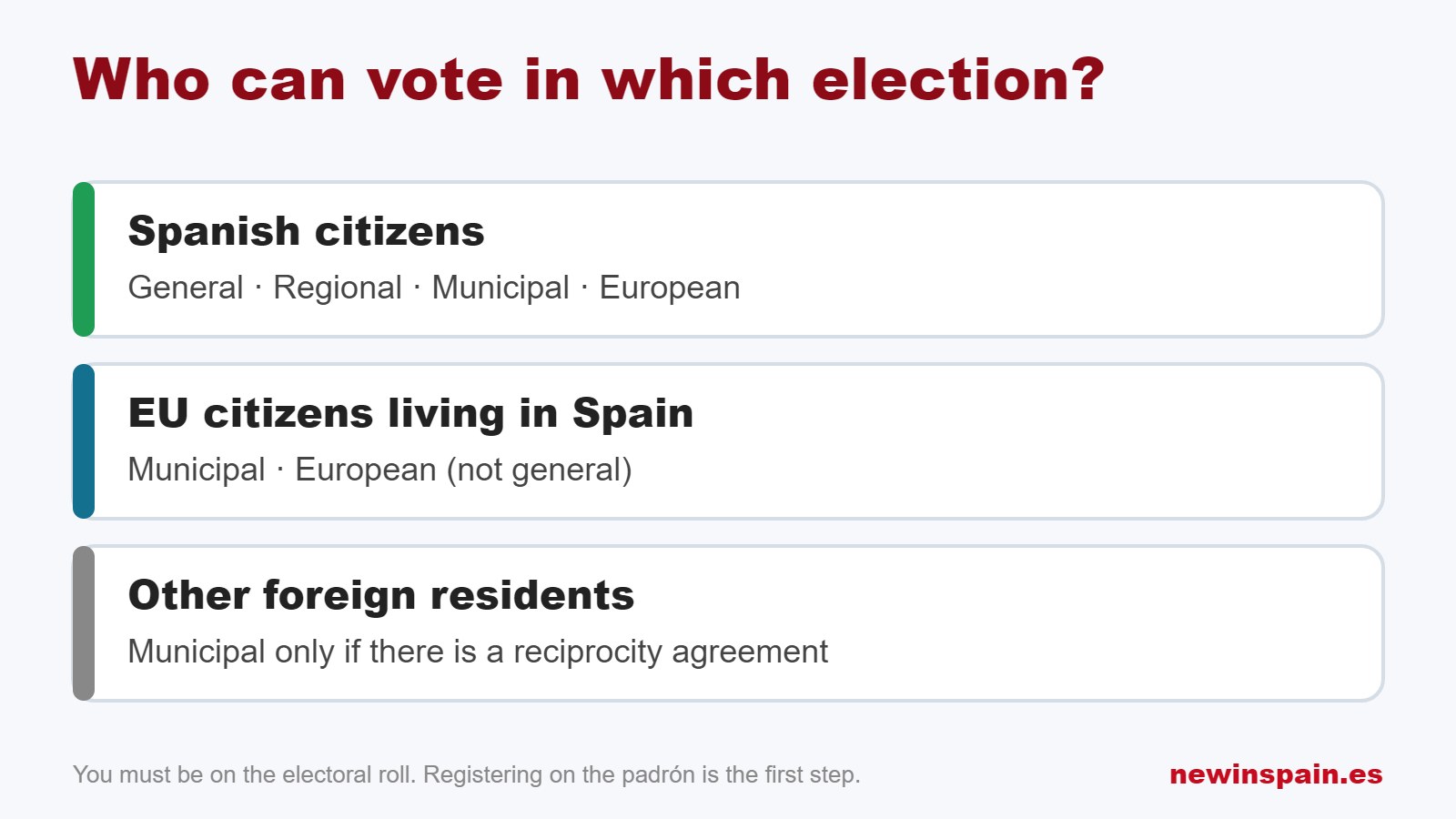
No. Only Spanish citizens who are on the electoral roll can vote in a general election. This also applies to EU citizens living in Spain.
EU citizens who live in Spain can vote in municipal (local) elections and European Parliament elections, as long as they are registered on the electoral roll. To be on the roll, you must be registered on the padrón at your town hall. If you are not sure, ask at your town hall before the next local or European election.
Key dates
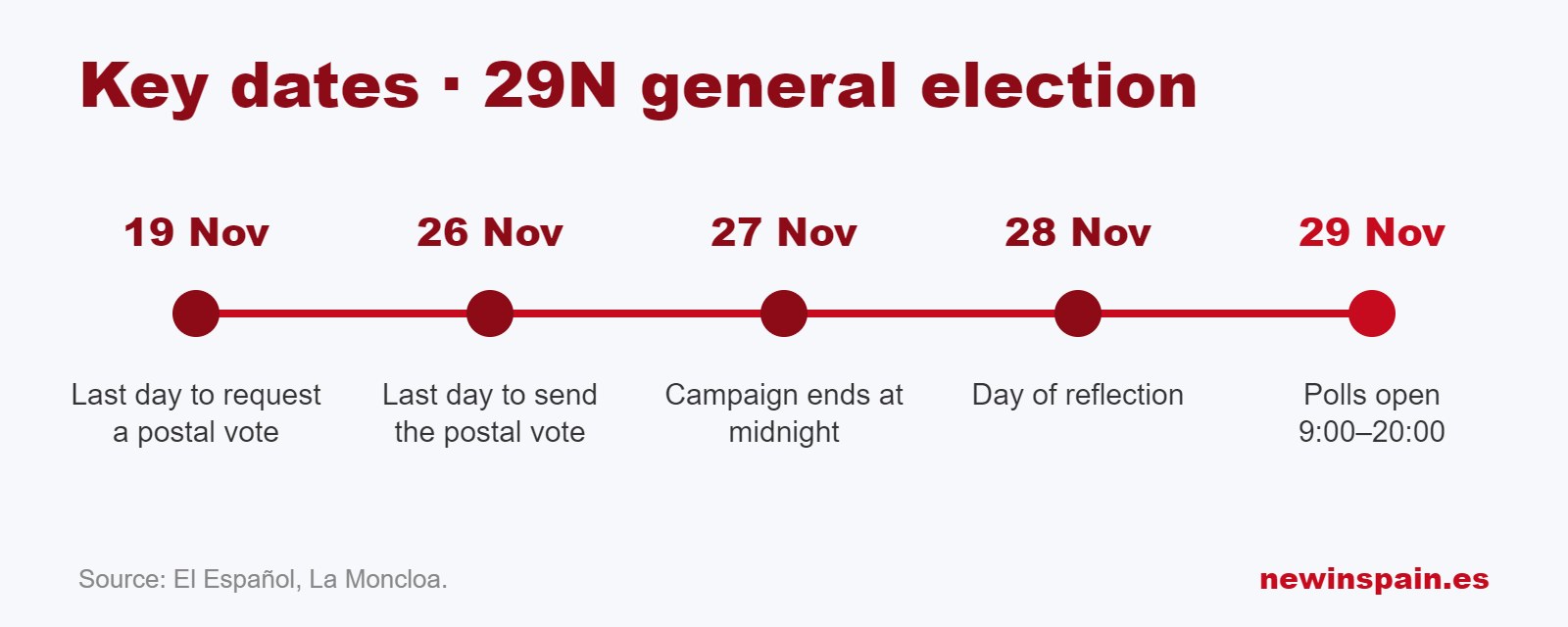
- 19 November: last day for Spanish voters to request a postal vote (now closed).
- 26 November: last day to send the postal vote. No stamp is needed.
- Friday 27 November, midnight: the election campaign ends.
- Saturday 28 November: “day of reflection” (jornada de reflexión). No campaigning is allowed.
- Sunday 29 November: polling stations are open from 9:00 to 20:00. The Ministry of the Interior publishes provisional results during the evening.
What it means for you on the day
- Many polling stations are in schools and public buildings, so expect more people and traffic around them on Sunday.
- Spanish friends, neighbours or staff may be called to serve at a polling station (mesa electoral). This is compulsory for those chosen.
- Election day is a Sunday, so shops and services follow their usual Sunday hours.
Does anything change for expats?
Not overnight. Existing rules for residency, the NIE, healthcare and taxes stay in force until a new government and parliament change them, and that takes time. It can also take weeks before a new government is formed. Housing, immigration and taxes are among the issues where the parties’ plans differ most, so it is worth following what the new government decides in 2027.
One change is already decided and does not depend on the result: from 1 December 2026, short holiday rentals pay 10 % VAT. The rule was confirmed by Congress’s Permanent Committee on 12 November. Read more in our guide to VAT on holiday rentals in Spain.
Sources and useful links
- Mapa Electoral: polls and averages for 29N (Spanish)
- Última Hora: the main parties’ programmes (Spanish)
- Caudete Digital: the ten main proposals of each party (Spanish)
- La Moncloa: basic guide to the 29 November election (Spanish)
- Ministry of the Interior – official results









 A European bank you open from your phoneSign up with bunq in about five minutes.Get started →(ad)







 Ad
 A sea-view escape in MallorcaThe Donna Portals – stay by the sea with views over the Mediterranean.See prices →
Vivid BusinessA business account for freelancers and companies in SpainOpen your account online, with sub-accounts and cards for your team.✓ For autónomos and companies
✓ Sub-accounts for budgets and taxes
✓ Cards for your teamLearn more →(ad)


















Spain’s general election on 29 November: parties, polls and what expats need to know

10 % VAT on holiday rentals in Spain from 1 December 2026

Your own website for your holiday home in Spain: direct bookings without commission

Andalucía guide: cities, culture and life in southern Spain

How the Spanish government works: state, regions, provinces and town halls

Living on a small salary in Spain in 2026











-

 Tourist Info2 years ago
Andalucía guide: cities, culture and life in southern Spain
-
Spanish System2 years ago
How the Spanish government works: state, regions, provinces and town halls
-
Cost of Living2 years ago
Living on a small salary in Spain in 2026
-
Tourist Info2 years ago
Marbella guide: areas, beaches and everyday life
-
Cost of Living2 years ago
Family living costs in Spain in 2026: monthly budget and moving-in money
-
Insurance2 years ago
Understanding insurance in Spain: a 2026 guide for expats
-
Banking & Finances2 years ago
Understanding the tax system in Spain
-
Tourist Info2 years ago
Benalmádena explained: Pueblo, Arroyo de la Miel and the coast