Tourist Info
Torremolinos guide: beaches, districts and living by the airport
Torremolinos for newcomers and visitors: its four beaches, the districts to live in, train links to the airport and Málaga, schools, health and local tips.









Updated: October 2026
Torremolinos was the first big holiday resort on the Costa del Sol, and in the 1950s and 60s it drew film stars and jet-setters. Today it is a compact town of high-rise seafront, older streets on the hill and a well-known LGBTQ+ scene. For people moving to the coast, its biggest selling point is simple: the airport is minutes away and the train runs straight into Málaga.
Torremolinos in brief
| Topic | What to expect |
|---|---|
| Feel | Busy resort town, lively all year, mixed Spanish and international population |
| Beaches | Four main beaches, three with Blue Flag status |
| Train | Several Cercanías C1 stations along the town |
| Best for | Frequent flyers, people working in Málaga, those who want a town without needing a car |
| Less good for | Anyone looking for a quiet village atmosphere |
Districts: where people live
The centre and El Calvario are built around Calle San Miguel, the pedestrian shopping street, and the La Nogalera square. You are close to shops, bars and the main train station, but evenings can be loud.









El Bajondillo drops down the cliff from the centre to the sea. Steep streets and lifts connect the two levels, and the seafront is lined with apartment blocks.
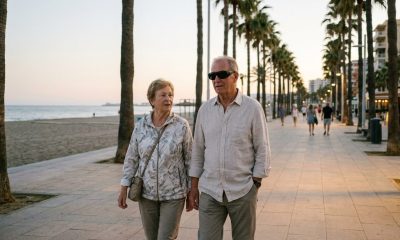
La Carihuela, the old fishermen’s quarter at the western end, is known for its seafood restaurants and long promenade leading towards Benalmádena’s marina. It mixes holiday flats with long-term residents.
Montemar and El Pinillo are more residential, with low-rise houses, small blocks and their own train stations. They suit families who want to be near the town without living in it.
Playamar and Los Álamos, at the eastern end towards Málaga, have large apartment complexes, beach clubs and easy road access to the airport.








Rents are high for the coast because of demand from tourists and airport workers. Long-term contracts can be hard to find in summer, when many owners switch to holiday lets. See our guide to renting in Spain as a foreigner.
The four beaches
The town’s tourism office describes the coastline from west to east like this:
- La Carihuela: more than 2 km of sand, traditional beach bars and water sports.
- El Bajondillo: about 1 km right below the centre, with a section popular with the LGBTQ+ community. Blue Flag.
- Playamar: one of the busiest stretches, with windsurfing, paddle board and beach clubs. Blue Flag.
- Los Álamos: a more relaxed beach near the Málaga border, with chill-out clubs and kitesurfing. Blue Flag.
Getting there and moving around
Few towns on the coast are as well connected. The Cercanías C1 line between Málaga and Fuengirola stops at Los Álamos, La Colina, Torremolinos, Montemar-Alto and El Pinillo, so most homes are within walking distance of a station. The airport station is on the same line, only a couple of stops away, and trains run roughly every 20 minutes for most of the day. Check times on the Renfe Cercanías Málaga site.
Torremolinos also has its own urban buses and interurban lines to Málaga, Benalmádena and Mijas Pueblo. The rechargeable Consorcio transport card works on the town buses, interurban buses and Cercanías trains and lowers the fare on each trip.
Schools, health and daily services
There are several public infant and primary schools across the town, as well as private options. Sunny View School, a long-established British school, is in the Torremolinos-Benalmádena area. Our guide to types of schools in Spain explains public, concertado and private schools.
For public healthcare, residents register with their local centro de salud. Torremolinos belongs to the Costa del Sol health area. Its reference hospital is Hospital Universitario Costa del Sol near Marbella, with the high-resolution hospital in neighbouring Benalmádena closer for many outpatient services. In an emergency, call 112. More detail in our guide to healthcare for foreign residents.
Things to do beyond the beach
- Molino de Inca botanical garden: nearly a thousand plant types, a maze and a Japanese garden, built around the town’s old mills.
- Casa de los Navajas: a 1925 neo-Mudéjar mansion on the cliff above El Bajondillo.
- Parque de la Batería: a family park near Montemar with a lake, a carousel and a viewing tower.
- Torre Pimentel: the medieval tower that gave the town its name, at the top of the steps down to the beach.
- Pride: Torremolinos holds one of the best-known Pride celebrations on the coast, usually in early summer.
Málaga city is one train ride away for museums and concerts; see our Málaga city guide. Heading west, Benalmádena starts where La Carihuela ends, and Fuengirola is at the end of the line.
Tips from the ground
- Flight paths pass close to parts of the eastern districts. Listen out before you sign.
- The town is built on two levels. Check how steep the walk is from a flat to the shops and the station.
- Winter is noticeably calmer, and many seafront restaurants keep shorter hours.
- Register on the padrón at the town hall once you have a fixed address.
Useful links
- Turismo Torremolinos: beaches
- Renfe Cercanías Málaga
- Aena: Málaga airport by train
- Consorcio de Transporte: travel card
- Málaga city guide for newcomers
- Benalmádena guide
FAQ: Torremolinos
How close is Torremolinos to Málaga airport?
Very close. The airport station is a few stops from Torremolinos on the Cercanías C1 line, and the drive is short outside rush hour.
Which beach is best for families?
Playamar and Los Álamos are wide and well equipped. La Carihuela is popular for its promenade and restaurants.
Can I live in Torremolinos without a car?
Yes. With several train stations, town buses and links to Málaga, many residents manage without one.
Disclaimer: This article is general information only. Beach awards, timetables and opening times can change – always check with the official source before you act.