













































































Housing & Utilities
10 % VAT on holiday rentals in Spain from 1 December 2026
Short holiday rentals pay 10 % VAT from 1 December. Who is affected, what owners must do and what else changes.




























Updated: November 2026
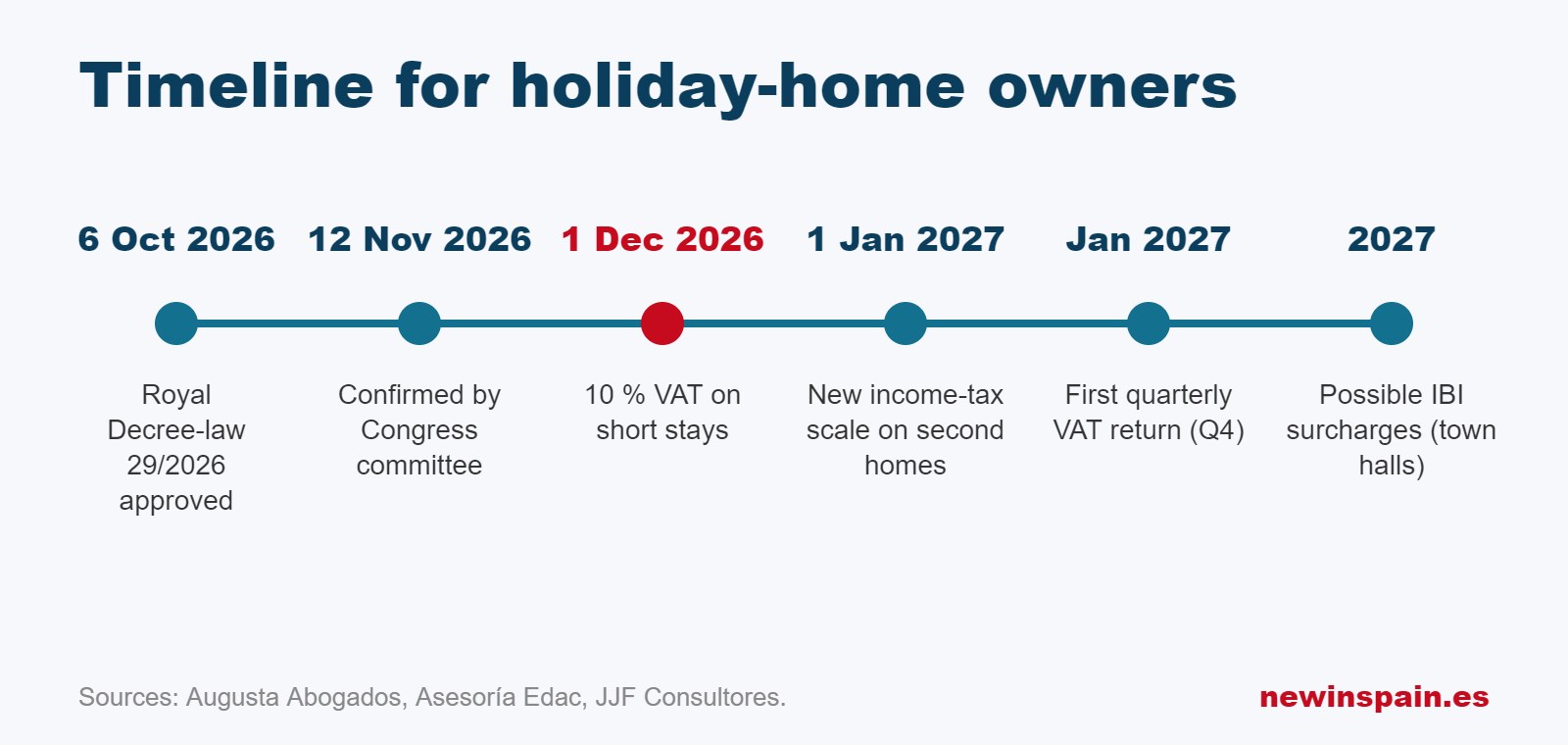
From 1 December 2026, most short holiday rentals in Spain pay 10 % VAT (IVA) on top of the rent. It is often called a new “tourist tax”, but it is VAT. The rule comes from Royal Decree-law 29/2026 of 6 October, which Congress’s Permanent Committee confirmed on 12 November 2026.
Which rentals pay VAT
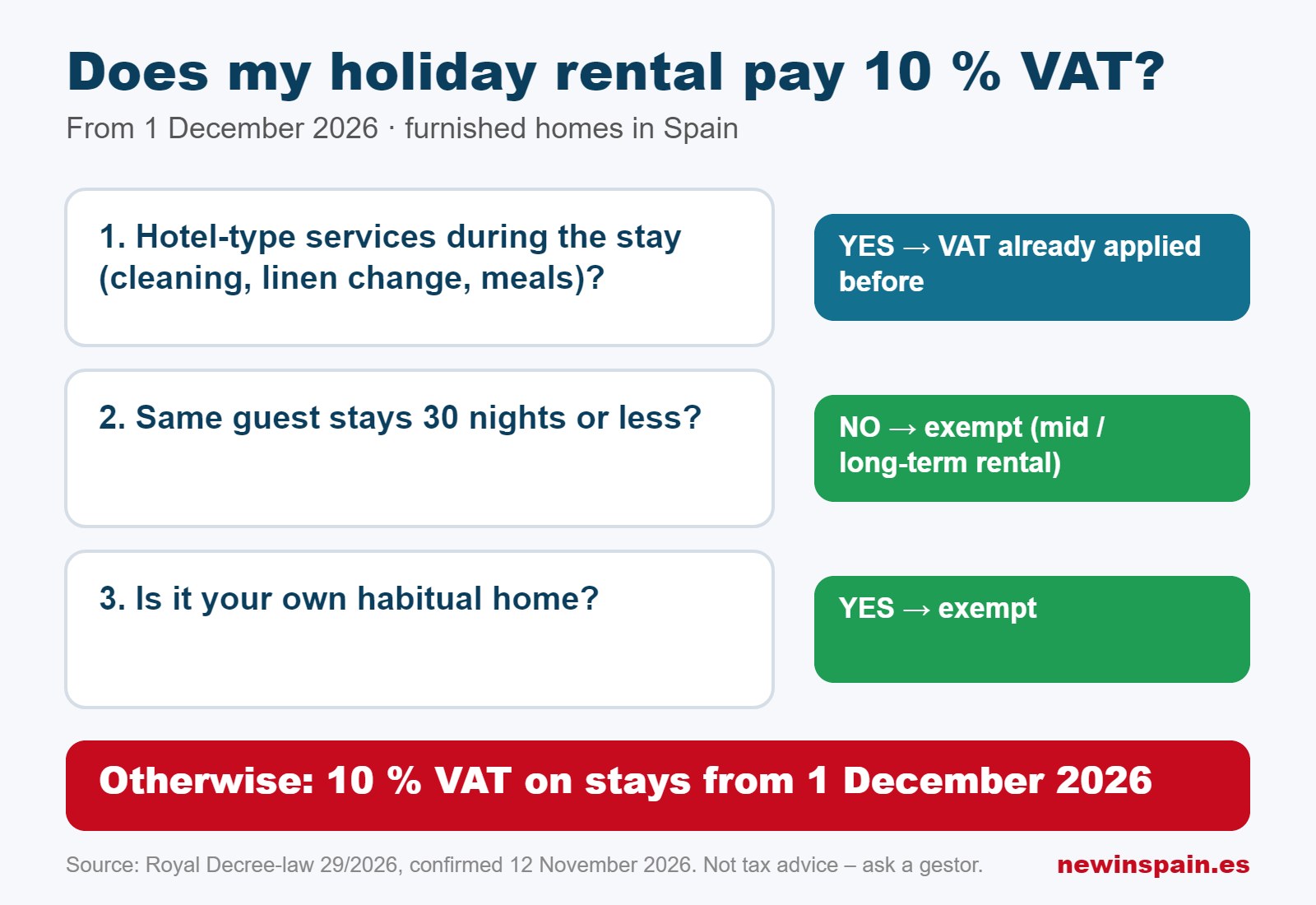
From 1 December, renting out a furnished home pays 10 % VAT when:


 Vivid BusinessA business account for freelancers and companies in SpainOpen your account online, with sub-accounts and cards for your team.Learn more →(ad)

 Buying a home in Spain? Simulate your mortgageSee your monthly payment with Banco Sabadell’s mortgage simulator.Try the simulator →(ad)

 A bank account for autónomos in SpainCuenta Clara Autónomos: no commissions, free debit and credit cards, opened online.See the account →(ad)


 A European bank you open from your phonebunq: an EU-licensed bank with debit cards, managed fully in the app. Sign up in about five minutes.Get started →(ad)


 A mobile bank account with no commissionsB100, the mobile bank from Abanca: everyday account and free debit card, all in the app.Get the app →(ad)
 Online pharmacy & parapharmacySkincare, vitamins, baby care and more – delivered in SpainShop now




















 CAR INSURANCEInsure your car in Spain onlineGet your quote online with Prima Seguros.Get a quote →


- the same guest stays 30 nights or less, and
- the home is not the owner’s own habitual residence.
Rentals with hotel-type services, such as cleaning during the stay, regular change of towels and sheets or meals, already paid VAT before. That does not change. Cleaning and a change of linen only when a guest arrives or leaves do not count as hotel services.
Which rentals stay exempt
- Long-term rentals where the tenant lives in the home.
- Mid- and long-term rentals of more than 30 nights without hotel services.
- Short stays in the owner’s own habitual home, without hotel services.
- Stays that took place before 1 December 2026.
The Canary Islands, Ceuta and Melilla have their own rules, as Spanish VAT does not apply there.
Example: what 10 % VAT means for your income
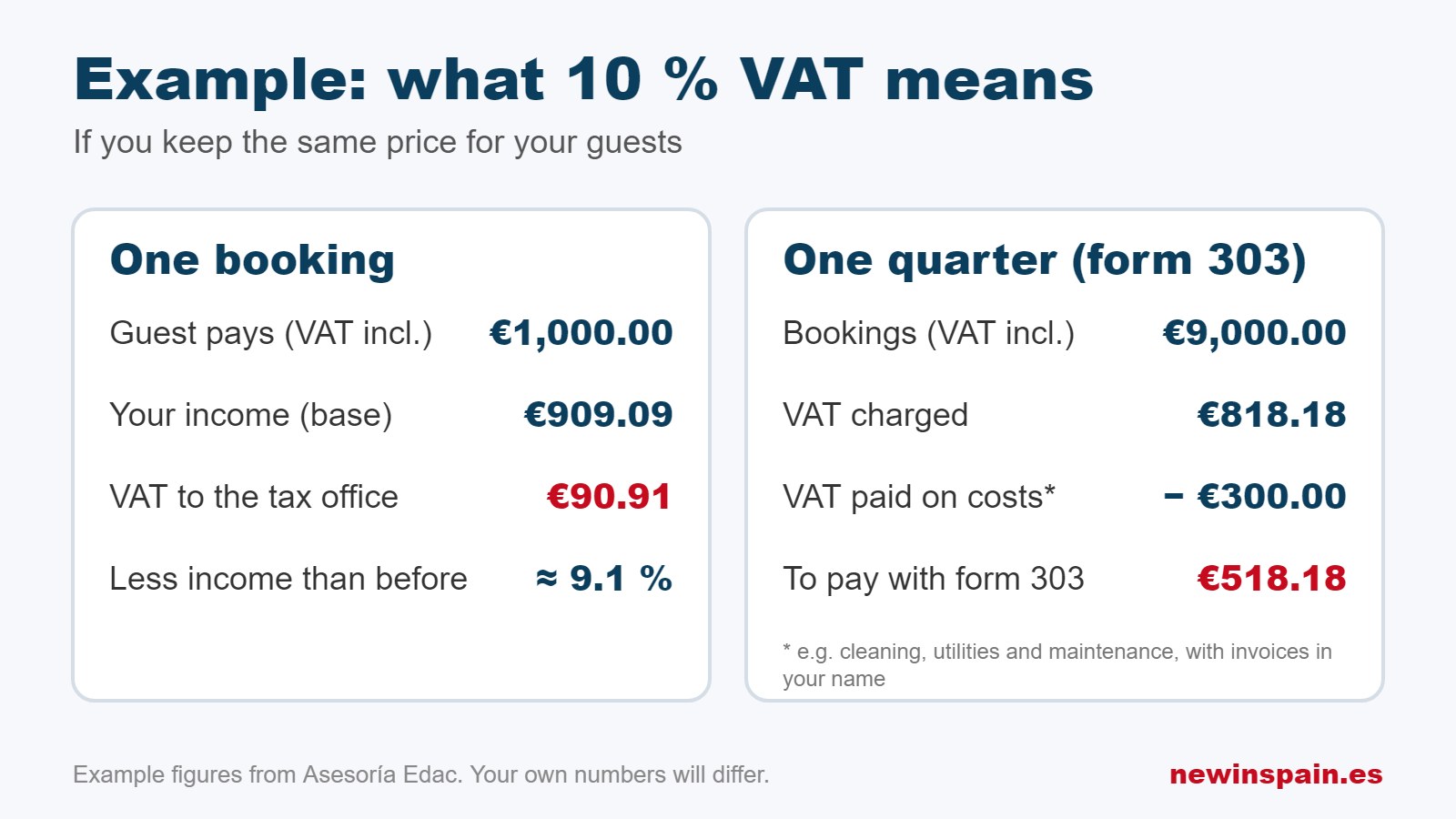
If you keep your prices the same and VAT is now included, part of every booking goes to the tax office. With a booking of €1,000 including VAT, your income is €909.09 and €90.91 is VAT – about 9.1 % less than before.
You can deduct the VAT you pay on costs linked to the rental, such as cleaning, utilities, maintenance, platform commissions and furniture, as long as the invoices are in your name. In the example, a quarter with €9,000 in bookings gives €818.18 in VAT. With €300 of VAT on costs, you pay €518.18 with the quarterly return.
Many owners will therefore look at their prices. Adding 10 % on top keeps your income the same, but makes your home more expensive for guests. There is no right answer – compare with similar homes in your area.
What owners need to do

- Register the activity with the tax agency (form 036), if you have not already.
- Charge 10 % VAT on stays from 1 December and issue invoices to your guests.
- File quarterly VAT returns (form 303) and keep VAT records.
- Check your prices. Decide whether your current prices include VAT, or whether you add 10 % on top. Remember bookings already made for December and later.
- Show your registration number in every advert. The decree requires the home’s registration or licence number in all offers and advertising, where one exists.
The rules apply to owners who live abroad too. Ask a gestor or tax adviser how it works for your situation, especially if you rent out more than one home.
Good to know
- Bookings paid before 1 December: the decree has no special transition rules. Under the general VAT rules, an advance payment can trigger VAT when it is paid. So a booking may be partly paid before and partly after 1 December. Check each advance payment with your gestor.
- Platform commissions: if the booking platform is based in another EU country, you may have to declare VAT on its commission yourself (reverse charge) and register in the EU operators register (ROI).
- Mixed rentals: if you rent out some homes that pay VAT and some that are exempt, you can only deduct part of the VAT on shared costs.
- Income tax: you still declare the rental income in your income tax return. The VAT you charge is not counted as income.
- First return: the first quarterly VAT return (form 303) covers October–December 2026 and is due in January 2027. There is also an annual summary (form 390).
Timeline
Other changes for holiday-home owners
- Higher IBI in some towns: in areas declared a stressed housing market, the town hall may add a surcharge on tourist homes: up to 50 % of the IBI, up to 100 % if you own two or more, and up to 150 % if you own four or more. It only applies if the town hall approves a local ordinance, and normally from 2027.
- Income tax on second homes: from 1 January 2027 a new scale of 1.1 % to 3 % of the cadastral value applies to properties that are not your main home and not used in a business.
- Platforms: booking platforms must share more information with the authorities, linked to the national rental register.
Rent out your licensed home
Own a holiday home with a rental licence? You can list it on Spainholiday.eu, our holiday rental portal with town guides for visitors.
Sources
- Augusta Abogados: RDL 29/2026 confirmed – calendar and tax measures (Spanish)
- Asesoría Edac: 10 % VAT on tourist rentals – guide and examples (Spanish)
- JJF Consultores: when VAT applies to short-term rentals (Spanish)
- Check-in Scan: RDL 29/2026 and holiday homes (Spanish)









 A European bank you open from your phoneSign up with bunq in about five minutes.Get started →(ad)








 Ad
 A sea-view escape in MallorcaThe Donna Portals – stay by the sea with views over the Mediterranean.See prices →
Vivid BusinessA business account for freelancers and companies in SpainOpen your account online, with sub-accounts and cards for your team.✓ For autónomos and companies
✓ Sub-accounts for budgets and taxes
✓ Cards for your teamLearn more →(ad)


















Spain’s general election on 29 November: parties, polls and what expats need to know

10 % VAT on holiday rentals in Spain from 1 December 2026

Your own website for your holiday home in Spain: direct bookings without commission

Andalucía guide: cities, culture and life in southern Spain

How the Spanish government works: state, regions, provinces and town halls

Living on a small salary in Spain in 2026











-

 Tourist Info2 years ago
Andalucía guide: cities, culture and life in southern Spain
-
Spanish System2 years ago
How the Spanish government works: state, regions, provinces and town halls
-
Cost of Living2 years ago
Living on a small salary in Spain in 2026
-
Tourist Info2 years ago
Marbella guide: areas, beaches and everyday life
-
Cost of Living2 years ago
Family living costs in Spain in 2026: monthly budget and moving-in money
-
Insurance2 years ago
Understanding insurance in Spain: a 2026 guide for expats
-
Banking & Finances2 years ago
Understanding the tax system in Spain
-
Tourist Info2 years ago
Benalmádena explained: Pueblo, Arroyo de la Miel and the coast